

Category: Issue Two

  • Reading the Earth: On Multiplicities of Time

    Reading the Earth

    On Multiplicities of Time

    Essay by nancy Smith


    Early clocks were as simple as a stick in the ground. The movement of the shadows captured by a stick (or what would later become a sundial) creates a visible progression of the day. Light and shadows come together to form a particular kind of meaning. Atomic clocks capture the invisible vibrations of atoms as we move through the universe. Both are precise in their own way, though precision offers a limited conception of what time could be. Whether visible or not, we are always moving, and time is a reminder of our constant orbit. 

    A heartbeat is our most personal measure of time, and the one that dictates how much time we have in this world. Heartbeats, like fingerprints, are unique and contain rhythms that are specific to the body they inhabit. Hearts, like our sense of time, speed and slow in relation to our surroundings, respond to emotions, and react to our embodied movements. 

    Time, most of all, imposes order on what can seem like an otherwise random, chaotic world. This is not to say that time is the same for everyone. Time for the farmer is not the same as time for the astronomer. Time for the poet is not the same as time for the physicist.

    A clock is not time itself; it is a representation. Like other models we create to visualize data, clocks have simply gathered up information on how the world moves and put it into a form that adheres to our, now commonly used, 24-hour day.

    Visual theorist Johanna Drucker writes, โ€œThe visual order of the calendar seems like the very structure of time itself, so naturalized has it become through graphic conventions. Like lines on a map demarcating one state or nation from another, the division of one day from another is powerfully structured by graphic conventions. These diagrammatic schemes are performative. They make the world by structuring our experience of it.โ€ We are so used to looking at clocks, calendars, trackers, and other time-keeping devices that it makes time feel like the world itself, rather than an interpretation of it. 

    She further writes, โ€œDiagrammatic images spatialize relations in a meaningful way. They make spatial relations meaningful. And they do so according to conventions about how we translate observation, sensation, perception of phenomena in knowable forms.โ€ Those conventions are deeply tied to Western science, capitalism, and colonial structures that have dominated the way timekeeping devices are designed and utilized. This has only increased as data visualization has influenced the way we understand the world.


    One of the problems with trying to impose our own order on the world is that our understanding of the world is limited. Consider the abrupt switch from the Julian to the Gregorian calendar. The Julian calendar, named for Julius Caesar, was used for many centuries; however, it was slightly misaligned with the solar year, and over time began to drift away from the seasons. In 1582, Pope Gregory XIII introduced the Gregorian calendar as a way to rectify the issues with the Julian calendar. Over time, countries around the world adopted this calendar, but it wasnโ€™t until 1752 that the British Empire switched to the Gregorian calendar. In order to align with the new calendar, a discrepancy needed to be resolved, so they simply dropped eleven days. Thus, September 2, 1752 was followed the next day by September 14. 

    There is an arbitrariness to time, or perhaps not time itself, but to our various methods of capturing and representing it. 

    Many systems of counting, including the Western system, are based on powers of ten. The Ancient Mayans, however, used a base-20 system, which also informed their calendar design. They used an eighteen-month solar calendar with twenty days per month. The twenty named days are all associated with a different deity who governed each day. This created a 360-day year. Those extra five days are deemed a special time called Wayeb. This scared โ€œtime out of timeโ€ has traditionally been used as a healing and cleansing period, a time to let go of the past and reconnect spiritually to the world. The Ancient Egyptians also had five extra days for festivities, though their calendar was twelve months and thirty days.

    We are always making adjustments for these holes in time because missing seconds eventually turn into missing days. 

    The movements of the universe both create and conflict with our clocks and calendars. The leap year is a response to how we move through space. The rhythms of our ever-expanding solar system donโ€™t align neatly with our various numerical groupings, whether in ten or twenty, twelve or twenty-four. Many cultures have historically missed the leap year, which is why so many ancient calendars drift away from the seasons. By the Western calendar, we fall about one day short every four years. There are more precise ways of measuring this. If you add one day every four years, skipping the thirty-third year, we get closer to capturing this missing time. After the Gregorian reform, the formula for calculating leap days became 97 leap days in 400 years. 

    To put that another way: each day is six hundred millionths of a second longer than the previous day. Which is to say, this is the longest day of your life. 


    We all have a sense of embodied time and biological clocks that shape our need for things like sleep, food, and water. Our circadian rhythms pull us through the day and night, pushing us in and out of sleep, though these too have been affected not only by clocks but by urbanism and electricity, which light up our days (and nights) in ways that defy the sun and moon. For millennia, people slept in two shifts, waking in the middle of the night, often for hours at a time. This phenomenon of โ€œtwo sleepsโ€ is widely documented across cultures throughout the Middle Ages and earlier. According to historian Roger Ekirch, there are numerous possible reasons for this biphasic sleep. People often slept together in the same bed; multigenerational families, and even traveling strangers, might be cuddled up for the night, which required a delicate balance of sharing the bed and not moving too much. This was easier to adhere to if you only slept for a few hours, then woke, and returned to bed later, rather than trying to stay still for a full night. It has also been suggested that it was simply additional time to get things done, as many folks returned to work during this time, taking care of household chores that hadnโ€™t been finished during the day. This window of time between sleeps was commonly used for socializing, sex, and prayer. It wasnโ€™t until the early nineteenth century that one sleep became common, perhaps not surprisingly due to the Industrial Revolution, and an increased reliance on clocks to orient with production schedules. Alarm clocks were invented in 1787 (incidentally, invented by a clock salesman who needed to get up early to sell clocks) and have forever been used to disrupt our natural wake times. Without clocks, without capitalism, one wonders if we might slip back into the rhythm of two sleeps. 

    Phenology is the study of when things happen in nature: when trees bloom, when birds migrate, when seasons end. The Phenology Clock, a project led by artist Natalie Jeremijenko includes a series of timekeeping objects that capture seasonal time. These clocks, which were designed in both physical and digital form, collected place-based observational data contributed by thousands of people to highlight the shift in natural phenomena over a decade. Designed with a circular shape โ€” the form of most contemporary clocks and watches โ€” and stripes of different colors to represent different seasonal activities, the clock wasnโ€™t exactly a time-keeping device, but more of a record of natural data. To see the subtle shifts in time โ€” when roses bloom, when oak trees drop their leaves โ€” shows a world that is warming, a world whose rhythms are changing because of the climate crisis.   

    Bears in Colorado, for example, are starting to emerge from hibernation too early. Itโ€™s warm enough for them to wake up, but there isnโ€™t enough food, so they have to venture further down the mountain, which leads to more humanโ€“bear conflicts. Depending on the region, bears can hibernate for two or three months, or up to seven months in the coldest areas. They arenโ€™t necessarily asleep for all of this time, but they go into a state of torpor where they donโ€™t eat or drink. Instead, their body temperature drops, and they live off their fat stores. 

    Cats sleep for about eighteen hours a day. Giraffes sleep for only about five hours a day, though they can go weeks without actually sleeping, only standing or lying down for short stretches of time for a nap. Dolphins sleep unihemispherically, which means half of their brain is awake and on the lookout, while the other half is asleep, and like us, they typically snooze for about eight hours a day. Sea otters sleep for about half a day, and often link hands during sleep, or ingeniously use seaweed to tie themselves to a friend so as not to float away. 

    Bees keep a 24-hour biological clock. In 1929, Ingebord Beling, a German ethologist, trained bees to come to a feeding station, adding sugar water at specific times. The bees quickly learned the schedule and adapted when she changed it. They were even able to anticipate the timing of the sugar water, often showing up slightly before it was feeding time. Based on her research, she coined the term time-memory, which is something many animals, including humans, possess. 

    In the 1950โ€™s Max Renner conducted another experiment to test beesโ€™ time-memory. He trained bees in Paris to find sugar water in a dish at 8:15pm. After the bees had learned this routine, he took them one evening after feeding, and carefully shuttled them on a plane to New York City, where he replicated the space and set out a dish of sugar water to see when they would appear. Despite the five-hour difference between cities, the bees emerged in search of food exactly twenty-four hours later, at 3:15pm Eastern time. 

    It makes sense that bees would have a highly attuned sense of time since they eat from plants that open and close in relation to daylight. Whatโ€™s more, bees use the sun as a navigation device and are able to provide precise directions to other bees about the distance and location of nectar, which requires a deep connection to time.   


    Even before the Industrial Revolution, there were many clocks that helped us to tell time in the dark; to capture the time beyond light, clocks that use water, flame, scent, or sand were designed so that we could tell time on a cloudy day or at night.  

    The fenjaan clock is a Persian water clock that relies on a small metal bowl with a tiny hole in it, which floats on the top of a container of water and then slowly fills until it drops to the bottom. Like an hourglass where material flows, this kind of design has been used by the Babylonians, Ancient Egyptians, and some Native American peoples. In Ancient Persia, the fenjaan was used to regulate water for farmers, ensuring that each farm received an equal amount of water. 

    Incense clocks, historically used in China and throughout East Asia, can work in various ways. Incense burns at a consistent rate, so simply watching the stick burn down works as a timer. Sometimes these clocks were attached to a gong or another mechanism for creating a sound at regular intervals. Perhaps more interestingly, some incense clocks are based on smell itself. A series of different incense sticks can be aligned to burn in a specific order, and the smell changes depending on the specific time of day. According to this clock, we might have lunch at the rose hour and dinner at the lavender hour.

    Smell is also one of the ways dogs tell time. They can smell how long you have been gone as your scent wanes throughout the day. This is why, if you keep a regular schedule, they have a sense of when you will come home.

    One of the most longstanding, Earthly timekeeping devices is the Newgrange monument in Irelandโ€™s Boyne Valley. Newgrange was built by a farming community that inhabited the lush region over 5,000 years ago, making it even older than the pyramids at Giza. It is a large, round mound (279 ft. wide and 43 ft. high) atop a hill, with a long (62 ft.) passageway that leads to the interior, which is thought to have served as a tomb or temple. What makes Newgrange special is that the passageway is perfectly aligned toward the sun, allowing light to enter only at certain times. Only once per year, precisely on the morning of the winter solstice, sunlight hits the back wall of the tomb. During the days around the solstice, light creeps into this space gradually, until it hits the back wall every year, once per year.

    Unlike many other societies of the time, the builders at Newgrange were apparently aware of the problems of drift and accounted for the leap year. There are 97 keystones around Newgrange, which correspond to the most accurate accounting of 97 leap days that occur over 4oo years.  

    Newgrange, like the phenology clock, feels deeply connected to seasonal time. Because it was created and used by a farming community, a connection to, and reverence for, the land can be felt in the design of this monument. It feels almost oppositional to the current moment, where there is an obsession with โ€œpreciseโ€ time, inherited from the Industrial Revolution, as it relates to efficiency and productivity. Time cards, factory manufacturing, and more recently, cell phones (which double as clocks), activity trackers, and so-called smart watches alert us with constant notifications, keeping track of our every move. We are expected to be always attuned to every moment, but do these devices actually attune us to anything in the world, or simply to the devices themselves and the way they structure our time?

    Digital clocks have become a dominant form because of their practical use value and the prevalence of digital technologies, but they are not beautiful in the way a watch face can be. (Though it is possible to set your phone to a clock face.) Digital clocks capture only a very specific moment in time. They do not give you a sense of time. On a watch face with hands, you can see the whole span of the day as you check the time. There is a sense that time is moving because the hands are circulating around in their little orbit. To watch it click ahead is a reminder of the physicality of time, which includes the bodies we live in, which are beholden to this ticking away. This, too, feels evident in a sundial, a water clock, or an incense clock, where the movement of time becomes something physical to observe.   

    Atomic clocks are considered to be precise because they donโ€™t drift in the way mechanisms, such as a pendulum or a quartz crystal, do. Over time, most mechanical clocks will become slightly fast or slow, needing adjustment over the years. Atoms, though, cannot drift because they are moving with the universe. Each kind of atom absorbs and emits light at specific frequencies. Tuning into these atomic frequencies โ€” typically these clocks use cesium โ€” tunes us into the most constant, stable beat in the universe. It is often said that atomic clocks are billions of times more accurate than any other clocks that exist. Numerous systems rely on them for accuracy, such as GPS, data networks, financial markets, power grids, and communications systems.  

    Somehow, the precision of Newgrange is all the more impressive when considering it was created without the use of digital technology, machines, telescopes, or other tools we have today. In fact, the atomic clock, which was created in 1949, was only about as accurate as other mechanical clocks of the day. It was through the development of technologies that we were able to use light waves more and more accurately to tap into the resonance of atoms. The creators of Newgrange didnโ€™t have these kinds of tools. They must have spent generations watching, observing, and noting the rhythms of the solar system. Like those who tracked their local environments and contributed data to the phenology clock, there is a slowness to Newgrange that requires us to pay attention in a way that seems to rarely happen in most contemporary contexts.

    There are clocks that attempt to capture a sense of deep time. Deep time refers to time on a scale that we have trouble comprehending: the billions of years of geologic time that stretch back to the start of our universe. The Clock of the Long Now, for example, is designed to keep time for 10,000 years. Built into the side of a mountain in Texas, and funded by Jeff Bezos, this mechanical clock aims to actually tick for 10,000 years. Stewart Brand, one of the founding board members of the Long Now Foundation, has said that, โ€œSuch a clock, if sufficiently impressive and well-engineered, would embody deep time for people.โ€ 

    There is an irony, even a misstep, in the attempt to build a human-centered device to capture a sense of deep time โ€” humans have not been around for 99.99% of the Earthโ€™s existence. The hubris speaks to the desire of billionaires to impose their own order on the Earth, not an enduring symbol of geologic time. Rather than designing something that works with the Earth, they are trying to build something that relies on human-made structures and conceptions of time. A true deep time clock would be ecological by design. Why not build a 10,000-year clock using bees? Or dirt? Or sun? Or air? Something that already provides the basis for deep time? Itโ€™s highly unlikely humans will be here in 10,000 years, so who exactly are we building this mechanical clock for? Aliens would more readily understand a clock that connected to the natural elements of the Earth, rather than human mechanical technology. Besides, hasnโ€™t nature already given us a deep time clock? The Earth itself is telling time in a billion different ways if we simply spend time in it. 

    Each ring on a tree marks one year. Other creatures develop lines like this; mollusks and clam shells have lines that correspond to the tides. We even have microscopic lines on our teeth that record the days of our lives. 


    What living thing (besides the planet itself) has lasted 10,000 years? The longest living organism in the world, currently on record, is a hexactinellid sponge, thought to be at least 15,000 years old. Sometimes called glass sponges, they are beautiful creatures who live in the deep sea. Cylindrical, white, and ethereal, they look like fine pieces of lace woven into careful geometric patterns. In fact, they offer a shape that has inspired biomimicry in engineering and design contexts, including the cross-hatched structure of the Eiffel Tower. Could a hexactinellid sponge offer us a more elegant path to a deep-time clock? At any rate, it might return us closer to the Earth, whose time we are trying to express. 

    In his essay, โ€œTime as Kinship,โ€ Indigenous philosopher Kyle Whyte explores the idea of kinship time as it relates to climate change. He argues that climate change is typically presented in a linear way. The United Nations Intergovernmental Panel on Climate Change (IPCC) reports, which guide climate policy, consistently point to specific points of warming related to specific points in time (e.g. if we donโ€™t reduce carbon emissions by X% in the next ten years, temperatures will rise by Yหš). This is typically how climate data is presented: climate events, over time, projected into an incremental future based on the past. Climate change, in other words, is presented to us as a ticking clock. Itโ€™s not that this data is wrong, per se, only that the way we organize it in uniform linear units generates a sense of imperilment and urgency. Whyte argues that thinking about climate in a linear way limits how we can create meaningful change and pushes us toward upholding the colonial status quo, rather than imagining more radically sustainable ways of engaging with the environment. He writes, โ€œSince time is running out and thereโ€™s seemingly little time to respond, taken-for-granted strategies get employed to protect the taken-for-granted state of affairs from disruption.โ€

    Kinship time, on the other hand, offers us a relational way of thinking about how we can respond to the climate crisis in a more communal and responsible way. Kinship, which does not mean biological kin, is about relationships of shared responsibility within a society that generate an ethic that requires people to come together to support one anotherโ€™s safety, well-being, and self-determination. If we are to frame climate change and its unfolding in kinship time, we can focus on complex social relations and our obligations to others, rather than simply adhering to a set of established expectations about โ€œproblem solving.โ€ Whyte writes, โ€œWhen time is experienced through kinship, the ticking clock goes away. Duration is perceived according to the degree of current kinship relationships, the history of kinship relationships, and future possibilities of kinship relationships.โ€ If we shift our perspective of time, we can shift our approach to the climate crisis, ensuring that we donโ€™t implement changes that simply continue modes of extraction and exploitation that created the crisis.

    Kinship time can also account for multispecies relationships in a way that linear time resists. Samantha Chisholm Hatfield, in writing about Traditional Ecological Knowledge, highlights that โ€œtribal understandings of time are defined by cues and patterns observed in the natural world. As such, time is then relied on, operated in, and based on a 3D construction rather than the Westernized linear time system.โ€ 


    The phenology clock, too, tracks the natural phenomena and cycles of the Earth. It is a design that attempts to capture that connection to and observation of nature in a navigable data collection. However, in looking at the phenology clock, we are still a step removed from looking at the actual world. Watching the tides and the shifts in sand and rock as the water comes and goes is a vastly different experience from simply reading a tide clock.    

    One clock that might reconcile different notions of time is a garden clock, a living representation of time. Carl Linnaeusโ€™s Floral Clock, a mostly theoretical idea dreamed up by the well-known biologist, would rely on the natural rhythms of plants to tell time. Within a garden, it is thought, one could plant a range of species that respond to the light and dark. Many flowers open and close at specific times; Moonflowers and Jasmine open up in the dark and close during the day, while Morning Glory opens up at sunrise. A garden clock suggests a deep relationality between species that would require a careful sense of collaboration and care to maintain. Itโ€™s a beautiful thing to imagine; however, the whole world is already a clock. Flowers are but one lifeform that is telling us something about how we spin through space. There are countless other species that express a sense of time, and the environment is a reminder that there is no single way to tell time.

    What does this array of clocks tell us? One interpretation is that we are obsessed with time, but perhaps a more generous reading is that we are trying to make sense of our world, and that doesnโ€™t happen in a singular way. We define time over and over again because it doesnโ€™t mean just one thing. Anthropologist Tim Ingold writes, โ€œEnvironments are constituted in life, not just in thought, and it is only because we live in an environment that we can think at all.โ€ As we navigate an ever-increasingly chaotic world, it makes sense that we would lean into time as a way of ordering our environment, but we donโ€™t need a clock to tell us what time it is; the Earth is always already telling us. 


    See also

    SEE ALSO: Graphesis: Visual Forms of Knowledge Production and Visualization and Interpretation: Humanistic Approaches to Display by Johanna Drucker โ€ข At Dayโ€™s Close: Night in Times Past by Roger Ekirch โ€ข The Time Nature Keeps: A Visual Guide to the Cycles and Time Spans of the Natural World by Helen Pilcher.


    Author Bio

    Nancy Smith is a writer and artist in Brooklyn. She is currently working on a climate fiction novel and a collection of essays. Her work has been published in McSweeneyโ€™sThe RumpusSanta Fe Writers ProjectYour Impossible Voice, and elsewhere. She received her MFA in Creative Writing from the University of San Francisco.  somequietfuture.com
  • Beyond the Hero: Collective Archive, Collective Futures

    Beyond the Hero: Collective Archive, Collective Futures

    Essay by Randa Hadi

    Beyond the Hero: Collective Archives, Collective Futures

    Much of Western design history has been written through singularity: the heroic figure, the lone innovator, the โ€œmaster.โ€ This is not unique to design; it echoes art history, architecture, and science, but it is particularly visible in how we are taught design. The Bauhaus. The Swiss grid. The great men of typography: Herbert Bayer with his universal type, Josef Mรผller-Brockmannโ€™s grids, Jan Tschicholdโ€™s Die Neue Typographie, Emil Ruderโ€™s typographic manuals, Wolfgang Weingartโ€™s experimental letterforms. The designer as celebrity: Milton Glaser with his โ€œI โค๏ธ NY,โ€ Saul Bass and his iconic film titles, Paula Scherโ€™s bold typographic posters, Massimo Vignelliโ€™s New York City Subway diagram. These are the names that circulate in classrooms and books, often spoken with praise, respect, and admiration. But what if we move beyond the individual hero and into a collective future? 

    For many of us, design was never just about icons. I grew up in Kuwait, in my grandmother Jawahirโ€™s house, surrounded by an unspoken curriculum of design: her yellow-and-green kitchen, her wooden chairs with their textured fabric, her careful placement of rugs, each one expressive and saturated with memory, and her layering technique of photo albums, creating collages and tapestries of ancestral lineages. My mother, a civil engineer by training but an artist at heart โ€” painted watercolors in the evenings and invited me to join her. My aunts embroidered. My uncles worked with wood. My cousin built houses on SketchUp. My family are all storytellers; storytelling is, to me, the ultimate form of design. These were not โ€œheroes,โ€ but they shaped my earliest understandings of design โ€” as something alive, relational, crafted in and shared through community.

    What happens when we stop looking for heroes in design? What if the most radical acts of design have never belonged to solitary figures, but to the collective? What if archives could hold multiple futures at once, and what if building them was less about preservation and more about connection, reclamation, and reimagining?

    These questions have been circulating in my mind as I move between roles: designer, researcher, curator, architect, facilitator, and archivist โ€” though that last word feels complicated to claim. They are also the questions at the heart of our work at BIPOC Design History, a project that creates courses centering Black, Indigenous, and People of Color voices in design. At its core, our work resists the narrative of the designer-as-hero complex, the myth that design is shaped by a handful of โ€œgeniuses,โ€ often white, often men, often Western/European whose names and objects are repeated endlessly in classrooms, leaving no room for the richness and expansiveness of BIPOC design histories.

    The danger of this narrative is that it flattens design into a lineage of
    isolated figures, as if innovation were the product of genius rather than the accumulation of many hands, voices, and contexts. When design history is told this way, it erases the collective โ€” the workshop, the classroom, the neighborhood print shop, the family kitchen table, the studio โ€” all the places where design actually lives. When we recognize this, we also see how collective making, collective learning, and collective archiving are acts of resistance โ€” not just against a narrow version of design history, but against the capitalist and colonial frameworks that taught us to value heroes in the first place. To shift from the hero to the collective is not just to diversify the archive; it is to recognize that collaboration itself is a form of resistance against the colonial and capitalist frameworks that teach us to center our life and time around productivity and efficiency, leaving us siloed from our communities precisely because they recognize the transformative power of congregation of any form.

    Consider the course I curated at BIPOC Design History, Design Histories in Southwest Asia and North Africa: Voices from the SWANA Diaspora. The classes layered perspectives from across the region and diaspora, weaving history with contemporary practice, cartography with storytelling. I often return to Sherine Sallaโ€™s session, where she showed the detailed twelfth-century maps of Muhammad al-Idrisi. His maps orient the world differently, centering North Africa, challenging our current assumptions about geography. 

    What if his maps, and other SWANA cartographers, rather than the Eurocentric Mercator projection, had become standard? How differently would we understand our world today? Maybe our sense of center and periphery would feel less fixed and more fluid. Maybe borders would appear less rigid, more porous. Maybe we would grow up understanding Europe not as the inevitable โ€œcenter of the world,โ€ but as one region among many. Maybe the maps themselves would tell us different stories, ones that resist colonial distortion and make room for other truths to surface. 

    For me, al-Idrisiโ€™s maps have flipped my worldview, subverting my own reality and how I see, relate to, and expand my world. When I first came across al-Idrisiโ€™s maps, I was intrigued, fascinated, and curious about his intricate and ornamental depiction of water and land. He was able to hold multiple truths in his maps: intuition and fact, subjectivity and objectivity, and collective shared space and recognition of a place. He was somehow able to draw out the invisible and make it visible. 


    The act of surfacing and engaging with these histories is collective resistance. It reminds us that there have always been multiple ways of knowing and representing, even if they were erased or sidelined. And it leaves me with further questions: What other ways of seeing the world have we lost because they didnโ€™t fit colonial frameworks? What truths about land, kinship, or belonging might we recover if we listened to those erased voices? I donโ€™t have one answer. But for me, the act of asking, and of archiving these questions, is already part of the work.

    This brings me back to the question of archiving. Iโ€™ve long asked myself: Am I an archivist? The term feels both necessary and heavy. Archives have historically been instruments of control: deciding what counts, who is remembered, what is preserved. For BIPOC communities, archives often carry violence โ€” the violence of erasure, exclusion, or misrepresentation. But what if an archive were not a vault of permanence, but a site of relation? What if archiving were less about capturing memory and more about tending to it?

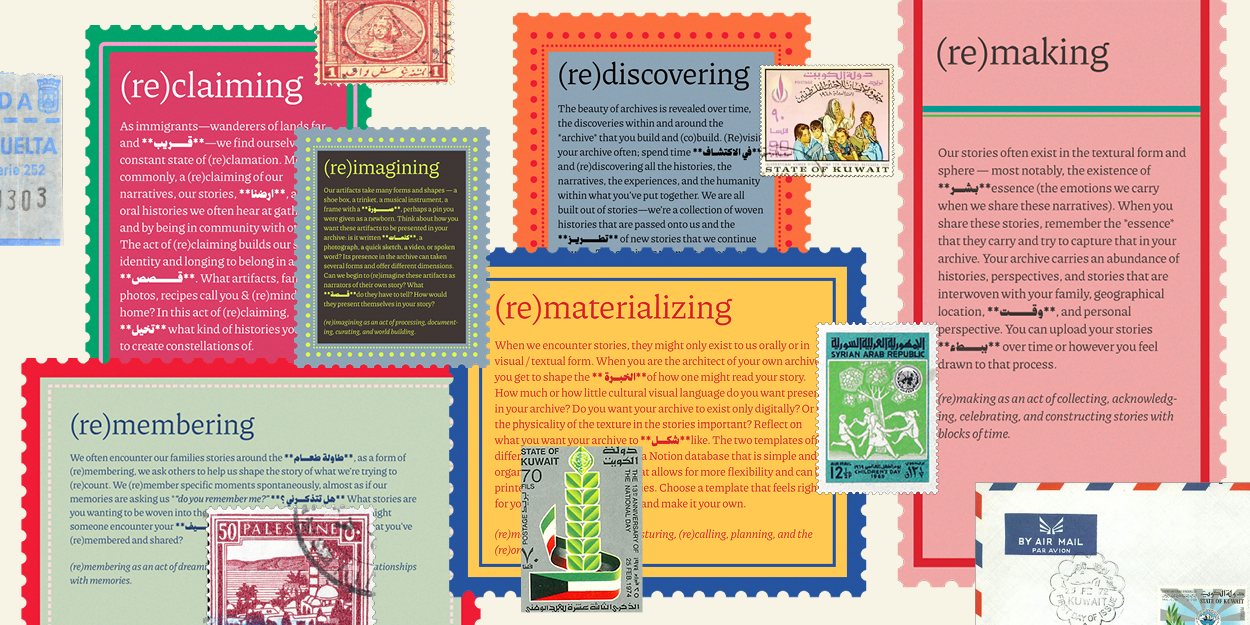
    These questions sit at the center of my project, How to Build an Archive. It is not a traditional archive but a toolkit, a proposal, an ongoing experiment. It gathers fragments: notes, images, recipes, glitches, videos, objects, questions. It is personal but also porous, designed to invite others in. This project expanded my view on what an archive can be: a living, breathing entity, never still, always in flux, in relation to something else. How to Build an Archive stemmed from my frustrations around access to knowledge about archiving practices โ€” gatekept, locked up, only for a few to dive into. But what happens when we open up access to archiving so that it becomes communal? What happens when the collective gets to decide what information we should preserve? What happens if the materials, information, and stories within the archive are interwoven and intermingled? 

    During my residency at High Desert Test Sites, for instance, I began archiving shadows, tracing the movement of my own body through film photography and camcorder footage. In other moments, the archive takes the form of screenshots of software glitches currently existing on my computer in a folder called โ€œscreenshots archive,โ€ or photos of family recipes that carry memory across generations. Each fragment holds a different register of time โ€” fleeting, ordinary, intimate โ€” but together they become a practice of resisting erasure. To me, the act of archiving is not just about saving the past; itโ€™s about opening up multiple possible futures.


    I often think about the difference between institutional archives and community-driven ones. Institutions promise preservation but often exclude, gatekeep, or sanitize. Community archives may be ephemeral and messy, but they are alive. They carry memory in ways that resist assimilation: through food, through oral storytelling, through a shared Are.na board full of links that might seem disparate, but together form a constellation.

    In this sense, archiving becomes an act of care โ€” and care itself is resistance.

    My practice slips between categories: design, research, pedagogy, archiving, art. I take screenshots of digital glitches. I document my working process through video and writing. I collect fragments that donโ€™t always resolve into a finished object. These gestures counteract the capitalist demand for neatness, productivity, and finality. They also remind me that design is never just about the designed object. It is about relationships: between people, between histories, between what is remembered and what is forgotten.

    When I think about collective projects โ€” cookbooks, zines, digital platforms like Are.na โ€” I see them as extensions of this philosophy. They are archives in motion, practices of knowledge-sharing that resist singular authorship.

    The word I keep returning to is multiplicity. To be in multiplicity is to refuse resolution. It is to allow many truths, many voices, many timelines to coexist. It is to hold both the grief of what has been erased and the joy of what can be reimagined. Design, when practiced collectively, expands beyond itself. It becomes pedagogy, world-building, resistance, care. It becomes an invitation to imagine otherwise.

    So I leave you with questions, not answers: What if design were always already collective? What if archives were not about preservation but about relations? What if every act of design was also an act of care? What if we embraced collective consciousness to expand our worldviews? What if we gave ourselves permission to subvert our realities and to dream up new futures?   


    See also

    SEE ALSO: How to Build an Archive: howtobuildanarchive.com โ€ข A History of Arab Graphic Design by Bahia Shehab and Haytham Nawar โ€ข Decolonizing Design by Dori Tunstall โ€ข Seeking Mavis Beacon (film) by Jazmin Jones and Olivia McKayla Ross โ€ข Kinstillatory Gathering by Karyn Recollet โ€ข The Body as Archive by Pรฉlagie Gbaguidi โ€ข Queer Arab Glossary by the Queer Arab Glossary Collective โ€ข Contemporary designers and artists: Sherine Salla, Dina Benbrahim, Munirah Al Shami, Wael Morcos, Marwan Kaabour, Ibi Ibrahim, and many more whose work continues to remind us that design is not a solitary act but a collective one. 

    Author Bio

    Randa Hadi is a Kuwaiti designer, researcher, and informal archivist whose practice weaves memory, migration, and fragmented narratives into visual and spatial form. Trained in architecture and graphic design, she builds digital and material archives that hold what might otherwise be lost: glitches, whispers, family histories, and the shadows between them. Through exhibitions, publications, and speculative interfaces, their work traces how stories travel and transform, asking what we choose to remember, and what remembering can remake.

  • Creating Community: A Conversation with BIPOC Design History

    A conversation with BIPOC Design History

    Creating Community


    Silas: All of us have gone to some pretty amazing design schools, but if you look at the design curricula, there werenโ€™t representations of our lineages there. 

    Ramon: We all sat in these ridiculous history classes, which, by the way, were usually taught through the lens of art history โ€” looking at slides, memorizing, taking tests. None of those images showed anybody or anything that looked like any of the people I know. Even in New York City, graphic design was atrociously white. In a city where you canโ€™t move an inch without seeing a person of color, that makes no sense.

    Silas: I never had Black faculty at RISD or CalArts. But then, conversations with โ€‹โ€‹Tasheka Arceneaux-Sutton, one of a handful of other Black students at CalArts, turned me on to some of the first texts that would inspire BIPOC Design History. One was Saki Mafundikwaโ€™s Afrikan Alphabets in 2006. And then, Ron Eglashโ€™s African Fractals. I began seeking out friends, family, and other scholars worldwide, uncovering a whole set of histories that were not included in โ€œnormalโ€ design curriculum or even in studio critique conversations. In the years that followed, I became an accidental design historian, teaching at places like Vermont College of Fine Arts and Otis College of Art and Design. I co-authored a book about W. E. B. Du Boisโ€™s data visualizations. When the pandemic hit and George Floyd was murdered, the urgency just accelerated. In late June 2020, I posted a tweet asking if folks wanted a BIPOC history course, and the responses went viral. One of the people who responded was Tanvi Sharma. We ended up doing a crazy sprint in December 2020 to make a microsite, enlist speakers, and schedule class dates for Black Design in America. The response was overwhelming, so I was like, Brian, Randa, help . . .

    Brian: One day, Silas says, you want to start this school? And I was like, cool, letโ€™s draw up some paperwork. We need a person of color whoโ€™s a lawyer, who understands IP law. We have to be able to defend this in case something happens, because we might be attacked by doing this. Silas reached out to different people to give talks, and thatโ€™s how it was made.

    Silas: Ramon was such a fixture as a student in the first course โ€” he
    was always sharing in a powerful way and dropping resources from his Decolonizing Design Reader. As we wrapped up Black Design in America, it made sense for there to be another course.


    BIPOC Design History Reader, 2024. Designed by Randa Hadi, Sadeem Yacoub, Silas Munro, Brian Johnson, and Edgar Casarin. Courtesy of BIPOC Design History.


    โ€‹โ€‹Ramon: Silas called me up one day and wanted to do a LatinX class. I love history, but Iโ€™m really challenged by history books these days, particularly design history books. Thereโ€™s still so much missing. So I started gathering people to get this class together. I was really interested in trying to get as many different voices as possible. Latin America is a gigantic piece of land. There are dozens of countries in the whole region. And within those countries, there are smaller subsets of cultures: multiple, multiple, multiple Indigenous cultures that have their own structures and systems and visual languages. How are we going to tell the story in a continent thatโ€™s so diverse?

    Randa: There was an urgency to this information being out there. Weโ€™re responding to what people are saying, both inside and outside of the classroom, which is why we thought it was important to start aggregating those resources. I was also a learner, first and foremost, because thereโ€™s a lot of information that I wasnโ€™t aware of, didnโ€™t have access to, because of erasure.


    From left: Elizabeth (Dori) Tunstall, with illustrations by Ene Agi, Decolonizing Design: A Cultural Justice Guidebook, MIT Press, 2023; Jon Key, Black, Queer, and Untold: A New Archive of Designers, Artists, and Trailblazers, Levine Querido, 2024; Whitney Battle-Baptiste and Britt Rusert, W. E. B. Du Boisโ€™s Data Portraits: Visualizing Black America, Princeton Architectural Press, 2018; Ron Eglash, African Fractals: Modern Computing and Indigenous Design, Rutgers University Press, 1999.


    Brian: Design is a deliberate planning and creation of something that solves a problem or meets a need. It involves research, ideation, planning, prototyping, and iteration. Design develops a solution that has a function or use, or is just aesthetically pleasing. To me, this definition of design is also the definition of craft. Take, for example, a basket weaver. You have a craft that specializes in processes and skills that were learned over years of practice and iteration and experimentation. What fiber is best? How do I find it? How do I harvest it? How do I dye it? How do I bend it? How do I shape it? It also takes a high level of understanding, complex math, algebra, strategic forethought, skill, and dexterity. It takes a deep knowledge of traditional ecological knowledge (TEK) of the area that you live in. The maker has to understand the people who are going to use this object. So, what is the purpose of the basket? Does it have multiple uses, but can it also tell a story? Can it also hold our culture and our lessons? You can answer yes to all of those questions. Craft is design. The only difference is power. The European or colonial hierarchical system asserted that the fine arts are better than applied craft or applied arts. Social class structures then asserted that intellectual work is greater than manual labor; craft is more manual, thus not as good. Then this leads to gender and cultural bias. Textiles, ceramics, basketry โ€” primarily, these were done by women, so you have an issue of misogyny. Non-Western cultures are considered just completely not worth it. Theyโ€™re savage, theyโ€™re uncivilized, they donโ€™t ascribe to Western norms. Coloniality has placed these silos that destroy the breadth of what creativity has to offer.

    Ramon: Design can be defined in different ways in different communities. I like the idea of the lowercase โ€œdโ€ design. Capital โ€œDโ€ design is the material thatโ€™s in all those books that we study. Those are supposed to be the โ€œstandard.โ€ But I think itโ€™s all design if itโ€™s serving a function for a particular community, whether I can understand it or not. If Iโ€™m not a member of that community, why would I understand that? Design doesnโ€™t need to be universal. I donโ€™t even know what that means. Thereโ€™s no way you can do that. We donโ€™t speak the same language; some people in the world donโ€™t even use the same alphabet.

    Randa: Language shapes how we understand design. Terms like โ€œcleanโ€ design, โ€œminimal,โ€ or โ€œuniversalโ€ โ€” they carry assumptions of values, and they reinforce exclusion. And now, weโ€™re having to do the work to unlearn that language thatโ€™s been imposed on us. I think about that more broadly, too, how a lot of the terminology thatโ€™s used in the workspace is rooted in vernacular taken from the military. Similar to divide and conquer. At Polymode, we actually use โ€œsplit and sparkle,โ€ which feels a little bit more gentle and not so military.

    Silas: And a little more gay!

    Randa: A lot more gay, actually. I think thereโ€™s also subjectivity in the language that we use. As someone who also speaks Arabic, and is also learning a little bit of Spanish and Portuguese, I often notice how certain concepts canโ€™t be translated into English, and it reminds me, too, that design, which is basically a language, carries cultural specificity, and if we only use one language or design vocabulary, we erase the nuance and the possibility of expansion to this kind of more holistic overview of design. I think itโ€™s important for us to be in that state of constantly learning, reclaiming language around design, reintroducing words, and redefining things. In a way, I feel like we are doing that collectively, which feels really powerful. To me, the labels become less important than the practices themselves. What is it that weโ€™re actually making? What are we communicating? Who are we connecting with?


    From left: Baskets, clockwise from center: Madeline Tomer Shay, Fancy Basket, 1990s, courtesy of Theresa Secord Collection, Hudson Museum, University of Maine; Sarah Sockbeson, Basket, Fancy, 2013, courtesy of Frances Robinson Mitchell Collection, Hudson Museum, University of Maine; Theresa Secord, Penobscot, Storage Box, 2023, collection of the Farnsworth Art Museum, Rockland, Maine Museum purchase, Lynne Drexler Acquisitions Fund; Sarah Sockbeson, Glowing Sunset on the Carrabassett, 2011, courtesy of Maine Indian Basketmakers Alliance; Jennifer Sapiel Neptune, Basket, Miniature, 2007, courtesy of Hudson Museum, University of Maine; Mbuti People, Bark Cloth Paintings, 1900s, bark cloth and pigment. Courtesy of Andres Moraga Textile Art; Photos by Sebastian Bach and courtesy of the Ford Foundation Gallery.


    Randa: Societally, you canโ€™t call yourself an artist unless your work is up in institutions. There are certain criteria, but why canโ€™t my grandmother be an artist? Why canโ€™t she be a designer? Why canโ€™t she be a craftsperson if sheโ€™s already doing these things? She doesnโ€™t have a degree in it, but why does that actually matter? We fall into these rules that are placed onto us. Why canโ€™t my experience, my interests, and my curiosity be what is actually guiding me in calling myself something?

    Ramon: When I think of design in the Global South, I realize that a lot of designers, particularly in Latin America โ€” not to generalize โ€” are not just graphic designers but also multidisciplinary. In the US, in the Northern Hemisphere, we have been pigeonholed into specific places: Youโ€™re a textile designer, youโ€™re a ceramicist. Youโ€™re an architect, youโ€™re a graphic designer. But, Mexican art and design is riddled with architects, who are also painters, who are also graphic designers, who are also working with textiles. And itโ€™s incredible, because they were asking, what is the medium that best helps me to tell this? To talk about this story, or this narrative? History can help you to do that, and to tell the stories in different ways. And I think that thatโ€™s all a function of design, and thinking of ourselves as designers who are really interested in so many crazy things. Itโ€™s an incredible thing, I think, to realize that as a designer, you kind of have to be interested in everything.

    Silas: Design was redefined for me in 2021 when my cousin Dorcas made matoke, a staple dish in Uganda that is made with a type of banana more savory than a plantain. The way she cooked this banana was a process of design. The banana is roasted in the leaves from the previous time the dish was prepared, along with fresh green leaves. Traditionally, thereโ€™s a fire built in the ground to steam the dish before itโ€™s mashed. Dorcas built this structure underneath out of snapped stalks, which she wrapped in these beautiful folds of green leaves. Just the way that she built this kind of grid of leaves, I thought, โ€œOh my god, this is design.โ€ Thatโ€™s connected to some of the things Brian was talking about: women in the domestic landscape, being in intentional connection with the land and people, creating something thatโ€™s sustenance, and that also communicates something and is ritual. There are all these value judgments weโ€™re unpacking in BIPOC Design History coursework. What Iโ€™ve been taking away, especially after your last course, Brian, is the importance of questioning everything, and that, to me, is part of bringing Indigenous ways of knowing into the conversation. 


    Mary Sully, Henry Ford, Edwin C. Hill, and John Philip Sousa, 1930s, colored pencil, ink, crayon, paint, 34 ยพ x 18 ยพ inches each. Photo by Sebastian Bach. Courtesy of The Mary Sully Foundation and Ford Foundation Gallery.


    Brian: I feel like we also came to this because of our work with Dori Tunstall and Decolonizing Design. There was this push to decolonize, to start breaking it down, but then after my course ((re)Creating Turtle Island), weโ€™ve started to tweak that lens. Instead of deconstructing, or negatively impacting something, we would rather Indigenize: insert something, add something more to the dialogue so itโ€™s more generative and not extractive. We want to then change that dialogue; itโ€™s us making more space. And Native American and Indigenous cultures, especially within Turtle Island, are not homogeneous. There are hundreds of cultures speaking hundreds of languages, and we all see things in similar and different ways. Itโ€™s just that we like to use blanket terms to easily discuss something when itโ€™s actually not beneficial โ€” we find commonalities to meet in the middle. But my definition with you today could also change by this afternoon, right? 

    Randa: Thereโ€™s multiplicity in definitions. Often during conversations, weโ€™ll throw out a word and just assume that someone knows how weโ€™re defining it. Iโ€™m trying to get into the habit of defining words in the moment. As an example, if Iโ€™m talking about red, describing what kind of red Iโ€™m talking about. There isnโ€™t this assumption of a โ€œuniversal red,โ€ because my red could look totally different from Brianโ€™s red, from Silasโ€™s red, from everyone elseโ€™s red in this room. 


    BIPOC Design History course mash-up, 2025. Designed by Sundhya Anthony. Courtesy of BIPOC Design History.


    Brian: We canโ€™t fully upend all of what imperialist culture and capitalism have done to us. We canโ€™t just blow up the system while weโ€™re literally on the plane. I think there is a way of inserting ourselves into the dialogue using an additive word; then, does the BIPOC Design History space allow us to also forgive each other? We need to learn in a space where you can still be vulnerable, where you can still make a mistake. You can make amends, and then grow from that. So, we all come with a sense of both vulnerability and awe.

    Silas: Some of this is really personal because during the course of the classes, Iโ€™ve lost both parents. I was just in Uganda to do a burial ritual for my mom. Some of the joy of doing this work has been connecting with different generations. Both ancestral memory and the presence of people like Colette Gaiter and Saki Mafundikwa, along with their experiences, create a lineage of voices that bring powerful and healing insights. This is achieved by invoking the Ghanaian idea of sankofa, which involves going back and bringing things from the past into the present. Having these four different courses and different perspectives, whether itโ€™s an African perspective, SWANA, Latinรฉ, or an Indigenous perspective, has been so healing and has helped us work through collective traumas. Weโ€™ve been seeing solidarity across different ways of being. You can see your experience in someone else, even if they have a different ethnocultural perspective. You find that you share a common understanding of pain, and that you can help transcend it and see each otherโ€™s experiences in a new light.


    From left: Silas Munro, Strikethrough: Typographic Messages of Protest, Letterform Archive Books, 2022; Saki Mafundikwa, Afrikan Alphabets: The Story of Writing in Afrika, Mark Batty Publisher, 2006.


    Ramon: I think itโ€™s actually even more rewarding, because you start to see how history ends up being more multidisciplinary as well. Youโ€™re engaging in the totality of how communities, human beings, have developed ideas, languages, ways of seeing โ€” and that itโ€™s not the same. It also gives us an opportunity to have a conversation with the ancestors. You have to go back home and really start to dig through that incredible archive and elevate it. It requires a lot of unlearning. It gives you a better perspective, and I think it makes you a better designer. 

    Brian: Some of that is a choice, too. You have to turn to the hardships, to the sadness. My Native past was erased from me. There are 2,300 Monacans that remain. We were not given Federal recognition as a tribe until 2018. That doesnโ€™t diminish the fact that Iโ€™m as Indigenous as other tribes. We have no language. Tutelo died in the 1870s. We are trying to awaken it from its slumber, but it will be a new, modern version of the language. We can either be stressed and squashed by the sadness, by the fear, or we can make a choice to call out the elephant in the room and then say, Iโ€™m gonna work through this. Yes, Iโ€™m surrounded by fear, but did you notice how pretty this is? Did you notice that the sun still came up today? Did you notice that I can still take a large, deep breath? I can feel the earth under my feet? You can consciously say, yes, this is harrowing, and I felt it, and Iโ€™m really sad about that. I didnโ€™t cause these things to happen. I am not perpetuating these things. But I can then also say: letโ€™s talk about the goodness thatโ€™s also around this.

    Silas: In your course, Brian, you held space for people to process the hard things. Itโ€™s complicated to hold space for that. You can be in the conflict and be in the painful moments, to give us time to chew on that. I feel like there is a cathartic part of that, learning by doing. 

    Randa: So much of doing this work of facilitating, curating, researching, and putting together these courses means confronting histories that were intentionally erased โ€” and obviously at different scales, at different levels of erasure. I want to be clear that colonization, genocide, and trauma for Indigenous, Black, SWANA, and POC folks is different. I donโ€™t want to paint it as being at the same level. But I think that discovering something about your culture or your lineage can be both joyful, but also painful. Itโ€™s almost like youโ€™re finding a gem, but then thereโ€™s also grief in realizing that it was hidden from you. Itโ€™s important not to be in that headspace of what if, what if, what if. Itโ€™s just really daunting. But I think thatโ€™s why the balance feels crucial: taking pauses, making space for rest, finding joy in the small moments to sustain the work that weโ€™re all doing. I do think that thereโ€™s joy in teaching, in witnessing students connect the dots, and sharing stories together. Asking these big questions that I think weโ€™re often scared to ask because thereโ€™s so much complexity and nuance. Itโ€™s fucking complicated, you know?


    From left: Frank Reyes y Yovanny Polanco, Igua Bar, concert poster, Dominican Republic. Photo by Ramon Tejada; Burhan Karkoutly, Palestine Lives, c. 1978, print, 17 x 11 1/2 in. Image courtesy of the Palestine Protest Project Archive.


    Brian: It relates to how we approach teaching time. From a very Western standpoint, time is linear. It goes from A to B to C to D, and it keeps moving in a one-directional sense. Absolutely not! Thatโ€™s trash. Time is a circle; it is cyclical, and itโ€™s also a cylinder at the same time, it wraps on itself. The lesson changes as you age, and when we think about teaching time as past, present, and future . . . no, they are all happening simultaneously. Our small, little human brains canโ€™t wrap around that.

    Silas: When I am facing all the challenging ideas of these problematic things in the past, and present, I think there is still hope that learning from history can help us iterate in new ways. That is the power of design, this idea of iteration, of reshaping or recycling the past to create a new experience in the present that can lead to a new future. Iโ€™m thinking of a timescale not for next week or next month, but seven generations from now. How will that change the way that I think about treating someone else, or how does that make me think about a design process thatโ€™s not about an eighteen-month cycle of packaging design, necessarily, but about eighteen years, or eighteen generations?


    Get perhaps in print!


    Randa: I love this conversation about time. I grew up in Kuwait, where we used the Hijri calendar, which is an Islamic calendar based on the moon. I remember being in high school and middle school, and having to contend with two different forms of time. What does it mean for a calendar to be constantly in motion, versus the Gregorian calendar, which is fixed? It doesnโ€™t actually move; itโ€™s always the same. Versus the Hijri calendar, which is constantly in motion. Thatโ€™s why Ramadan is always ahead each year.

    Brian: This also makes me want to go back and change my entire definition of design that I started with. Design becomes the liminal space between. Itโ€™s not the start and itโ€™s not the end. It is the process.


    Luba People (Democratic Republic of the Congo, primarily South-Central region), Lukasa Memory Board, late 1800s or early 1900s, wood, metal, beads. Courtesy of Brooklyn Museum, gift of Marcia and John Friede.


    Brian: BIPOC Design History is full in the face of what we are going through. No, we were not given this at RISD. We were not given this at any other school. Of all the things that show resistance, itโ€™s twofold. Show up and learn something new to allow your brain to be plastic, and to change, and to evolve, and to grow. And also, at least for me, is to live my truth. So thereโ€™s a difference in understanding, like, yeah, I want to go out, and I want to use design to sort of fix everything. That level of Pollyanna doesnโ€™t work for me. I feel like I have to kind of do all the things. I do have to resist, but I also have to think about care. I also have to take care of other people. Like, itโ€™s little incremental changes versus, Iโ€™m just gonna get some kind of big weapon and just break it all down. I think itโ€™s both/and. Thatโ€™s why I love just holding space for BIPOC Design History, and then saying, cool, Iโ€™m still going to be an out-queer person who is Native, who is growing my hair long, to resist this idea of what masculinity is, especially white masculinity with how you have to look, and yeah, this [my hair] is a lot to take care of, but itโ€™s also holding a level of what was cut off from me when our ancestors were sent to boarding schools. So I feel like living in that truth and being in that space is just a mode of design. 

    Randa: Knowledge and literacy are power. There is a form of resistance in actually learning and having access to this knowledge that we didnโ€™t have previously. Weโ€™re archiving every single resource, every single question that people are dropping in the chat into our resource page that anyone can access. Weโ€™re also pointing it back to the person who dropped the link in the chat, who dropped the question, who dropped what we call a nugget of knowledge, for people to look at and to know the citation of who this is coming from. This becomes a resistance to or a critique of institutional archiving, which operates in a very different way. There, you have one individual who decides what is important or not important. To us, everything thatโ€™s being said is important, and weโ€™re trying our best to just capture all of it and keep it in a space where people are able to visit and revisit and relearn. This collective knowledge is also a network or an ecosystem of different entry points into learning design history, not just through talking, but through visual references. There are so many music references and film references that are in the collective knowledge. It becomes really expansive โ€” you can fall into a rabbit hole and spend hours. That, to me, is a form of really powerful resistance.

    Silas: The citational practice is such a powerful form of resistance, and weโ€™re not the only ones that do that. I was thinking about Mindy Seu, who is not part of BIPOC Design History, but she frequently discusses the concept of collective voice. I also think about the literal protests, like Coletteโ€™s talks about Strikethrough, which evolved into a comprehensive publication and exhibition that Polymode worked on, exploring the history of protest and civil rights. Protest is something that can be passed on. We havenโ€™t even used the word โ€œallyโ€ yet in the conversation, but thatโ€™s also one of the things that Iโ€™ve seen come out of BIPOC Design History โ€” how allies can navigate and be supportive, how to hold space for their part of the process, or how we all can have a form of allyship in the way that we live. Thatโ€™s a form of protest, too.


    From left: Aqa Mirak, Fereydun Tests His Sons, c. 1535, opaque watercolor, gold, and ink on paper, Tabriz, Iran. Courtesy of the Aga Khan Museum; Kay Khusrau and Fariburz with Chained Prisoners, 1493โ€“94, painting, Gilan, Turkman dynasty. Courtesy of the British Museum.


    Randa: The way that BIPOC Design History started was very much about responding to the current moment. I know that Silas did that with his class, and I know that Ramon was also doing that in his class when he was curating it. I was also looking at what was happening politically in the SWANA region and bringing that to the forefront. I invited someone to speak about Palestinian typography, the Women, Life, Freedom Movement, and the Sudanese Revolution. Itโ€™s important that those come to the forefront and highlighting them is a form of resistance. Instead of not talking about it, instead of siloing ourselves and existing in the space of, oh my god โ€” what is actually happening? โ€” weโ€™re opening up dialogue for hard and difficult conversations. I donโ€™t think we often have that opportunity in a class or institutional setting, because there are obstacles. Opening things up for vulnerable and deep discussion and dialogue feels like itโ€™s fighting against that.

    Ramon: At this particular moment, design can create community. Look at the ways that design has always been a part of many communities. Some communities literally embedded their stories into artifacts because that was the only way that they were going to be able to survive โ€” everything was being demolished. When I think of design, I think of teaching as well. The space of the classroom is like a workshop, and we can talk about a lot of things in this workshop, and you can use your knowledge of form-making. You can use that to tell these stories to empower, to elevate your people, in essence, to elevate your community.


    EXPLORE: BIPOC Design History

    Randa Hadi is a Kuwaiti designer, researcher, and informal archivist whose practice weaves memory, migration, and fragmented narratives into visual and spatial form. Trained in architecture and graphic design, she builds digital and material archives that hold what might otherwise be lost: glitches, whispers, family histories, and the shadows between them. Through exhibitions, publications, and speculative interfaces, their work traces how stories travel and transform, asking what we choose to remember, and what remembering can remake.

    Brian Johnson, a member of the Monacan Indian Nation, is an award-winning designer, creative director, writer, and curator. He is a partner at Polymode and formerly UNC Chapel Hillโ€™s Marketing Creative Director, developing scalable, multi-platform brand campaigns. His research centers on Indigenous-made works to combat erasure. Johnson co-curated Reverberations: Lineages in Design History, will curate Designed To Be Red (Poster House, 2026), and is a 2025 Mellon Fellow at the IAIA Research Center for Contemporary Native Arts (RCCNA).

    Silas Munro is a designer, artist, writer, curator, surfer, and descendant of the Banyole People of Eastern Uganda. Founder of the LGBTQ+ and minority-owned studio Polymode, he co-curated Reverberations: Lineages in Design History and curated Strikethrough: Typographic Messages of Protest (Letterform Archive, 2022โ€“23). He was a contributor to W. E. B. Du Boisโ€™s Data Portraits and co-author of Black Design in America. His art has shown nationally and is held in major collections. He is founding faculty and chair emeritus at Vermont College of Fine Arts.

    Ramon Tejada is a DominicanYork (of Dominican-American, Afro-Caribbean, and LATINX descent) designer and educator based in Providence, Rhode Island. His hybrid design and teaching practice focuses on collaboration, inclusion, unearthing, and the responsible expansion of design โ€” a practice he calls โ€œpuncturing.โ€ Ramon is associate professor and Department Head of Graphic Design at RISD and principal of El Estudio RT. He was the facilitator of BIPOC Design Historyโ€™s Incomplete Latinx Stories of Diseรฑo Grรกfico Borderlands / La Frontera* course and is a 2024 recipient of the Vilcek Prize in Design.