This thought was a turning point in our conversations about founding a magazine during a time of crisis. We asked ourselves what it meant to start a creative project amid the political, economic, ecological, and other challenges that confront us every day, some of which are explored in this issue. From record flooding driven by climate change to words that have been banned based on political ideology, these are only some of the many problems that need our attention, and urgently.
We also recognize a feeling of hopelessness that comes with this moment, a sense that our efforts will not make a difference or that the issues are so large and complex that there’s simply nothing we can do. Against this feeling of despair, we wanted to give form to something meaningful. Not something that solves all the problems we face today — what can? — but something that creates a space for wondering, that contemplates the world in a different way, and opens up new avenues when more and more possibilities seem foreclosed. There is power in making space, in the margins if not in the mainstream, as Ash Holland reminds us in her exploration of comics and the queer community.
As we consider this moment, it feels like an in-between time — not settled and certainly not stable, but also not yet finished — like the traces of light and memory that haunt the empty spaces in Kathleen Creighton’s photos in this issue. It is a time of transition, not just a space of possibility but also a space for movement — but movement towards what? Our essay on void moons suggests that there are times we might be freed from the forces that normally push and pull us and instead be left to pause, reflect, and look ahead.
Sometimes new ideas come from putting things together in unexpected ways, like this issue’s piece on heart memory, which places art and emotion in conversation with science and medicine, or our cover art, Immigrants by Lilli Muller, a series of chairs that have been cut in half and arranged in mismatched and precarious positions. A little space is left between each half, making the liminal almost tangible. Installed in Joshua Tree National Park in 2021, these chairs suggest both that we live in a fragmented world and also that we can build new connections, even from broken parts. For Muller, it speaks to a notion of home that is neither the country of her roots nor the one she lives in. In a political climate that is increasingly hostile to immigrants, her work highlights the importance of being seen within cultural landscapes that fail to reflect one’s own experience. Immigrants is included in the Amplification Project, a digital archive of art and cultural productions related to forced migration and refugeehood, which Kathy Carbone frames here as an act against erasure.
In starting a print magazine, we aimed to slow things down a bit and dwell within these ideas. Creativity, like hope, needs time to grow. Several of the pieces here think about the process of creation, from Rosa Chang’s work with indigo and dyeing techniques that connect to her cultural roots to Andrea Gough’s collection of recent books about traditional crafts and ways of making. A printed object is something that gets handled, passed along, read on the train, and carried to and from homes, bookstores, cafés, and all the places in between. With all of that physicality comes other people, and opportunities for new and unexpected interactions with those around us.
Part of what excites us about this project is being in community with contributors, readers, and everyone else involved in producing a magazine. To launch this effort, we’ve called on our networks of friends, family, colleagues, and neighbors to trust us with their work, offer advice, and lend their attention. We’ve talked with others who are starting their own print magazines and sustaining creative projects in these uncertain times. We’re getting to know our local booksellers and shop owners on a first-name basis. Across all of these interactions, we’ve encountered people who are trying to make a difference, create something beautiful, or simply imagine otherwise. Like them, we are making a little room to grow.
Welcome to the first issue of perhaps. We are so glad you are here.
Michael, Nancy, and Chris
On the Cover, Issue One Lilli Muller, Immigrants, 2021.
Art has always been a way for me to navigate my emotions, identity, and place in the world. As a first-generation immigrant artist living in the United States, my work is deeply intertwined with my heritage, memories, and the cultural threads that shape me. At the heart of my practice is the concept of reincarnation — a belief deeply rooted in Korean tradition — which manifests in both the themes and materials I use. I find beauty in giving new life to old materials, whether through natural dyes, textiles, or repurposed objects, mirroring the cycles of nature and personal transformation.
Storytelling has also been something I wanted to incorporate into my art. Perhaps I simply wanted to share my story, and in doing so, I found a sense of connection and understanding. In the beginning, I wasn’t sure which medium I enjoyed the most. I felt immense internal pressure to choose — fine art or illustration, traditional painting or digital media. Would I remain a fine artist, or should I take any job I could find? These questions brought confusion and uncertainty throughout my college years, my twenties, and even into my thirties.
One of my works, The Weeping Trees, is an ongoing illustration and drawing series that explores human relationships and resilience. This series began on my little sketchbook during an emotional period while caring for my father in the ICU in 2015
One day, while working at a book fair in New York, I received a call from 911. My father was being transported to Georgetown University Hospital in Washington, DC. Without hesitation, I rushed to catch the next Amtrak train, unprepared for what lie ahead. He had suffered a severe stroke and was diagnosed with global aphasia — a condition that affects a person’s ability to speak, understand language, read, and write. For the first five days, he spoke in a language I had never heard before. It wasn’t just slurred or fragmented speech; it was as if he were speaking an entirely unknown language.
Oddly, despite this, I could still understand him. Through his gestures and expressions, I instinctively interpreted his needs — something the doctors and nurses couldn’t do. Without a change of clothes, without meals or rest, I stayed by his side, translating his non-existent language. At times, his misfiring neurons led him to call me “wife.” Then, on the seventh morning, his language ability suddenly returned — almost 80% restored.
It was the longest and most difficult week of my life.
Time, Space & Blues Series The cyanotype prints narrate an eight-month planting odyssey with the annual Japanese indigo plant (Polygonum tinctorium), from seed germination to seed collection.
Thriving in my small Brooklyn backyard, these plants sprouted from April to August, underwent harvest between August and September, and culminated in the gathering of seeds in late October 2018.
Each image serves as a visual chapter, unveiling the intricate and transformative journey of nurturing and harvesting Japanese indigo within the boundaries of my urban oasis.
During that time, I began sketching. These tree-like figures, with their tangled and interconnected branches, became a metaphor for the unseen bonds between people — the ways we support, shape, and hold one another up, even in the most uncertain moments.
A couple of years after the incident, my friend Ivanny gifted me a book, The Hidden Life of Trees by Peter Wohlleben, after seeing my Weeping Trees series. Through this book, I learned how real trees support one another — sharing nutrients through their interconnected roots, sustaining ailing trees, and even helping rival trees for the sake of a larger symbiotic ecosystem. This deeper understanding reinforced the meaning behind my work, highlighting the resilience and interconnectedness that exists not only among trees but also among people.
For over a decade, I have been immersed in the world of indigo. The traditional dyeing techniques of Korea and East Asia have become a cornerstone of my work, not only for their aesthetic qualities but also for the philosophy they embody. Indigo is resilient. It thrives in poor soil, replenishing it rather than depleting it. This mirrors my own journey — learning to adapt, grow, and give back to the communities around me.
Working with Polygonum tinctorium, the indigo species cultivated in Korea and Japan, has been a way for me to reconnect with my cultural roots. When I first encountered natural dyeing, I was unaware of Korea’s rich indigo traditions, despite being born there. Up until the 1940s, growing indigo and dyeing clothes were common practices in rural areas of Korea. A young bride’s mother would hand-stitch a blanket from indigo-dyed fabric as a wedding gift for her daughter. According to old scripts from the Chosun period, farmers and lower-class people who could not afford medicine would boil indigo-dyed fabric in water and drink it as a remedy during epidemics. In fact, indigo has antiseptic and antioxidant properties, and people in the past discovered these benefits long ago.
Now, indigo is a bridge — connecting past and present, tradition and innovation, my old home and my new one. By growing the same indigo plants my ancestors cultivated, and practicing similar methods to extract pigments from these magical plants, I honor their legacy. Additionally, I incorporate indigo into my daily life, embedding their wisdom into my own journey.
I explore various natural dye techniques, drawing from traditions like Japanese boro and Korean bojagi — both methods of mending that honor sustainability and longevity. Through patchwork, hand embroidery, beading, and resist-dye techniques such as katazome and shibori, I create layered narratives that expand my storytelling beyond paper and canvas. Each piece carries a history, a connection to the land, and a reflection of my personal journey. In 2021, after my grandmother’s passing, I returned to Korea and brought back sambae, a traditional hemp fabric used for summer clothing and funeral rituals. This material inspired my large-scale installation Relics, in which I dyed sambae with black walnut and indigo to symbolize mourning and memory. I also mended two of my grandmother’s old cotton sheets, incorporating fabric scraps as a way to honor her life and the generations of women before me.
My journey with indigo, textiles, and my research-based online project, Indigo Shade Map, eventually led me to publish My Indigo World, a picture book that weaves together science, art, and storytelling. The book celebrates the cultural significance of indigo and my personal connection to it. Writing and illustrating this book became another form of storytelling — one that allowed me to share my love for indigo with a wider audience, particularly children. Seeing how the book has resonated with readers has been incredibly rewarding, reaffirming my belief in the power of art to educate, connect, and inspire.
The Weeping Trees short stories and drawings series interprets a variety of emotions and relationships around the world. Three different natural pigments (black walnut, indigo, and madder root) were used to create these sketches.
This piece depicts two tree figures with interconnected branches, forming a circular shape that represents a moon. These tree figures are derived from another personal drawing series of mine, Weeping Trees, which symbolizes the complexity inherent in relationships. The tree figures were created using a soy paste resist technique and dyed with a naturally fermented indigo vat. The Relics Series serve as cultural cornerstones, reflecting the deeply ingrained values of Korean culture. The belief in not wasting material and in giving a second life is intricately woven into the fabric of the installation, providing a meaningful reflection on sustainability, interconnectedness, and the cyclical nature of existence.
Relics Series Relics. Sambae fabric, cotton threads, natural pigments.
The highlighted fabric, known as “sambae,” is a hemp fiber deeply rooted in Korean cultural practices, specifically used in funeral ceremonies. Obtained after my grandmother’s funeral in 2019, this aged fabric serves as a tangible connection to her life, marked by dual identities forged during the Japanese occupation era and an education in a second language. To honor her journey, I dyed the sambae fabric using madder root and indigo. After dyeing, I hand-mended it, symbolizing her life and spiritual beliefs, reflecting the notion of reincarnation in Buddhism.
Wound. Hand stitch on linen, natural indigo-dyed Sashiko threads on avocado-dyed linen fabric.
Through all my work, I seek to honor tradition while forging new paths, to celebrate resilience while embracing change. Whether through paintings, textiles, or books, my art is a conversation between past and present, between what was and what can be. It is my way of remembering, healing, and offering something back to the world — one stitch, one brushstroke, one indigo-dyed thread at a time. 🌿
Rosa Chang is an artist based in Baltimore and New York whose work is deeply rooted in fostering a harmonious relationship between humans and nature. Drawing inspiration from natural materials and environments, Rosa creates art in various forms, mediums, and scales. Her current focus is on sharing the cultural significance of Korean and Asian traditional indigo and natural dye processes through community engagement and exchanges. Rosa is an adjunct faculty member at the Maryland Institute College of Art and serves as the Executive Director of Hand Papermaking, Inc., a nonprofit publication dedicated to advancing both traditional and contemporary practices in the art of hand papermaking. rosafulgarden.com
The Art of Dario Robleto and the Science of Heart Transplants
The artist Dario Robleto has a sculpture called Lunge for Love as If It Were Air, which consists of two small, black feathers floating in a glass jar, positioned upside down, conjuring the image of a pair of shadowy lungs. The feathers were created with stretched audiotapes of two deceased lovers’ recordings of each other’s heartbeats. I was drawn to this object because of its beautiful form, and upon learning about the underlying material, the piece became even more captivating. A recording of a heartbeat already generates a deep sense of wonder in me — to even capture this mysterious beating organ feels like a kind of magic — but to then reconfigure the tape into an unexpected pair of feathers gives the heart a whole new dimension of awe. I encountered this piece in The Heart’s Knowledge: Science and Empathy in the Art of Dario Robleto, a book about a range of his works, including those that were part of an exhibit at The Block Museum of Art at Northwestern University in 2023. Jennifer L. Roberts, in writing about this piece in the exhibition’s catalog, says, “The span and stretch of their love is sealed in the jar like a black moth. Or like the cold filament of an inverted light bulb. Or perhaps like a dark firefly, a speck of rapture once perceived.” While looking at this piece and Robleto’s intriguing collection of heart-inspired work, such as sculptures and prints of early waveform recordings of the heart, I was reminded of the first human-to-human heart transplant, which took place in Cape Town’s Groote Schuur Hospital in 1967.
Dario Robleto, Love, Before There Was Love, 2018. Earliest waveform recordings of blood flowing through the heart during an emotional state (1870), rendered and 3D printed in brass-plated stainless steel, and brushed steel and glass vitrine. Image courtesy of the Mary and Leigh Block Museum of Art, Northwestern University.
I had a brief stay at Groote Schuur in 2003 when I was sick from what was eventually diagnosed as dengue fever. I remember sitting in a dimly lit waiting room, drooping from a fever and a light delirium, my muscles on fire. Dengue fever is sometimes referred to as break-bone fever because it is so painful. I tried to move as little as possible as I eyed the other patients, wondering what they had — were their insides shattering like mine? I was taken to an exam room, where I sat alone and waited for a doctor to see me. I have no particular connection to the first heart transplant, other than my profound curiosity and those lonely moments in the exam room when I imagined what it must have been like for the heart’s recipient, Louis Washkansky. If I hadn’t been so sick at the time, I think the sense of wonder would have been more heightened than it was, but still, I remember sitting on the exam table, my legs dangling, aware that this was an especially historical place.
Washkansky was a 53-year-old grocer who had suffered multiple heart attacks and ultimately developed congestive heart failure. He had ended up in Groote Schuur after numerous surgeries and months of decreasing heart capacity until his heart had only about one-third of its capacity to circulate blood through his body. On a sunny morning in early December, as Washkansky slowly declined in the hospital, 25-year-old Denise Darvall was out in the city, shopping with her family, when a car hit her as well as her mother. Although her mother died instantly, Denise was taken to the hospital with a severe head fracture. It was soon determined that she had no brain function, but her heart was still viable. The surgeon, Christiaan Barnard, carefully discussed the options with Denise’s father and soon secured her heart for the transplant. The very concept of an organ transplant was not readily accepted and, in the early days, was often criticized for being unethical, especially as the concept of brain death was not widely adopted until the 1970s. Which is to say, someone can be effectively dead but still have a beating heart. Indeed, this was an issue with Denise Darvall, and there was significant debate about how to actually declare her death.
Remarkably, Ann Washkansky, Louis’s wife, had driven by the scene of the accident that morning, unaware that her husband’s new heart would be recovered, some hours later, from that gruesome scene. Ann had been conflicted by the fact that to receive a heart transplant someone else had to die and as she came to understand details about Denise, the donor’s heart took on a sense of identity. “Knowing about that girl, and her life and her family, made it all so inhuman, somehow. My husband’s heart had an identity. It wasn’t just a piece of flesh anymore,” she said. The Heart of Cape Town Museum, in detailing the story of this first transplant, refers to the heart as “the symbol of the essence of life,” and it is especially within the context of a transplant that the organ seems to take on these dual characteristics — form and essence.
Making something visible is the first step in knowing it, and knowing the heart meant we could record it, change it, and, ultimately, operate on it. Even heart cells in a petri dish do one thing: beat.
Above: Dario Robleto, The Boundary of Life is Quietly Crossed (still), 2019. Two-channel 4K video, color, 5.1 surround sound installation. Image courtesy of the Mary and Leigh Block Museum of Art, Northwestern University.
Dario Robleto, Unknown and Solitary Seas (Dreams and Emotions of the 19th Century), detail, 2018. Earliest waveform recordings of blood flowing from the heart and in the brain during sleep, dreaming, and various emotional states (1874–96), rendered and 3D printed in brass-plated stainless steel; lacquered maple, 22k gold leaf. Image courtesy of the Mary and Leigh Block Museum of Art, Northwestern University.
The sphygmograph, invented by Karl von Vierordt in 1854, and further developed by Etienne Jules Marey in 1863.
Robleto has several other sculptures that put recorded heart rhythms into physical form. Unknown and Solitary Seas represents the earliest waveform recordings of inhalation and blood flowing through the heart and brain during various emotional experiences. Recorded during 1874–96, these sound waves were solidified in brass-plated stainless steel. The pieces are presented as a series of golden waves, creating an elegant snapshot of centuries-old pulse waves. Other early recordings, wavy oscillations in Sparrows Sing to an Indifferent Sea, capture the heart’s reaction to different experiences: riding a bike, being scolded, and listening to music, among others. Roberts writes, “All of Robleto’s recording sculptures have a quality of waiting about them — waiting for someone or something to recognize that there is something to detect about them, that they still harbor messages to decipher. Waiting to tell them that they are not alone.” This strikes me as analogous to falling in love. There is a sense that your beloved holds secrets for you to uncover while you are quietly waiting to be understood through each increasingly intimate interaction. This piece makes me wonder why hearts are the physical place where we situate love. The heart is a common metaphorical catchall for emotion — though there are many arguments to be made that love happens all over the body, from the brain to the fingertips. So, why this organ in particular? How did the heart become the place that signifies our emotional center?
Some of the earliest Western poetry, written by Sappho for her female companions in the seventh century, identifies the heart as a place of passion. She writes, “And then Love shook my heart / like the wind on the mountain / troubling the oak trees.” Likewise, philosophers Plato and Aristotle situated the deepest human emotions in the heart. Plato says, “Every heart sings a song, incomplete, until another heart whispers back. Those who wish to sing always find a song. At the touch of a lover, everyone becomes a poet.” Venus, the goddess of love, is said to have coupled humans by setting their hearts on fire. This mythical history has ingrained in Western culture a sense that there is something special about the heart, and within it, something meaningful to be unearthed in our fellow humans.
The heart and its connection to the human condition are central to much of Robleto’s artwork. In Radical Fiber: Threads Connecting Art and Science, he has written about the organ: “For most of history, across time and cultures, the heart wasn’t simply a metaphor. It was considered the literal vessel of the soul, this conduit between the immaterial and material domains. Our great poets and philosophers and priests have all weighed deep questions about identity and emotional authenticity, fate and faith, around the heart.” This tendency to hold the heart above other organs doesn’t only happen in philosophy or poetry; hearts have always been special in the world of science and medicine too. Part of what makes Robleto’s work so interesting is that it exists at the complicated intersection of art and science, often bringing poetic observations to scientific discovery.
Another piece in The Heart’s Knowledge exhibit, First Pulse, 1854, captures the first time a human heartbeat was recorded. Karl von Vierordt, a German doctor, created a sphygmograph, a device that wraps around a person’s wrist, captures their pulse, and records it. The recording is not entirely unlike a contemporary blood pressure reading or an EKG, if not exactly as precise. The sphygmograph used a soot-covered piece of paper under a tiny rod of metal that reacted to the pulse and created a set of curvy lines on paper, representing the arterial movement. This device, like many medical breakthroughs, made the invisible visible. The unknown, inside world of our bodies, was now represented on the outside. Making something visible is the first step in knowing it, and knowing the heart meant we could record it, change it, and, ultimately, operate on it. Even heart cells in a petri dish do one thing: beat.
When I lived in Cape Town, my house was only a short walk from the Main Road, where Denise Darvel’s accident occurred. I didn’t know it at the time, but reflecting now, I am struck by the way paths cross: Denise and the drunk driver who killed her, Ann as she drove past the scene, and some decades later, me, as I walked to a nearby cafe. And then, there are the many cars and pedestrians who have crossed over that same street since. What kinds of histories do we unknowingly pass every day? The routine moments and the remarkable lives, mostly unknown, under our feet. The first heart transplant, and those physical human connections, contain within it that sense of mystery, of magic — the same feeling I get from Robleto’s artwork.
My most vivid memory of Groote Schuur Hospital wasn’t the nurses or doctors, the other sick folks around me, or even the exam itself — all of which feel hazy in my mind. For some reason, I have a clear image of a long hallway I walked down after I exited the exam room. Feeling tired and confused, I’d taken a wrong turn back to the lobby and found myself in a deserted hallway, a dark corridor with a window at the end, and a lone wheelchair stationed at the far end of the hall facing the window, as if a ghost might have been sitting in it watching the clouds float by, carefree in the blue sky.
The wheelchair was an older variety, turn-of-the-century, wooden, with a tall back. It felt like something that could have existed at the time of the heart transplant. Perhaps the very wheelchair that Louis Washkansky might have been transported around the hospital after his surgery. He survived the transplant but died 18 days later from pneumonia. Denise’s father lamented her death for a second time.
Why does this quiet memory remain so clear in my mind? I was only in that hallway for a few moments. Nothing eventful happened. It was silent and there wasn’t a single person there. I think now it might have been because I was afraid I would die alone in a country that wasn’t mine and that hallway would have been my last memory. I didn’t experience anything so severe as a heart transplant, but there is something about being in a hospital with an uncertain set of painful symptoms that can make you imagine the worst. I stood for a moment, and then turned and found my way back to the main waiting room where I picked up some medication, went home with a friend, and, surprisingly, recovered a few days later.
The duality of the heart, as both an emotional and biological entity, is clear in the case of broken heart syndrome, which occurs after someone suffers severe emotional distress or intense loss, such as the death of a loved one. The technical name for this, Takotsubo Cardiomyopathy, comes from Japan, where it was first described in the early 1990s. A person’s heart develops a weakness in the left ventricle, which causes the rest of the heart to work harder. As the shape of the left ventricle becomes enlarged, it takes on a bulging form similar to the small, round container called a takotsubo, which is used to catch octopuses in Japan. The physical symptoms seem to be a reaction to emotional trauma; the heart materializes what it feels. Elizabeth Gilbert suggests that having a broken heart is a good thing. “It means we have tried for something,” she writes. However, anyone who has suffered a broken heart might find this perspective to be of little comfort, as the residue of loss remains with us long after our companion has departed.
In the case of a transplant, it is sometimes thought that an organ recipient takes on the emotions, memories, or personal qualities of their organ donor. This is not just a superstition or myth. The kinds of changes that have been reported include shifts in preference, such as for certain foods, alteration in emotions or temperament, modifications of identity, and intriguingly, memories from the donor. Many of these memories are of the actual moment of death and seem to be more common in recipients who received a heart from someone who experienced a violent death. For example, one transplant recipient had a repeated visualization of a blinding light and an intense sense of fear. His heart donor was a police officer, killed by a gunshot wound to the face. The changes, though anecdotal, are quite commonly reported. One woman was able to recall the name of her donor, despite never having been told his name. Another woman said that she even feels love differently, and after the transplant, she became a less emotional person. A straight man, after receiving a heart from a lesbian woman, became a significantly better lover, saying that he simply had a better understanding of the female body. This was verified by his wife.
Above: Dario Robleto, First Pulse, 1854 from the portfolio The First Time, The Heart (A Portrait of Life 1854–1913), 2017. Photolithograph with transparent base ink on hand-flamed and sooted paper, brushed with lithotine and lifted from soot, fused with shellac and denatured alcohol. Mary and Leigh Block Museum of Art, Northwestern University, gift of Northwestern Engineering. Image copyright Dario Robleto.
A Lady, A Map of the Open Country of Woman’s Heart, Exhibiting its Internal Communications, and the Facilities and Dangers to Travellers Therein, c. 1830.Lithography of D.W. Kellog & Co.
F.T. Lewis and M. E. Abbott, Model of the Heart of a Human Embryo 4.6 mm long x 108, 1915.
Pieter van Gunst, Anatomical Study of the Blood Vessels and Circulation, 1685. Engraving after an image by Dutch painter and art theorist Gerard de Lairesse.
Johannes Gossner, The Heart of Man Who After His Conversion Has Fallen Again Into Former Sins, And Is Now Entirely in the Power of Satan, 1851.
What kinds of histories do we unknowingly pass every day? The routine moments and the remarkable lives, mostly unknown, under our feet.
Recent research has shown that there are four types of memories that live in cells: epigenetic memory, DNA memory, RNA memory, and protein memory. Scientists are still unearthing the various ways these kinds of memory function — in our hearts and the rest of our bodies — but the connection between the heart and the brain is so strong that doctors have coined terms like “heart memory” and “heart feelings.” This was something Ann Washkansky seemed to intuitively know, as she, at one point, wondered if Louis would acquire any of Denise’s personality traits. He may not have lived with her heart long enough for us to know if he experienced any changes related to her identity, but there is every reason to believe that he could have.
Despite the recipient taking on personal qualities from the donor, a primary issue with transplants is organ rejection. The body instinctively tries to reject a transplanted organ because it is a foreign object. Transplant recipients have to take immunosuppressive drugs for the rest of their lives, which ironically, makes them more susceptible to other diseases, like cancer, which are often stopped by early immune responses. It is strange that to understand another person’s memories through their heart, we have to suppress another embodied reaction — our own capacity to fight off intruders that can cause us real harm. It raises questions, too, about the people who love a heart transplant recipient. Do they have to relearn their relationship, adjusting to these new personality traits?
Perhaps this is somewhat true, even without a transplant. What do we shut down in order to understand another person? What part of ourselves do we let go of to be with, and to better know someone else? What happens as we change and become new people over and over again in the course of a relationship? What part of us is lost when we lose someone we love? The heart generates 50–60 times more electrical power than the brain, and 5,000 times more electromagnetic power. I wonder if this is why, when we’re in love, our hearts flutter and spark, race and drop.
Another potential tactic to avoid organ rejection can be found in the ghost heart, something I first learned about from Robleto’s writing on the subject. Initially, the concept behind a ghost heart, which is being developed in Dr. Doris Taylor’s lab at the Texas Heart Institute, was to take a damaged human heart and wash it clean, literally, removing all the cells, and reducing it down to its shell, or what is called an extracellular matrix protein. The result is an uncanny and hauntingly ghost-like heart, entirely white, almost translucent, every damaged cell stripped away. If a person’s faulty heart could be removed, cleaned, infused with the person’s own stem cells to rebuild the muscle, and reinserted back into the body, it is thought this might prevent the rejection issue altogether because you are effectively getting your own heart back. However, it’s not quite that simple. Despite the remarkable capacity of stem cells to regenerate healthy cells, it is difficult to get a damaged human heart to work again, and scientists have yet to perfect the ghost procedure in humans (and are currently experimenting with pig hearts), though the possibility itself is fascinating. Why is the ghost heart so intriguing? It is visually arresting — and like Robleto’s artwork, generates a new vision of the heart and what it can be — but there is also something seductive in the way it offers a sense of newness, of starting over, as if we could simply wash away the damage we’ve done to our bodies and begin again.
Robleto’s sculptural piece, Love, Before There Was Love, captures a waveform recording of blood flowing through the heart before and during an emotional experience. Two waveforms, captured in brass-plated stainless steel, stand side by side, solidly grey and decidedly different. The first wave has a softer form, a calm, steady rhythm, while the second wave has sharper, deeper angles, suggesting a more intense heartbeat. Recorded in 1870, this early recording forever froze a heart’s physical reaction to emotional feelings. Some of the other emotions captured in Robleto’s work — through photolithography created with invisible ink and hand-flamed and hand-sooted paper, evoking the original sphygmography recordings — illustrate human experience at various times, both mundane and extraordinary: 8 Months Pregnant, 1870; Umbilical Cord, First Gasp, Cutting of the Cord, 1886; Riding a Bike, 1906; Name Softly Called While Sleeping, 1877; Emotion of Fear from Shouting the Word Snakes 1896; Sadness from Listening to a Sung Melody, 1896; and, my personal favorite, Smelling Lavender, 1896. The original recordings rendered everyday emotional connections as scientific data, and Robleto both retains the science and simultaneously re-renders them into art, centering the emotional capacity of the heart. The works included in The Heart’s Knowledge ultimately collapse the boundary between what is known and what is felt, a boundary that was always tenuous.
Zelda Fitzgerald writes, “Nobody has ever measured, even poets, how much a heart can hold.” In looking at Robleto’s work, I get a sense of how much the heart can hold, though it’s not a physical capacity or a number of beats, but rather an indescribable, infinite range of feelings. If the heart has memories, what else does it have that we have not yet uncovered? If emotions shift when we receive a new heart, what hidden traits are we carrying around in our own hearts? Art and science are both exploring these kinds of questions, and despite the many advances in medicine, the heart remains mysterious, not because we don’t know how it works, but because we don’t know what it can truly do. 💜
SEE ALSO: The Heart’s Knowledge: Science and Empathy in the Art of Dario Robleto, edited by Michael Metzger, Mary and Leigh Block Museum of Art, 2023 • Radical Fiber: Threads Connecting Art and Science, edited by Rebecca McNamara, The Tang Teaching Museum and Art Gallery at Skidmore College & DelMonico Books, 2023.
Nancy Smith is a writer and artist in Brooklyn. She is currently working on a climate fiction novel and a collection of essays. Her work has been published in McSweeney’s, The Rumpus, Santa Fe Writers Project, Your Impossible Voice, and elsewhere. She received her MFA in Creative Writing from the University of San Francisco. somequietfuture.com
Queer Mediums and Life in the Margins: What Comics Have To Offer Us
It feels like queer artists have been front and center in the past decade, in popular artistic mediums like TV, film, and music.
The seeming queer takeover in mainstream and pop culture art, however, belies a volatile and often violent world. Today, queer communities battle an oppressive sociocultural moment in which nearly 400 anti-LGBTQ+ bills were proposed in the first two months of 2025 alone. The current US administration is actively rolling back protective policies, prohibiting gender-affirming care in federal healthcare programs, and attacking the federal right to same-sex marriage.
No matter how much queer representation seems to flourish, our communities are continually pushed to the margins.
But queer folks have always turned, and likely will always turn, to the creativity available in the margins as a means of expression and survival. And the margins just might offer a key to unlocking a better world. What if within that marginality lives a creative and generative power? What if we look beyond the themes and subjects and makers of creative forms to consider the queerness of the forms themselves? Can a queer form lend us any tools for navigating an increasingly hostile world?
Comics’ Long History of Marginality
Artistic revolutions and reclamations have happened in nearly every medium and every time period. The Harlem Renaissance, the Beatniks, and even the birth of MTV were all countercultural reactions to oppression of various kinds, with artists reinventing creative mediums to birth political engagement.
The forms these movements focused on aided in such potential. Television and film offer widespread popularity that lend themselves to mobilization. Theater provides spatial and temporal liminality that allows viewers to consider new ways of being. Literature, poetry, music, and visual arts give creators the flexibility to expand ideas of what’s possible.
Among these creative forms, though, comics offer a unique — even seemingly contradictory — blend of these various potentialities: temporal liminality, yet images set in time. Sequentiality, yet the ability to move the eye across the page as desired. Visual cues, yet active and kinetic margins filled with potential.
So if we’re going to look at the intersections of creative mediums, queerness, and marginality, comics are a great place to start.
Comics have historically been a much-maligned and marginalized medium themselves. The rise of crime and horror comics in the 1940s produced a cultural anxiety about the medium, largely in the all-too-common “save the children” vein. Psychiatrist Dr. Frederic Wertham advocated for a “regulation or banning of comic books” in an effort to care for the wellbeing of child readers — or so he claimed. His call to action reflected a larger post-WWII cultural regression in which the country collectively sought to tighten its once-loosening set of cultural norms.
What became of Wertham’s complaints? His 1954 book, Seduction of the Innocent: The Influence of Comic Books on Today’s Youth, combined with his testimony at the Senate Subcommittee to Investigate Juvenile Delinquency, eventually led to the Comics Code Authority (CCA). While most publishers have since abandoned the CCA, it was originally a self-regulatory body (à la McCarthyism) that put strict guardrails around what content was allowed in comic books. It was not unlike the crackdown on violent video games, R-rated movies, or other mediums that “corrupt” our children.
From left: Reproduction of Fredric Wertham’s Seduction of the Innocent: The Influence of Comic Books on Today’s Youth. Cover of the 2019 edition of Joseph Sheridan Le Fanu’s 1872 Carmilla, Lanternfish Press.
Here’s a snippet of what Wertham had to say: “The comic books, in intent and effect, are demoralizing the morals of youth. They are sexually aggressive in an abnormal way. They make violence alluring and cruelty heroic. They are not educating but stultifying.”
Based heavily in Wertham’s disparaging take on comics, the CCA was fundamentally concerned with perpetuating a traditional moral code, specifically when it came to sex and sexuality. In fact, the code’s “Marriage and Sex” section explicitly prohibited humorous depictions of divorce, sexual “abnormalities,” and sexual “perversions,” all while demanding a “respect for parents, the moral code, and for honorable behavior.”
Importantly, Wertham and the CCA were preoccupied (almost obsessively so) with the vampire as a perverse and corrupting figure. This is critical because the vampire has taken its place as a symbolic queer figure among mythic creatures, starting with one of the first vampires, Sheridan Le Fanu’s 1872 Carmilla, a lesbian-coded figure who seduced young women. Since then, vampires of all genders have evoked a specifically amorphous, alluring sexuality that very often threatens the status quo.
Speaking of the lesbian vampire trope specifically, Paulina Palmer says this: “Her shape-changing abilities can be read as denoting her refusal to become entrapped in the conventional domestic role, while her erotic relations with women represent a challenge to the institution of marriage and the control men seek to exert on female sexuality. Transgressive sexuality is a key feature of the lesbian vampire’s representation.”
This transgressive sexuality is central to the figure, and for Wertham, that simply wouldn’t do. The fact that Wertham’s and the CCA’s concerns centered on the “abnormal and unhealthy” sexual desires caused by comics creatures like the vampire only lent to a prevailing notion of the day: If we don’t watch out, comics will turn our kids into “sexual deviants.”
The Queerness of Comics
So it was that in the middle of the century, comics took their place in the margins of popular media.
But out of that marginality came a reclamation through which the countercultural Underground Comix movement was born in the 1960s. The so-called “sexual deviants” of the underground came out in full swing. Mary Wings, Lee Marrs, Howard Cruse, Roberta Gregory — the era was full of queer artists who didn’t just tolerate, but embraced, marginalization as a generative position.
While the CCA was still effectively regulating comics from more mainstream publishers, for example, these underground artists used their marginal position to depict images like women lying naked in bed together, hairy armpits out for the world to see. Or a person birthing a child surrounded by community and stating, “Here’s a squirt for Sappho!” Or a lesbian lamenting her lack of long-lasting love.
A selection of panels from Mary Wings’ body of work (left to right): “What Lesbians Do” from Dyke Shorts (1978), birth scene from Dyke Shorts, and abstract reflection from Come Out Comix (1979). Courtesy of the Lesbian Herstory Archives.
This kind of work was a direct response to the oppression of the time — oppression that unfortunately hasn’t changed much in the past 50-plus years. In a letter to Tee Corinne, an artist and creator of the Lesbian Herstory Archives’ comics collection “The Yellow Binder,” Mary Wings states, “when I did Come Out Comix it was actually a response to another woman who published what I felt was an anti-gay coming-out story and I got really ticked at men who were ripping off all women and dykes in their macho porno comic strip. I did Come Out Comix because SOMEBODY had to do it!”
Wings and other underground artists hand-drew copies of their work or bribed folks to use company printers to clone their illustrations, then stood on the street corners of New York and San Francisco passing out deeply political, super queer art to passersby. It was a magical moment that was amplified by a magical core element of the comics medium: the margins or gaps that grace the pages of any good comic book.
This kind of work was a direct response to the oppression of the time.
In comics, an artist creates fragments of a visual narrative, often in the form of panel images. These are mere snippets of a story, and it’s up to the reader to stitch the fragments together to form the narrative itself. Scott McCloud demonstrates it best in Understanding Comics: The Invisible Art (even if he is simultaneously accusing us of murder): McCloud presents two panels for the reader, one depicting an axe being raised behind a terrified person, and the next zooming out to a scream ringing out across the cityscape. McCloud writes, “I may have drawn an axe being raised in this example, but I’m not the one who let it drop or decided how hard the blow, or who screamed, or why. That, dear reader, was your special crime. Each of you committing it in your own style.”
Here’s the magic of the medium: The creative momentum lies within the margins, the empty space between images — rather than in the images themselves. In comics, the reader holds the narrative possibility in their hands and co-creates the story alongside the artist.
The concept of closure, as explained by Scott McCloud in Understanding Comics.
We use the process of closure to weave together two disparate images, closing the gap to form a narrative that makes sense to us. Closure is the reason why each reader can take away something different from the narrative based on their own imagination. When we read comics, we perform closure in a number of ways: between two images, between two pages, between the visual and textual divide, between the real and fantastical, between the tangible and implied, and even between various codes of significance (icons, colors, artistic style, font, typography, etc.).
The margins are everywhere. They allow for innovation and imagination, albeit imagination anchored in visual cues from the artist. For example, a spread splash page — an image that reaches wall-to-wall of the recto and verso pages of a comic — could be a visual cue for the reader to pause and immerse themselves in the depths of the scene. Multiple small panels aligned in an organized grid, on the other hand, creates a staccato reading experience that may convey time passing quickly. A pop of color on a black-and-white page could draw the eye, indicating a crucial metaphor or clue to the narrative.
We use the process of closure to weave together two disparate images, closing the gap to form a narrative that makes sense to us.
Consider page 2 of A.K. Summers’ memoir Pregnant Butch: Nine Long Months Spent in Drag, for example.
At the top of this page, the author’s avatar, Teek, holds a subway car railing, which also functions as a margin between two panels. The spatial concerns of Teek’s queer pregnant body — one that she notes offers both a bodily dissonance and the ability to pass as “just another fat guy on the subway” — are both separated and connected by the margins. As a structural element typically meant to denote two distinct times and spaces, the margins here muddy that distinction, highlighting the fact that Teek’s body exists both as a whole and a fragment, in both the “straight world” and the queer one, in both one and many temporal moments and spaces.
Two (or three? or four?) panels from A.K. Summers’ Pregnant Butch: Nine Long Months Spent in Drag. Reproduced with permission from Soft Skull Press.
These tensions and convergences give Teek the power to reorient her gender performativity — and give the reader of Pregnant Butch a rich opportunity to consider these queer logics. The margins here make the narrative bigger than the sum of its parts: In its preservation of queer pregnancy, with the margins blurring how Teek moves through space and time, Pregnant Butch is as much an archive as it is a memoir. It validates stories of female masculinity and queer reproduction that are typically left untold.
But here’s the important caveat: This is just my reading, as both the writer of this essay and a big fan of Summers’ work. The beauty of comics is that the artist gives readers a glimpse of something anchored in both the narrative context and the reader’s imagination, so every reading offers the potential for something unique. As “silent accomplices,” we’re given an opportunity to consider unseen spaces and times. And for queer folks, that’s life.
The Margins as a Tool of Power
Queer communities have always lived in the margins. With no scripts for how to live or love, we’ve built our various and varied cultures from our collective imaginations. We’ve been pushed to develop a creative adaptability to survive. It’s the double-sided coin of what J. Jack Halberstam has called a “queer time and place,” an in-between position and a liminal temporality that both oppresses and empowers a people.
Like other queer theorists, Halberstam claims that queerness can open up new narratives and histories that have otherwise been neglected or erased. Queer space refers not only to the bounded places we create for our communities, but also to the process of creating and sustaining those places in the face of conservative notions of public respectability. In Halberstam’s words, it “refers to the place-making practices within postmodernism in which queer people engaged and it also describes the new understandings of space enabled by the production of queer counterpublics.”
Queer space is about inhabitation as much as it is about spatial boundaries. It’s what makes a gay bar so powerful: You can get drinks with friends anywhere, but there’s something special about being surrounded by other queer folks in a dimly lit, safe, probably grungy space. The bar becomes the marginal space in which we can imagine, create, and inhabit something uniquely our own.
Sasha Velour’s Body Language, 2014. Reproduced with permission from the artist.
Queer time, on the other hand, can help us form new temporal logics that don’t rely on heteronormative reproduction for meaning. At the center of an imagined futurity, Halberstam argues, is the transgender body — a symbol and embodiment of a possible queer utopia, exemplifying the “potentiality of a life unscripted by the conventions of family, inheritance, and child-rearing.” (Summers would likely amend that statement to traditional conventions of family.)
Interestingly, Halberstam situates queer time and space within marginality with this bold rallying statement: “The project of subcultural historiography demands that we look at the silences, the gaps, and the ruptures in the spaces of performance, and that we use them to tell disorderly narratives.”
The “gaps” Halberstam refers to make comics the perfect example (though not the only one) of what queer time and space can look like. Their inherently fragmented nature creates gaps that inspire innovation, while their staticness and sequentiality lend toward a strange interplay of various timelines.
Consider how you actually read a comic book, for example. When you open a comic book, you see the whole page, taking in — even subconsciously — the whole narrative, however briefly. But then you likely follow each panel as it leads through each specific moment within the larger narrative. Since fragments imply time in a comic book, you’re simultaneously seeing the long- and the short-term timeline of the story. Time, in comics, is a weird iteration of the margins that allows you to go at your own pace or even create your own timeline.
Where Form and Politics Meet
What does this all mean for the queer and trans folks just trying to make it through each day? It’s a call to action to use our relegation to the margins to embrace creativity and possibility, to envision a new time and space, and then to work to manifest it. Art, in all its various forms, enables vulnerability alongside resistance. It allows for intimacy, connection, critical thinking, energy exchange, joy, anger, and possibility. It can heal wounds and cause them. It offers the potential for interrogation, self-love, and community.
When queer communities are bombarded with anti-LGBTQ+ legislation and the very real threat of continued violence — as they are today — art provides a way to both cope and fight back. It’s why the history of queer comics and comix is full of political engagement and why queer artists today are reinventing the form yet again for political engagement. Just look at Sasha Velour’s work as an example.
When queer communities are bombarded with anti-LGBTQ+ legislation and the very real threat of continued violence — as they are today — art provides a way to both cope and fight back.
In 2017, drag queen Sasha Velour won season 9 of the hit reality TV show RuPaul’s Drag Race, marking a turning point for the show by validating a particularly cerebral kind of drag. Velour’s style is at once experimental, visceral, cartoonish, illustrative, political, silly, and performative. It’s a charged commentary on identity.
But Velour is also an accomplished comics artist, with a gender studies and arts education from the Center for Cartoon Studies. When taken together, her combination of live performance and innovative comics muddies the idea of comics as a static and material art form. In fact, her piece “What Now” was originally a performance piece that she then transformed into “comics poetry” in 2015 for INK BRICK, no. 4.
In the self-portrait featured in that piece, Velour draws herself with her signature monstrousness: long, sharp talons, a contorted body, and a furrowed brow. Her body isn’t simply drawn within marginal space. Rather, it is the marginal space. She’s only made legible by the surrounding color, made possible by the margins that form the body she actively chooses to inhabit. In this way, Velour embraces the margins as a place of becoming and uses what we typically see as emptiness as a form of self-narrativization. The margin — the gap, the emptiness, the negative space — ends up being a place to create herself in her own image.
For Velour, the marginal space also offers an opportunity to grapple with the relationship between queer embodiment and family. Velour dedicates the comic to her late mother, stating “I want to be my mother’s drag queen.” It’s a declaration that stakes a personal and familial claim in gender performativity, and Velour uses her drag and her marginal embodiment as a way of understanding her loss.
Sasha Velour’s self-portrait character, who originally appeared in INK BRICK no. 4. Reproduced with permission from Sasha Velour.
Throughout “What Now” — the performance and the comic — Velour plays with the idea of “putting on” gender. She says, “I learned that it can be empowering to wear your mother’s dress. Or power suit. At first, I was worried that it was a little Norman Bates psycho, but then I just embraced it and now I’m a murderer.” Loss, becoming, monstrosity, performativity, marginalization — it’s all wrapped up in a complex web of queerness for Velour.
It’s no wonder she chose comics and drag as her mediums for expressing this complexity.
Making It Up as We Go
W.J.T. Mitchell, an academic who’s built a career analyzing humans’ relationships to pictures and seeing, once said something I just can’t forget: “Vision is (as we say) a ‘cultural construction,’ that it is learned and cultivated, not simply given by nature; that therefore it might have a history related in some yet-to-be-determined way with the history of arts, technologies, media, and social practices of display and spectatorship; and (finally) that it is deeply involved with human societies, with the ethics and politics, aesthetics and epistemology of seeing and being seen.”
Every time I walk into a gay bar or see two women kissing on a street corner, I’m reminded of Mitchell’s thoughts here, that what some see as deviant or abnormal or simply different, I and others in the queer community often see as empowering, enriching, and energizing. If seeing itself is wrought with the baggage of social construction — just as the images, dialogue, and margins of a comic book are — then we all have the power to change that meaning. We can construct what we see and how we fill the margins in different ways.
And if Mitchell is correct that vision itself is a construct, then what we don’t see becomes just as important as what we do. Readers can become “silent accomplices” who envision a better, more just world. We can imagine the possibilities of the margins, the gutter, the gaps, and combine that with our anchoring in reality as a tool for change.
What do queer folks do with our marginalization in a literal sense? How do we actualize the potential of the margins? I’m not sure, exactly. But I know it happens. I see it every time queer folks gather, or choose their family, or provide allyship for other marginalized groups. I feel it every time I see my wife. I’m called to it when I flip through the pages of one of the many queer-authored comics out today, or when I imagine new possibilities in the margins of comics that are decidedly not queer.
Just as the comics margins allow us to imagine a resonant narrative, in this politically fraught moment in which our very right to live and love is under constant attack, the marginal space offers us something we very much need: hope.
SEE ALSO: J. Jack Halberstam, In a Queer Time and Place: Transgender Bodies, Subcultural Lives, New York University Press, 2005 • Scott McCloud, Understanding Comics: The Invisible Art, HarperCollins, 1993 • W.J.T. Mitchell, What Do Pictures Want? The Lives and Loves of Images, University of Chicago Press, 2005 • Paulina Palmer, Lesbian Gothic: Transgressive Fiction, Cassell, 1999 • A.K. Summers, Pregnant Butch: Nine Long Months Spent in Drag, Soft Skull Press, 2014 • Sasha Velour, The Big Reveal: An Illustrated Manifesto of Drag, 2024 • Mary Wings, Come Out Comix (1974)and Dyke Shorts (1978), Self-published.
Ash Holland is a writer, editor, and comics scholar who lives in Portland, Maine, with her wife, pup, and orange cat. She currently writes and edits for various education and environmental conservation nonprofits. Ash is also the owner of The Lucky Fox Bookshop, a pop-up bookstore that curates collections of queer fiction for communities across New England. theluckyfoxbookshop.com
Tradition can be a fraught concept these days, used by politicians and tradwives alike to evoke some monolithic, perfect bygone era when everything was in harmony. But far from making tradition a cudgel of conformity, makers, crafters, and creators know that the traditions their work is grounded in are indispensable — especially in a society increasingly hell-bent on creating AI art and manufacturing disposable goods. How did patterns and techniques evolve, in response to which stimuli, connected to which places? How do those connections enrich contemporary practices, grounding us even as we innovate?
Andrea Gough, Color Study #3, 2024. Bargello “pomegranate” stitch, wool on canvas.
Andrea Gough, Color Study #2, 2024. Bargello “flame” stitch, wool on canvas.
Andrea Gough, Untitled, 2024. Bargello “flame” stitch variation, wool on canvas.
The authors of these books tackle these questions through different lenses. Like them, I’ve been on my own lifelong journey through craft, from finding community through knitting at college and beyond, to learning to weave in the Bolivian highlands. More recently I’ve gone on a deep dive into Bargello, a style of embroidery distinguished by its focus on repeated geometric motifs and named after fabric found on seventeenth-century Italian shoes and furniture upholstery. This type of needlework saw a revival in the 1970s, and now a second contemporary revival. I’ve loved exploring the evolution of classic stitch patterns and their pairing with modern bright color palettes (acrylic yarn in the 70s, artisanally-dyed yarn today), even as I rely on Margaret Boyles’s 1974 book, Bargello: An Explosion in Color, when making my own patterns. How lucky I am to explore crafts with such depth of history and to follow along as others document the variety of ways of making.
Water, Wood & Wild Things: Learning Craft and Cultivation in a Japanese Mountain Town
by Hannah Kirshner
After forming a friendship with the owner of a bar in Japan, Kirshner immersed herself in Yamanaka, a remote town in Japan’s Ishikawa prefecture. Over four years, she delved into the myriad industries and cultural traditions rooted there, from saké making and serving, to lacquer making and painting, woodworking, traditional methods of hunting, charcoal making, and much more. In doing so, she explored how a specific place deeply influences the items created there, the customs that develop, and how they feed and support one another. For example, at one point the author tastes various sakés in different, locally made bowls, each combination subtly impacting the flavor of the saké. The result is an enthralling portrait of a place enriched by its artisanal history and the contemporary artists continuing that work. (Penguin Books, 2022)
This Long Thread: Women of Color on Craft, Community, and Connection
by Jen Hewett
Professional artist and designer Hewett noticed that many organized craft spaces (retreats, guilds, craft fairs, online spaces) were overwhelmingly white. So she sought out BIPOC women and nonbinary creators of textile arts and crafts, diving deeply into questions of how and why they learned different skills and how their creative practices connect them to their families and communities. Through survey responses, in-depth interviews, and commissioned essays, this collection presents a compelling and beautifully varied tapestry exploring the perspectives and experiences of women of color across the fiber arts community. From a seventh-generation Navajo rug weaver, to the founder of the Modern Quilt Guild, to artists who combine activism and craft, there’s a tremendous variety and depth of voices represented. (Roost Books, 2021)
Almost Lost Arts: Traditional Crafts and the Artisans Keeping Them Alive
by Emily Freidenrich
This beautifully produced work highlights 25 artisans keeping traditional ways of creating alive: weavers and watchmakers, bronze and plaster casters, mapmakers and neon sign makers, and many more. Interviews reveal the artists’ paths and philosophies, while gorgeous photography shows the artists at work, with photos of their workspaces, materials, and final products — an element absent in other books in this collection. Two essays highlight the continuation of knowledge, from Harvard’s pigment collection to making calligraphy a living art. There’s a joy to reading about the deep skill involved in these arts, while witnessing both the preservation of knowledge and practice, as well as the creation of beautiful and interesting work. (Chronicle Books, 2019)
A Short History of Black Craft in Ten Objects
by Robell Awake
Awake, a chairmaker and teacher, illuminates the skill and history of Black craftspeople through an examination of ten objects and the people who made them: from the more well-known, such as the quilters of Gee’s Bend and South Carolina’s Gullah sweetgrass basket makers, to the perhaps lesser-known, such as the Haitian architectural innovation that brought the front porch to Louisiana, or Tennessee chairmaker Richard Poynor’s refinement of the ladder-back chair. It’s a history obfuscated by slavery and written record-keeping that intentionally anonymized individual artisans and their innovations. What Awake does is, in part, a reclamation of credit, such as in the chapter where he describes a chest of drawers attributed to a white furniture maker in early 1800s South Carolina; when the piece was purchased in 2016, a penciled-in name was found, likely the free Black maker who worked in the shop and made the piece. From there, Awake discusses two other Black cabinetmakers of the time. This is a short, accessible work that draws on thorough research, a chronicle of some of the ways Black people have carried knowledge and skill through enslavement, passing on both knowledge and a spirit of innovation. (Princeton Architectural Press, 2025)
Custodians of Wonder: Ancient Customs, Profound Traditions, and the Last People Keeping Them Alive
by Eliot Stein
As a BBC writer, Stein’s background as a travel reporter is evident in this lovely tour of ten people preserving cultural customs. Stein casts a wide net, not only chronicling areas perhaps easily categorized as traditional craft (making pasta, hand-painting film posters, building a bridge from woven grass) but also taking a wider view with things like oral storytelling, or the tradition of the nightwatchman atop the medieval church tower in Ystad, Sweden. It’s a work in which Stein follows his own sense of curiosity and wonder. By highlighting forms of resistance to the smoothing out or homogenization of local eccentricities, he counters the flattening of experience that can be a byproduct of internationalization. (St. Martin’s Press, 2024)
American Flannel: How a Band of Entrepreneurs Are Bringing the Art and Business of Making Clothes Back Home
by Steven Kurutz
Many of the crafts discussed by other books were once industries, before automation, industrialization, and international trade agreements drove them into a “heritage” distinction. In American Flannel, Kurutz asks: What does it mean for a country to lose the ability to make their own clothing, and what would it take to bring it back? Kurutz, a reporter for TheNew York Times, looks at the different elements in the process of making clothing (design, production of cloth, cutting and sewing, etc), the history of those industries in the United States, and how they were displaced in the last 30–50 years. He also profiles two companies determined to make clothing in the United States: American Giant founder Bayard Winthrop became fixated on crafting entirely made-in-America clothing from beginning to end; and Gina Locklear of Zkano is still making socks in Fort Payne, Alabama, once the “sock capital of the world.” It’s a fascinating look at what we lose when we lose the ability to make — on both a large and small scale — and how difficult it can be to regain expertise once lost. (Riverhead Books, 2024)
Andrea Gough is a librarian and crafter in Seattle, WA.
And when we’ve moved on (inevitably) we empty a space, but how long does our energy remain in the place we’ve occupied?
Perhaps only as long as we are unable to let it go and move on — freeing it to the exposure of the quantum to fertilize it — in its entirety — with light and stardust and all manner of invisible energy in the minerality of time.
Nature finally free to release its blessings — to sow its seeds and allow the harvesting of stars — elements — and the magic the universe has sown to blossom — unobstructed.
Does any consciousness that remains judge us? Miss us? Does it ever relive a favorite memory as we might? Or does it simply join the pantheon of endings stretching across spacetime and connecting to all the other same or similar events — creating a rosary of ghost images and people in various states of vitality and disintegration.
A haunting of ourselves — by ourselves
Is that what comprises dark matter/energy?
Or do these spaces mourn the loss of the life we provided — with its stories, animation and earthly address, as they are now relegated to a shadow world in another universe, communicating only through an occasional postcard.
Kathleen Creighton is: A daughter of Brooklyn / transplanted to a place at the edge of the world / A teacher and a student — contemplating the universe / Reading and transcribing the hieroglyphs recorded on exoskeletons of the marine life that surrounds me / sending the messages on in the ink of the seasons. creightonphotography.com
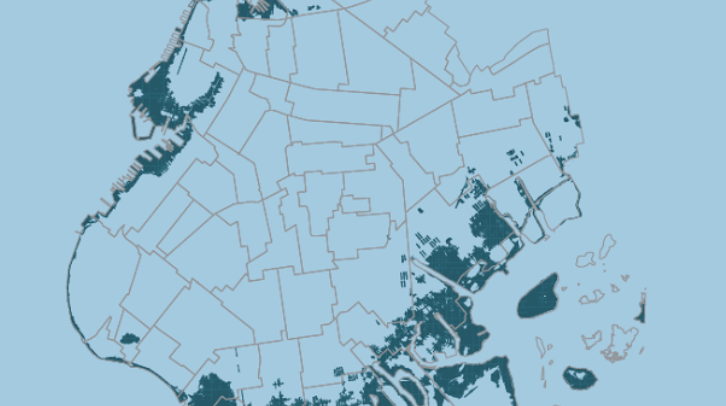
SOURCES AND FURTHER METHODOLOGY: All data and shapefiles are from NYC Open Data and nyc.gov. Percentages for land coverage were calculated using Overlap Analysis in QGIS.
Michael L Kelly is a Brooklyn-based designer, educator, and writer who does everything he can to make those roles overlap, ideally with civic engagement somewhere in the mix. He has worked with small non-profits and large companies around the world, and is Creative Director for a small mapmaking company, Good Foot Enterprises. mlkelly.com
The Amplification Project’s Digital Archive of Forced Migration
Art is an expression against disappearance. Over the past decade, as the number of people forced to flee has increased, so too has the number of artists narrating and bearing witness to forced migration and refugee experiences that would otherwise go unseen.1 The art of forced displacement might also be conceptualized as a collective narrative and record of witness. It renders visible and testifies to complex histories and contemporary phenomena, including the legacies of colonialism, nation-state operations, climate-related disasters, and geopolitical conflicts.
Formed in 2019, The Amplification Project: Digital Archive for Forced Migration, Contemporary Art, and Action is a crowdsourced community digital archive aiming to raise the visibility of art and cultural productions inspired, influenced, or affected by forced migration and refugeehood. Founded by an international group of artists, curators, activists, and an archivist with activist and interventionist aims,2 The Amplification Project provides artists and cultural producers worldwide a space and platform to preserve and disseminate their work, as well as a portal for anyone to engage with their creations (contingent on access to digital devices and internet connectivity).
The collection includes visual artworks, photo narratives, videos, and blogs by artists and cultural producers from across four regions — the Middle East (Bahrain, Lebanon, Palestine, Egypt), Europe (Ireland, Albania), Africa (Tunisia), and North America (United States) — that span from the late 1970s to 2023. Together, these materials chronicle diverse experiences of war and displacement, revolution, and institutional detention, as well as interconnected struggles against border regimes, authoritarian crackdowns, and asylum system failures.
This essay explores the origins, methodology, and significance of The Amplification Project. It examines how this participatory community archive challenges traditional archival practices, confronts the lack of representation and misrepresentation of refugees in archives and media spaces, and actively counters xenophobic narratives while fostering connections across boundaries and borders.
Qais Al-Sindy, The Exiled-1, 2015. Acrylic and oil on canvas, 108 x 84 in. Image courtesy of The Amplification Project and Qais Al-Sindy.
Lilli Muller, Mandala Project Venice: We Are Humanity, 2019. Venice Biennale, Venice, Italy. Photo courtesy of The Amplification Project and Lilli Muller.
Positioning Myself and the Archive
Before continuing, I would like to clarify my relationship to The Amplification Project and situate it within community archives practices and discourses. I engage with this work as one of its co-founders, current director, and archivist with experience documenting artists’ work. As a white North American woman without refugee experience — with backgrounds in archival studies, librarianship, and the performing arts — I acknowledge the privileges and limitations that frame my understanding. To address these limitations, I actively seek input from refugee advisors and project community members, routinely sharing my work before public presentation or publication to verify representational accuracy, uncover blind spots in my understanding, and challenge privilege-based assumptions. Moreover, recognizing that refugee experiences are neither monolithic nor static but diverse and evolving across time and space, I commit to continuous learning and critical self-reflection, particularly regarding power dynamics, ethical representation, and the nuanced complexities of documenting and sharing refugee narratives. Further, I view the work of The Amplification Project and my involvement not as “enabling agency” or “giving voice” to refugees. Instead, the focus is on addressing power imbalances, silences, and misrepresentations in archives, challenging the erasure of refugee experiences from social consciousness, and disrupting anti-refugee and xenophobic rhetoric through interventionist and cross-border participatory community archiving ethics and practice.
Community archives are grassroots efforts by communities to document and share their histories on their own terms. They are often run independently (and are a response to) mainstream or institutional archives. Community archives take many forms across cultural and geographical contexts and often develop around shared experiences, identities, or missions — such as locality, race, ethnicity, shared interest, gender, sexual identity, faith, or specific events. Despite their diversity, these archives share common characteristics: they often emerge from groups underrepresented or misrepresented, or whose histories have been suppressed or excluded by institutional archives. A defining feature of community archives is the active participation of community members in documenting, managing, and sharing their histories — challenging dominant historical and political narratives and addressing exclusions and distortions in mainstream archives. Additionally, as Andrew Flinn and others have noted, many community archives, including The Amplification Project, also function as activist projects with clear political objectives, aligning with broader social justice movements that are fighting against discrimination and injustice and reshaping collective memory. As archival scholars Ricardo L. Punzalan and Michelle Caswell argue, the creation of community archives can be seen as a form of “political protest” — an effort to take control over how history is written and to amend dominant narratives about the past.
Considering the fleeting nature of exhibitions and performances, how can archives provide lasting platforms for artists’ work on displacement?
Wael Darweish, A Sacred Stone, 2018. Image courtesy of The Amplification Project, Biba Sheikh, and Wael Darweish.
This work was created in response to poetic texts written by Habibah Sheikh, a nomadic performance artist originally from Lebanon, and the curator of the Mitli Mitlak exhibition. In the text, a character named Ruba experiences the destruction of war first hand and becomes a refugee in the process. The use of imagery of violence evokes the emotional and physical vulnerability of certain Mediterranean themes…such as being without asylum. This painting was made in the artist’s homeland of Cairo, Egypt.
Why This Archive? Why Now?
The Amplification Project emerged from shared concerns, questions, and aspirations among its co-founders. Central to its inception was our recognition of the inadequate representation — and frequent misrepresentation — of refugee experiences in archives and mainstream media. This gap, coupled with the alarming rise of xenophobia and anti-refugee rhetoric in political and social discourse, underscored an urgent need for action. This section outlines these phenomena and the questions they continue to evoke.
Stories about refugees are often told by others. Institutional archives, for instance, predominantly house records created about refugees rather than by them. These collections, as Dima Saber and Paula Long note, are filled with materials such as administrative files, policy documents, and NGO reports, which capture the perspectives of institutions, detailing the actions and decisions of officials and agencies with whom refugees interact, rather than refugee voices themselves. Moreover, such records frequently reduce complex human experiences and individuals to statistics and categories, failing to convey the daily realities of displacement. These patterns in institutional archives raised a critical question: How might archivists collaborate with refugee communities to create more inclusive and representative archives that authentically capture their experiences and perspectives?
As many have noted, mainstream media systematically shapes public perceptions of refugees, typically elevating political commentary and stories about refugees but not from refugees. (For these and other references, see this story on the perhaps website.) Besides rarely having a voice within news stories about them, news coverage often anonymizes refugees as faceless masses or uses dehumanizing language such as “waves” or “floods” — language that likens them to natural disasters rather than individuals or reduces them to suffering bodies, emphasizing victimhood rather than portraying the full spectrum of human identities. Even when aiming for empathy, the media often depersonalizes refugees, representing them as numbers and statistics instead of people with families, social ties, jobs, education, and aspirations. Reflecting on these media representations prompted the question: How might archivists and artists collaborate to document and amplify stories of displacement from the perspective of those displaced?
Over the past decade, there has been a disturbing rise in anti-refugee rhetoric from politicians in the US and Europe, amplified by media coverage. This trend coincided with US President Donald J. Trump’s first term and his administration’s implementation of harsh and cruel anti-immigration policies, including family separations and the caging of children at the US–Mexico border, and entry bans for asylum seekers from Muslim-majority countries. These moments in time were also framed by Trump’s inflammatory statements, such as expressing disdain for immigrants from “shithole countries,” questioning their need to be in the US.
The 2024 US election cycle saw Trump and other Republican candidates up and down the ballot persistently characterize migrants crossing the US–Mexico border as “animals” and as an “invasion.” Similar narratives have emerged in other countries, with far-right politicians, groups, and individuals leveraging social media to spread misinformation and conspiracy theories and incite violence against refugees. This online rhetoric has led to real-world attacks on refugees and migrants in Portugal, as well as protests, rioting, and arson attacks on properties housing and linked to asylum seekers in the UK. Encountering such portrayals and events across legacy and social media sparked the question: In an era of widespread anti-refugee sentiment and racist rhetoric, how can archivists leverage archives to challenge negative narratives, counter misinformation, and promote more accurate representation in media, public discourse, and collective memory?
Even art spaces aren’t immune to these issues, as demonstrated when someone defaced Banu Cennetoğlu’s The List at the 2018 Liverpool Biennial — a work commemorating those who, since 1993, have died seeking European refuge. These events and ongoing trends underscore the complex interplay between political discourse, media representation, public perception of refugees, and the shaping of collective memory. They also highlight the urgent need for more humanizing narratives in political, social, and artistic spheres.
Two intertwined objectives further guided the creation of this participatory community archive. First, we sought to document, preserve, and amplify global artistic practices that tell stories about forced displacement or bear witness to its realities. By connecting these diverse voices in one space, we aimed to foster a richer understanding of refugee experiences worldwide. Second, we envisioned a dedicated platform where refugee artists — and their allies — could freely preserve and share their work, ensuring their stories are told on their own terms. The co-founders asked (and continue to ask): What archival practices, systems, and technologies can we employ to raise awareness about refugee experiences? Considering the fleeting nature of exhibitions and performances, how can archives provide lasting platforms for artists’ work on displacement? Moreover, given that many artists and their audiences lack or desire access to mainstream art spaces, how can archives serve as enduring platforms for artists’ work and connect people with it?
In response to these challenges and questions, the Amplification Project co-founders developed a participatory archival methodology that prioritizes contributor agency, grassroots engagement, and transborder connections. Through this approach, we seek to directly address the representational issues and xenophobia identified above while leveraging digital technologies to create new possibilities for collaboration as well as relationship and solidarity building across borders.
Sinan Hussein, Just A Concert, 2018 (top), Rabab and Goats, 2018 (bottom). Images courtesy of The Amplification Project, Biba Sheikh, and Sinan Hussein.
Ahmed Nagy’s series, Daily Images of Chaotic Events, was created in response to poetic theatre texts written by Habibah Sheikh, a nomadic performance artist originally from Lebanon, and the curator of the Mitli Mitlak exhibition. In the text, a character named Ruba experiences the destruction of war firsthand and becomes a refugee in the process.
The series is based on pictures Nagy took with a cell phone, in the street during the Egyptian revolution. Daily Images of Chaotic Events is a cell phone capturing the Egyptian revolution. “I utilize what was happening in Egypt, and apply it as a formula to make artworks. In Egypt, what happened was fighting in the street. Through my artwork, I don’t have political say. The art itself is a great political action. When I am inspired by the streets I create something new,” says Nagy.
From left:Daily Images of Chaotic Events 4, 2011; Daily Images of Chaotic Events 6, 2011; Daily Images of Chaotic Events 8, 2011. Images courtesy of The Amplification Project, Biba Sheikh, and Ahmed Nagy.
A Participatory Archival Space
The Amplification Project harnesses digital technology to create a participatory archival space that facilitates crowd-sourced collecting and description, agency, and broad engagement across diverse communities and geographical locations. This approach disrupts traditional power relations in archives and archival practices, blurring the lines between all engaged with the archive’s materials: contributors, users, and archivists.
The archive’s multi-community, cross-border, two-pronged collection development approach also unsettles conventional hierarchies in archives. First, anyone can contribute work narrating or contemplating displacement experiences and refugeehood to The Amplification Project by uploading text, images, audio, and video through our website. Contributors retain full rights to their submissions, have complete authority over describing and contextualizing them, and can assign tags to their works, enhancing discoverability and thematic organization within the archive. We preserve contributors’ voices, understandings, and perspectives by not altering their submissions in any way. Contributors include The Amplification Project’s co-founders, who not only share content from their own collections but also invest their expertise, time, and effort to nurture the archive’s growth and use.
Second, we also take a grassroots, dialogue-driven approach to growing the archive. We engage in one-on-one conversations with artists and cultural producers within our networks to gauge interest in contributing, remaining attuned to their unique archiving needs and perspectives. These personal interactions often lead to further connections, conversations, and contributions, creating a network effect that organically expands the project’s reach. After receiving contributions, we welcome new contributors and gather their insights on how the archive can best serve their needs, striving to build ongoing relationships. This approach has led to meaningful collaborations and friendships, such as our multi-year conversation with multidisciplinary artist and community activist Lilli Muller, who has contributed numerous artworks to The Amplification Project.
Through this dual approach to collection development — personal outreach and independent submissions — we aim to foster community and ensure contributors feel valued and know they have a voice in shaping the archive’s development. Our collection development practice is also rooted in reciprocity. When someone contributes their work, we commit to preserving and amplifying their content through featured sections on our webpage, such as “most recently added,” “most viewed,” and “surprise me,” as well as through general browse and search options. In early 2024, we extended our amplification efforts through an engaged Instagram presence and a monthly newsletter showcasing archived work and featuring interviews with contributing artists, allowing for a deeper exploration of their works and experiences. We also invite newsletter subscribers to share their news and upcoming exhibitions and performances.
The Amplification Project contains significant collections exemplifying its participatory ethos and boundary- and border-crossing approach. For instance, we hold photographs from Vukašin Nedeljković’s Asylum Archive project, an over decade-long documentation of Ireland’s Direct Provision Centers (2008–19) — the controversial institutional housing system for asylum seekers as well as Ahmed Nagy’s visual chronicles of Egyptian revolutionary turmoil (2011–18), and transnational exhibitions like Mitli Mitlak (Like You, Like Me) (2018–24), which bridges Middle Eastern and European narratives of displacement.
As the above approaches and collections demonstrate, The Amplification Project operationalizes a participatory archival practice through multiple, interconnected strategies. By preserving contributor authority over their materials, engaging in dialogic relationships with artists and cultural producers, maintaining grassroots outreach alongside open submission processes, and committing to reciprocal amplification of contributed works, we create an archival space that challenges traditional archival practices. Our approach recognizes that archives are not neutral repositories but active sites where power relations are negotiated, and community connections and solidarities can be fostered through intentional inclusion, dialogue, and exchange.
Moving Forward
In his recent book on how art uniquely tells migration stories in ways the media cannot, journalist Ismail Einashe argues that “we need to use art to look and think again,” drawing attention to overlooked, disregarded, or disparaged refugee experiences in the media and other online spaces. Participatory community archives function as strategies of visibility and audibility, agency and representation, exchange and interaction. They can also serve as strategic interventions — interruptive tools that disturb and reframe public discussions, social realities and connections, and power relations.
As we move forward with The Amplification Project, we continue to grapple with complex questions of representation, ethics, community building, and the role of archives in shaping perceptions of forced migration. Rooted in collective archiving practices, our project actively participates in making visible the multifaceted experiences of refugees worldwide, inviting us all to look and think again. The project extends beyond preserving and sharing displacement-related art and cultural productions — it builds connections, counters xenophobic and anti-refugee rhetoric, and contributes to more complex and humanizing narratives about forced migration experiences. While social media and other digital platforms often amplify xenophobic and racist voices, The Amplification Project harnesses these same technologies to create counter-narratives while fostering connections where people, art, archives, and activism converge. The archive and each work in it represent acts of resilience and remembrance. Through this project, we hope to foster ongoing dialogue about displacement and explore how archives can enable community building to support refugees and serve as sites of resistance, solidarity, and transformation in the face of global displacements.
Vukašin Nedeljković, The Old Convent Direct Provision Centre, 2007. Ballyhaunis, Ireland. Photo courtesy of The Amplification Project and Vukašin Nedeljković.
Kathy Carbone is an assistant professor at Pratt Institute’s School of Information and co-founder/director of The Amplification Project: Digital Archive for Forced Migration, Contemporary Art, and Action. Her research interweaves critical archival studies and collective digital memory through collaborative preservation of contemporary artworks. She explores archives and archival practices as tools and methods for expressive resistance, fostering solidarity, and community building. Her publications appear in Archivaria, Archives and Records, the Journal of Critical Library and Information Studies, TheInternational Journal of Human Rights, Curator: The Museum Journal, Archival Science, and the Journal of Documentation.theamplificationproject.org
Acknowledgments: Many thanks to Jamie Lee for their support and to James Lowry for his helpful feedback and invaluable suggestions on an earlier draft of this essay. I am also grateful to the editors of perhaps for inviting me to revise this essay, which draws on an academic article currently under preparation. Their encouragement has enabled me to present this material to a broader audience.
Notes: 1. I use the term “refugee” to refer to the various status categories (e.g., asylum seeker, asylee, internally displaced person, refugee) that individuals experiencing displacement may belong to. I acknowledge the legal and experiential distinctions among these groups but use this terminology for brevity. For legal definitions, see: “Key Migration Terms,” International Organization for Migration, 2024, and United Nations High Commissioner for Refugees, “What Is a Refugee?,” UNHCR.
2. The founders include author, performer, director, and curator Biba Sheikh; artist, activist, and independent scholar Vukašin Nedeljković; curator Elizabeth (Lisa) Shoshany Anderson; artist Pinar Öğrenci; and, the author.
Bibliography: Archive of Destruction. “Invaders Not Refugees: Banu Cennetoğlu + UNITED for Intercultural Action The List Liverpool, UK 2018.” Accessed December 1, 2024. https://archiveofdestruction.com/artwork/the-list/.
Azevedo, Ruben T., Sophie De Beukelaer, Isla L. Jones, Lou Safra, and Manos Tsakiris. “When the Lens Is Too Wide: The Political Consequences of the Visual Dehumanization of Refugees.” Humanities and Social Sciences Communications 8, no. 1 (2021): 1–16. https://doi.org/10.1057/s41599-021-00786-x.
Boland, Lauren, Muiris O’Cearbhaill, Jane Moore, and Emma Hickey. “How Arson Attacks on Properties Linked to Asylum Seekers Have Escalated over the Last Six Years.” The Journal, July 16, 2024. https://www.thejournal.ie/arson-attacks-fire-asylum-seeker-accommodation-6252984-Jul2024/.
Cortellessa, Eric. “Read the Full Transcripts of Donald Trump’s Interviews With TIME.” TIME, April 30, 2024. https://time.com/6972022/donald-trump-transcript-2024-election/.
De Coninck, David, Christine Ogan, Christine, Lars Willnat, and Leen d’Haenens “Media Use and Attitudes Toward Immigrants and Refugees in Western Europe and the United States.” Paper presented at ECREA Digital Fortress Europe Conference, Brussels, Belgium (2019): 1-41.
Emery, Tom. “Why Liverpool’s Twice-Vandalized Memorial to Dead Migrants Stands as a Monument to Shame.” Frieze, August 21, 2018. https://www.frieze.com/article/why-liverpools-twice-vandalized-memorial-dead-migrants-stands-monument-shame.
Flinn, Andrew. “Archival Activism: Independent and Community-Led Archives, Radical Public History and the Heritage Professions.” InterActions: UCLA Journal of Education and Information Studies 7, no. 2 (2011). http://escholarship.org/uc/item/9pt2490x.
Flinn, Andrew and Mary Stevens.“‘It Is Noh Mistri, Wi Mekin Histri.’ Telling Our Own Story: Independent and Community Archives in the UK, Challenging and Subverting the Mainstream.” In Community Archives: The Shaping of Memory, edited by Bastian, Jeannette A. and Alexander, Ben, 3–27. London: Facet Publishing, 2009.
Fotopoulos, Stergios, and Margarita Kaimaklioti. “Media Discourse on the Refugee Crisis: On What Have the Greek, German and British Press Focused?” European View 15, no. 2 (2016): 265–79. https://doi.org/10.1007/s12290-016-0407-5.
Fritze, John. “Trump Used Words like ‘invasion’ and ‘Killer’ to Discuss Immigrants at Rallies 500 Times: USA TODAY Analysis.” USA TODAY. Accessed May 10, 2024. https://www.usatoday.com/story/news/politics/elections/2019/08/08/trump-immigrants-rhetoric-criticized-el-paso-dayton-shootings/1936742001/.
Fuller, Janet M. “Media Discourses of Migration: A Focus on Europe.” Language and Linguistics Compass 18, no. 4 (2024): e12526. https://doi.org/10.1111/lnc3.12526.
Gabrielatos, Costas, and Paul Baker. “Fleeing, Sneaking, Flooding: A Corpus Analysis of Discursive Constructions of Refugees and Asylum Seekers in the UK Press, 1996-2005.” Journal of English Linguistics 36, no. 1 (2008): 5–38. https://doi.org/10.1177/0075424207311247.
Gökarıksel, Banu. “The Body Politics of Trump’s ‘Muslim Ban.’” Journal of Middle East Women’s Studies 13, no. 3 (2017): 469–71. https://doi.org/10.1215/15525864-4179133.
Huynh, Anjali, and Michael Gold. “Trump Says Some Migrants Are ‘Not People’ and Predicts a ‘Blood Bath’ If He Loses.” The New York Times, March 17, 2024, sec. U.S. https://www.nytimes.com/2024/03/16/us/politics/trump-speech-ohio.html.
Ibreck, Rachel, Peter Rees, and Martina Tazzioli. “Counter-Archiving Migration: Tracing the Records of Protests against UNHCR.” International Political Sociology 18, no. 4 (2024): 1-20.
Kirka, Danica. “What’s behind the Anti-Immigrant Violence That Has Exploded across Britain? Here’s a Look.” AP News, August 5, 2024. https://apnews.com/article/britain-riots-unrest-social-media- misinformation-attack-5824d3136675e10d6a25c9e17287c994.
Kox, Mieke, Ilse Van Liempt, and Anna Smits. “Shaping a Climate of Arrival: National and Local Media Representations of Refugees’ Arrival Infrastructures in the Netherlands.” Journal of Refugee Studies 36, no. 1 (2022): 46–64.
Krawczyk, Dawid. “First to Feel Offended, First to Offend: Two Decades of Poland’s Culture Wars.” In Lost in Media: Migrant Perspectives and the Public Sphere, edited by Einashe, Ismail and Roueché, Thomas, 85–100. Amsterdam: Valiz, 2019.
Licona, Adela C., and Eithne Luibhéid. “The Regime of Destruction: Separating Families and Caging Children.” Feminist Formations 30, no. 3 (2018): 45–62. https://doi.org/10.1353/ff.2018.0037. Martikainen, Jari, and Inari Sakki. “Visual (de)Humanization: Construction of Otherness in Newspaper Photographs of the Refugee Crisis.” Ethnic and Racial Studies 44, no. 16 ( 2021): 236–66. https://doi.org/10.1080/01419870.2021.1965178.
Myers, Steven Lee, Adam Satariano, Leo Dominguez, and Rumsey Taylor. “How Online Hatred Toward Migrants Spurs Real-World Violence.” The New York Times, August 10, 2024, sec. Technology. https://www.nytimes.com/interactive/2024/08/09/technology/migrants-racism-social-media-violence.html.
Punzalan, Ricardo, L. and Caswell, Michelle. “Critical Directions for Archival Approaches to Social Justice.” Library Quarterly: Information, Community, Policy 86, no. 1 (2016): 25–42.
Saber, Dima and Paul Long. “Refugee Writing, Refugee History: Locating the Refugee Archive in the Making of a History of the Syrian War.” In Refugee Imaginaries: Research Across the Humanities, edited by Cox, Emma, Durrant, Sam, Farrier, David, Stonebridge, Lyndsey, and Woolley, Agnes, 444–62. Edinburgh: Edinburgh University Press, 2020.
Woodhouse, Leighton Akio. “Trump’s ‘Shithole Countries’ Remark Is at the Center of a Lawsuit to Reinstate Protections for Immigrants.” The Intercept, June 28, 2018. https://theintercept.com/2018/06/28/trump-tps-shithole-countries-lawsuit/.
Many people are familiar with their Sun sign, the zodiac constellation in which the Sun was located at the time of their birth. This is said to represent their essence or core traits. Many people also know their Moon sign, which is said to reflect inner feelings and instinctive drives. These two interplay, along with the signs of the planets and asteroids, to make up a person’s birth chart, or natal chart, which marks possibly the most important moment in their existence: the beginning.
The celestial bodies are always moving and interacting, changing their influence as they go. I imagine this progression as threads tied to each planet, winding around and intertwining over time, like the Moirai (Three Sisters) spinning, measuring, and cutting the lines of fate — or is it destiny, that which can still be changed? In any case, each strand plays its part, including the Moon.
Humans have long been fascinated with the Moon, our closest celestial neighbor, perhaps formed by a collision between the Earth and the ancient planet Theia billions of years ago. The favored hypothesis is that Theia, named after the mother of the Greek Moon-goddess Selene, impacted the Earth, sending parts of both out into space. A debris ring formed, eventually coalescing into the Moon. A 2022 NASA simulation shows Theia as a golden orb about the size of Mars crashing into a larger orb, the Earth. Their molten bodies act as liquid, glomming and globbing, together and apart. Bits of both swirl all around. The large orb recomposes itself quickly, while two smaller ones form farther out in space. At first, there’s a thin line of plasma tying all three of them together. Then, the orb closest to the Earth suddenly returns to it — perhaps some of the Earth’s iron core? — the tether breaks, and the remaining, smallest orb becomes the Moon in a stable orbit around the Earth.
A 2022 NASA and Durham University simulation of the formation of the Moon.
It all could have happened another way — some planets capture their moons — but if it happened this way, then the Earth was really never alone. The Moon has always been with us.
Throughout history, some peoples have oriented their calendar around lunar cycles, or worshipped the Moon in preference to the Sun, given the Moon’s apparently larger size. Across many cultures, the Moon is associated with deities, femininity (like Mother Earth), the length of menstrual cycles, dreams, poetry, and love — la bella luna, arguably a major character in Moonstruck that animates the unexpected romance between different characters.
Sketch of a film poster by Georges Méliès for his Le voyage dans la lune (1902).
The Moon was featured in one of the first silent films, A Trip to the Moon (Le voyage dans la lune) (1902), inspired by Jules Verne’s From the Earth to the Moon(1865) and its sequel Around the Moon (1870). The film depicts a group of astronomers who are shot to the Moon in a giant bullet, which crashes into its eye. While seeking refuge below the surface, they encounter the Selenites, are taken captive, and eventually escape back to Earth. The film was a huge success and widely pirated in its day. It was also recreated in the music video for “Tonight, Tonight” by the Smashing Pumpkins, with the addition of Neptune treating the astronomers to an underwater concert.
A different voyage is offered in Laurie Anderson and Hsin-Chien Huang’s To the Moon, a VR installation that launches participants to an interactive lunar surface, which I was fortunate to see in January 2020. The terrain is irregular, littered with craters large and small, and the pitch blackness of space is never far away. Light, whether from swirls of stars in the distance or from the piercing rays of the Sun, haunts the landscape. I mostly spent my time there wandering, finding peace in the quiet and open space. I also remember feeling mildly terrified, as if I were at once completely alone and also being watched, just over my shoulder. Maybe it was the Selenites.
The Moon in tarot can be illuminating — without electricity, travel by night is facilitated by moonlight. It can also be a sign of danger, the unconscious, or hidden forces working against someone — the Moon has its far side, roughly half of its surface that is never seen by the naked eye from our vantage point on Earth. Moon cards, from the fifteenth century through Pamela Coleman Smith’s well-known illustration, depict a dog and a wolf howling up at the Moon, as if to announce a warning, while a lobster emerges from water, bringing new knowledge to the surface.
Animals, too, are influenced by the Moon. Scorpions glow blue-green in the UV rays of moonlight, perhaps to warn predators or to aid their vision using the color they see best. Lions prefer to hunt on the darkest nights when their prey is more vulnerable. And, of course, there is the figure of the werewolf, a reflection of our own animalistic nature set free by the full moon.
Moon cards throughout history (left to right): Cary Sheet, Milan, c. 1499; Tarot of Marseilles, 1701–15; Rider–Waite Deck, illustrated by Pamela Coleman Smith, 1909.
Whatever its role, the Moon is relational. Its gravitational pull affects Earth’s tides. We see the Man in the Moon, a human face looking back at us. The Moon’s light is, after all, a reflection of the Sun. In fact, I’ve often observed that people with a particular Moon sign naturally align with someone of the same Sun sign, as if the Sun sign person just understands them and their innermost thoughts and motivations without much need for explanation.
Yet for all its power, the Moon is sometimes void, entering periods much like a retrograde planet or an eclipse, where its effects are inverted, malefic, or simply diminished.
As a celestial body like the Moon moves through a zodiac sign, there are moments where it forms aspects, or angles, with other celestial bodies, which themselves transit through different signs over time. These aspects can be mutually supporting or detrimental depending on the degree of the angle, the signs, or even the celestial bodies involved. For example, Great Conjunctions, which involve Jupiter and Saturn in close proximity, were regarded as omens — for good or ill — in ancient Arabic and medieval European astrology. The Great Conjunction of 1484 in Scorpio heralded the arrival of a “little prophet,” who was later taken to be Martin Luther, while the Great Conjunction of 1542 in Pisces was predicted to bring about a great transformation. This prophecy was dramatized as a great flood in the years leading up to the conjunction, spread through Europe with the help of new pamphlet printing technology of the time. Peoples readied themselves for a disaster that never came — though a peasant revolt did. Great Conjunctions happen only once every 20 years, due to the large orbits of the outer planets. Less dramatic conjunctions and other aspects give texture to the days, weeks, months, and years that a celestial body transits a sign.
There also comes a point in this transit where a celestial body will not form any more aspects while in that sign, and for that time, it is “void of course.” This is not unique to the Moon, but the Moon moves through all twelve zodiac signs rather quickly, in just 28 days, spending just over two days in each sign. The Moon’s small orbit creates more frequent opportunities for it to be void of course, a period that can last anywhere from a few seconds to several days.
Until recently, void moons were widely followed and discussed. In her essay on their history, J. Lee Lehman writes that “voids, like Mercury retrograde, the two bugaboos of modern astrology, both have the advantage of being easy to define and track, thereby making available these techniques even to non-astrologers, given a little bit of training in reading the tables.” Mercury retrograde is still discussed openly today, perhaps even more than in previous decades. But void moons are rarely mentioned anymore.
What does it mean that the Moon—so close to us in so many ways—regularly and perhaps even frequently is void?
Major aspects and their meanings
☌ Conjunction 0˚ — a focal point, the blend of the energies of two or more planets
⚹ Sextile 60˚ — harmony, a collaboration of energies in a subtle manner
□ Square 90˚ —challenge, a conflict of energies that can be restrictive if forced or productive if resolve
▵ Trine 120˚ — fortune, a flow of energies that bring good luck and opportunities; if taken for granted, may lead to idleness
☍ Opposition 180˚ — duality, a tension between energies that require balance
Al H. Morrison popularized the notion of void moons in the 1960s, along with the view that presidential candidates nominated under a void moon lose the election. As it turns out, Nancy Reagan regularly consulted astrologer Joan Quigley about the timing of the president’s schedule, and Ronald Reagan used void moons to hold press conferences on hard or controversial topics. The next day, the issue seemed to be forgotten.
Morrison cautions against “decisions” during this time — really, the start of anything new — recognizing that everyday activities carry on through the void. Contemporary astrologers still warn against making purchases, signing contracts, getting married, having a first date, or starting a new project during a void moon. Outcomes seem unpredictable in the void, as if luck is suspended. But some moons may be more fortunate than others. Medieval astrologer Guido Bonatti exempted moons transiting Cancer, Taurus, Sagittarius, and Pisces from these effects. Cancer is ruled by the Moon, which is said to be exalted in Taurus — it performs best there, as if realizing its full power. Sagittarius and Pisces are ruled by Jupiter, whose luck seems to be incorruptible, even by a void moon. Bonatti also thought that the Moon is void until it comes into aspect with something, not just when it enters the next sign. That would make void moons last longer, perhaps mitigated by the Moon switching into an exempted sign.
Hellenistic astrologers held the most restrictive views on void moons. With the zodiac wheel divided into 12 signs (30˚ in each sign), they thought a void occurs only when the Moon transits at least 30˚ (about 55 hours) without aspecting any planet, regardless of whether the Moon enters a new sign during that time. On this account, void moons happen less frequently, about as often as Mercury retrogrades. March 2025 had three void moons on this definition; sometimes, entire years have only one.
An intermediate number was given by seventeenth-century astrologer William Lilly, whose ideas have animated much of contemporary astrology. Each celestial body has a perimeter of influence, or “orb.” A square aspect is theoretically a 90˚ angle between two celestial bodies as seen from Earth. Accounting for the perimeters of these bodies, an actual square between them might be anywhere from 85˚ to 95˚, an orb of 5˚ in either direction. Most astrologers today use an orb of 6˚ for major aspects, though smaller orbs are associated with more significant events. Lilly’s orb was 10˚, making his aspects longer and void moons rarer, though not as rare as in the ancient definition.
However often we imagine a void moon to occur, it suggests a time when the celestial body has done its work in a sign (or not yet started). It’s a time for rest and reflection, like when the molten bits in the NASA simulation settle down after impacting one another. They begin to take shape, as if starting to understand themselves as separate entities for the first time, yet still held in a cosmic dance, hurtling through space in relation to one another.
As above, so below. Can we, too, be set free by a void moon? If the Moon speaks to our inner drives and darker forces, are we freed from those during a void moon — or perhaps free to explore them? Can we see this time as a necessary pause before or after taking action?
Even if void moons are frequent, they’re still quite brief. The moon may have just seconds before it starts forming new aspects with other planets. That’s a short breath, and rare enough to feel momentous.
Chris Alen Sula is a teacher and scholar living in Brooklyn. He is interested in technology, the occult, and cultural studies, and has been published in various journals and edited volumes.
This type specimen was inspired by children’s memory games as a way to highlight some of the words that the current US administration has banned from use. You can find many of these words throughout our first issue.
perhaps used ABC ETCtypefaces for this collection. Type specimens, which explore the possibilities of letterforms, remind us of the building blocks of language. By reclaiming these words, we make visible what persists.