
Category: Issues

  • Reading the Earth: On Multiplicities of Time

    Reading the Earth

    On Multiplicities of Time

    Essay by nancy Smith


    Early clocks were as simple as a stick in the ground. The movement of the shadows captured by a stick (or what would later become a sundial) creates a visible progression of the day. Light and shadows come together to form a particular kind of meaning. Atomic clocks capture the invisible vibrations of atoms as we move through the universe. Both are precise in their own way, though precision offers a limited conception of what time could be. Whether visible or not, we are always moving, and time is a reminder of our constant orbit. 

    A heartbeat is our most personal measure of time, and the one that dictates how much time we have in this world. Heartbeats, like fingerprints, are unique and contain rhythms that are specific to the body they inhabit. Hearts, like our sense of time, speed and slow in relation to our surroundings, respond to emotions, and react to our embodied movements. 

    Time, most of all, imposes order on what can seem like an otherwise random, chaotic world. This is not to say that time is the same for everyone. Time for the farmer is not the same as time for the astronomer. Time for the poet is not the same as time for the physicist.

    A clock is not time itself; it is a representation. Like other models we create to visualize data, clocks have simply gathered up information on how the world moves and put it into a form that adheres to our, now commonly used, 24-hour day.

    Visual theorist Johanna Drucker writes, “The visual order of the calendar seems like the very structure of time itself, so naturalized has it become through graphic conventions. Like lines on a map demarcating one state or nation from another, the division of one day from another is powerfully structured by graphic conventions. These diagrammatic schemes are performative. They make the world by structuring our experience of it.” We are so used to looking at clocks, calendars, trackers, and other time-keeping devices that it makes time feel like the world itself, rather than an interpretation of it. 

    She further writes, “Diagrammatic images spatialize relations in a meaningful way. They make spatial relations meaningful. And they do so according to conventions about how we translate observation, sensation, perception of phenomena in knowable forms.” Those conventions are deeply tied to Western science, capitalism, and colonial structures that have dominated the way timekeeping devices are designed and utilized. This has only increased as data visualization has influenced the way we understand the world.


    One of the problems with trying to impose our own order on the world is that our understanding of the world is limited. Consider the abrupt switch from the Julian to the Gregorian calendar. The Julian calendar, named for Julius Caesar, was used for many centuries; however, it was slightly misaligned with the solar year, and over time began to drift away from the seasons. In 1582, Pope Gregory XIII introduced the Gregorian calendar as a way to rectify the issues with the Julian calendar. Over time, countries around the world adopted this calendar, but it wasn’t until 1752 that the British Empire switched to the Gregorian calendar. In order to align with the new calendar, a discrepancy needed to be resolved, so they simply dropped eleven days. Thus, September 2, 1752 was followed the next day by September 14. 

    There is an arbitrariness to time, or perhaps not time itself, but to our various methods of capturing and representing it. 

    Many systems of counting, including the Western system, are based on powers of ten. The Ancient Mayans, however, used a base-20 system, which also informed their calendar design. They used an eighteen-month solar calendar with twenty days per month. The twenty named days are all associated with a different deity who governed each day. This created a 360-day year. Those extra five days are deemed a special time called Wayeb. This scared “time out of time” has traditionally been used as a healing and cleansing period, a time to let go of the past and reconnect spiritually to the world. The Ancient Egyptians also had five extra days for festivities, though their calendar was twelve months and thirty days.

    We are always making adjustments for these holes in time because missing seconds eventually turn into missing days. 

    The movements of the universe both create and conflict with our clocks and calendars. The leap year is a response to how we move through space. The rhythms of our ever-expanding solar system don’t align neatly with our various numerical groupings, whether in ten or twenty, twelve or twenty-four. Many cultures have historically missed the leap year, which is why so many ancient calendars drift away from the seasons. By the Western calendar, we fall about one day short every four years. There are more precise ways of measuring this. If you add one day every four years, skipping the thirty-third year, we get closer to capturing this missing time. After the Gregorian reform, the formula for calculating leap days became 97 leap days in 400 years. 

    To put that another way: each day is six hundred millionths of a second longer than the previous day. Which is to say, this is the longest day of your life. 


    We all have a sense of embodied time and biological clocks that shape our need for things like sleep, food, and water. Our circadian rhythms pull us through the day and night, pushing us in and out of sleep, though these too have been affected not only by clocks but by urbanism and electricity, which light up our days (and nights) in ways that defy the sun and moon. For millennia, people slept in two shifts, waking in the middle of the night, often for hours at a time. This phenomenon of “two sleeps” is widely documented across cultures throughout the Middle Ages and earlier. According to historian Roger Ekirch, there are numerous possible reasons for this biphasic sleep. People often slept together in the same bed; multigenerational families, and even traveling strangers, might be cuddled up for the night, which required a delicate balance of sharing the bed and not moving too much. This was easier to adhere to if you only slept for a few hours, then woke, and returned to bed later, rather than trying to stay still for a full night. It has also been suggested that it was simply additional time to get things done, as many folks returned to work during this time, taking care of household chores that hadn’t been finished during the day. This window of time between sleeps was commonly used for socializing, sex, and prayer. It wasn’t until the early nineteenth century that one sleep became common, perhaps not surprisingly due to the Industrial Revolution, and an increased reliance on clocks to orient with production schedules. Alarm clocks were invented in 1787 (incidentally, invented by a clock salesman who needed to get up early to sell clocks) and have forever been used to disrupt our natural wake times. Without clocks, without capitalism, one wonders if we might slip back into the rhythm of two sleeps. 

    Phenology is the study of when things happen in nature: when trees bloom, when birds migrate, when seasons end. The Phenology Clock, a project led by artist Natalie Jeremijenko includes a series of timekeeping objects that capture seasonal time. These clocks, which were designed in both physical and digital form, collected place-based observational data contributed by thousands of people to highlight the shift in natural phenomena over a decade. Designed with a circular shape — the form of most contemporary clocks and watches — and stripes of different colors to represent different seasonal activities, the clock wasn’t exactly a time-keeping device, but more of a record of natural data. To see the subtle shifts in time — when roses bloom, when oak trees drop their leaves — shows a world that is warming, a world whose rhythms are changing because of the climate crisis.   

    Bears in Colorado, for example, are starting to emerge from hibernation too early. It’s warm enough for them to wake up, but there isn’t enough food, so they have to venture further down the mountain, which leads to more human–bear conflicts. Depending on the region, bears can hibernate for two or three months, or up to seven months in the coldest areas. They aren’t necessarily asleep for all of this time, but they go into a state of torpor where they don’t eat or drink. Instead, their body temperature drops, and they live off their fat stores. 

    Cats sleep for about eighteen hours a day. Giraffes sleep for only about five hours a day, though they can go weeks without actually sleeping, only standing or lying down for short stretches of time for a nap. Dolphins sleep unihemispherically, which means half of their brain is awake and on the lookout, while the other half is asleep, and like us, they typically snooze for about eight hours a day. Sea otters sleep for about half a day, and often link hands during sleep, or ingeniously use seaweed to tie themselves to a friend so as not to float away. 

    Bees keep a 24-hour biological clock. In 1929, Ingebord Beling, a German ethologist, trained bees to come to a feeding station, adding sugar water at specific times. The bees quickly learned the schedule and adapted when she changed it. They were even able to anticipate the timing of the sugar water, often showing up slightly before it was feeding time. Based on her research, she coined the term time-memory, which is something many animals, including humans, possess. 

    In the 1950’s Max Renner conducted another experiment to test bees’ time-memory. He trained bees in Paris to find sugar water in a dish at 8:15pm. After the bees had learned this routine, he took them one evening after feeding, and carefully shuttled them on a plane to New York City, where he replicated the space and set out a dish of sugar water to see when they would appear. Despite the five-hour difference between cities, the bees emerged in search of food exactly twenty-four hours later, at 3:15pm Eastern time. 

    It makes sense that bees would have a highly attuned sense of time since they eat from plants that open and close in relation to daylight. What’s more, bees use the sun as a navigation device and are able to provide precise directions to other bees about the distance and location of nectar, which requires a deep connection to time.   


    Even before the Industrial Revolution, there were many clocks that helped us to tell time in the dark; to capture the time beyond light, clocks that use water, flame, scent, or sand were designed so that we could tell time on a cloudy day or at night.  

    The fenjaan clock is a Persian water clock that relies on a small metal bowl with a tiny hole in it, which floats on the top of a container of water and then slowly fills until it drops to the bottom. Like an hourglass where material flows, this kind of design has been used by the Babylonians, Ancient Egyptians, and some Native American peoples. In Ancient Persia, the fenjaan was used to regulate water for farmers, ensuring that each farm received an equal amount of water. 

    Incense clocks, historically used in China and throughout East Asia, can work in various ways. Incense burns at a consistent rate, so simply watching the stick burn down works as a timer. Sometimes these clocks were attached to a gong or another mechanism for creating a sound at regular intervals. Perhaps more interestingly, some incense clocks are based on smell itself. A series of different incense sticks can be aligned to burn in a specific order, and the smell changes depending on the specific time of day. According to this clock, we might have lunch at the rose hour and dinner at the lavender hour.

    Smell is also one of the ways dogs tell time. They can smell how long you have been gone as your scent wanes throughout the day. This is why, if you keep a regular schedule, they have a sense of when you will come home.

    One of the most longstanding, Earthly timekeeping devices is the Newgrange monument in Ireland’s Boyne Valley. Newgrange was built by a farming community that inhabited the lush region over 5,000 years ago, making it even older than the pyramids at Giza. It is a large, round mound (279 ft. wide and 43 ft. high) atop a hill, with a long (62 ft.) passageway that leads to the interior, which is thought to have served as a tomb or temple. What makes Newgrange special is that the passageway is perfectly aligned toward the sun, allowing light to enter only at certain times. Only once per year, precisely on the morning of the winter solstice, sunlight hits the back wall of the tomb. During the days around the solstice, light creeps into this space gradually, until it hits the back wall every year, once per year.

    Unlike many other societies of the time, the builders at Newgrange were apparently aware of the problems of drift and accounted for the leap year. There are 97 keystones around Newgrange, which correspond to the most accurate accounting of 97 leap days that occur over 4oo years.  

    Newgrange, like the phenology clock, feels deeply connected to seasonal time. Because it was created and used by a farming community, a connection to, and reverence for, the land can be felt in the design of this monument. It feels almost oppositional to the current moment, where there is an obsession with “precise” time, inherited from the Industrial Revolution, as it relates to efficiency and productivity. Time cards, factory manufacturing, and more recently, cell phones (which double as clocks), activity trackers, and so-called smart watches alert us with constant notifications, keeping track of our every move. We are expected to be always attuned to every moment, but do these devices actually attune us to anything in the world, or simply to the devices themselves and the way they structure our time?

    Digital clocks have become a dominant form because of their practical use value and the prevalence of digital technologies, but they are not beautiful in the way a watch face can be. (Though it is possible to set your phone to a clock face.) Digital clocks capture only a very specific moment in time. They do not give you a sense of time. On a watch face with hands, you can see the whole span of the day as you check the time. There is a sense that time is moving because the hands are circulating around in their little orbit. To watch it click ahead is a reminder of the physicality of time, which includes the bodies we live in, which are beholden to this ticking away. This, too, feels evident in a sundial, a water clock, or an incense clock, where the movement of time becomes something physical to observe.   

    Atomic clocks are considered to be precise because they don’t drift in the way mechanisms, such as a pendulum or a quartz crystal, do. Over time, most mechanical clocks will become slightly fast or slow, needing adjustment over the years. Atoms, though, cannot drift because they are moving with the universe. Each kind of atom absorbs and emits light at specific frequencies. Tuning into these atomic frequencies — typically these clocks use cesium — tunes us into the most constant, stable beat in the universe. It is often said that atomic clocks are billions of times more accurate than any other clocks that exist. Numerous systems rely on them for accuracy, such as GPS, data networks, financial markets, power grids, and communications systems.  

    Somehow, the precision of Newgrange is all the more impressive when considering it was created without the use of digital technology, machines, telescopes, or other tools we have today. In fact, the atomic clock, which was created in 1949, was only about as accurate as other mechanical clocks of the day. It was through the development of technologies that we were able to use light waves more and more accurately to tap into the resonance of atoms. The creators of Newgrange didn’t have these kinds of tools. They must have spent generations watching, observing, and noting the rhythms of the solar system. Like those who tracked their local environments and contributed data to the phenology clock, there is a slowness to Newgrange that requires us to pay attention in a way that seems to rarely happen in most contemporary contexts.

    There are clocks that attempt to capture a sense of deep time. Deep time refers to time on a scale that we have trouble comprehending: the billions of years of geologic time that stretch back to the start of our universe. The Clock of the Long Now, for example, is designed to keep time for 10,000 years. Built into the side of a mountain in Texas, and funded by Jeff Bezos, this mechanical clock aims to actually tick for 10,000 years. Stewart Brand, one of the founding board members of the Long Now Foundation, has said that, “Such a clock, if sufficiently impressive and well-engineered, would embody deep time for people.” 

    There is an irony, even a misstep, in the attempt to build a human-centered device to capture a sense of deep time — humans have not been around for 99.99% of the Earth’s existence. The hubris speaks to the desire of billionaires to impose their own order on the Earth, not an enduring symbol of geologic time. Rather than designing something that works with the Earth, they are trying to build something that relies on human-made structures and conceptions of time. A true deep time clock would be ecological by design. Why not build a 10,000-year clock using bees? Or dirt? Or sun? Or air? Something that already provides the basis for deep time? It’s highly unlikely humans will be here in 10,000 years, so who exactly are we building this mechanical clock for? Aliens would more readily understand a clock that connected to the natural elements of the Earth, rather than human mechanical technology. Besides, hasn’t nature already given us a deep time clock? The Earth itself is telling time in a billion different ways if we simply spend time in it. 

    Each ring on a tree marks one year. Other creatures develop lines like this; mollusks and clam shells have lines that correspond to the tides. We even have microscopic lines on our teeth that record the days of our lives. 


    What living thing (besides the planet itself) has lasted 10,000 years? The longest living organism in the world, currently on record, is a hexactinellid sponge, thought to be at least 15,000 years old. Sometimes called glass sponges, they are beautiful creatures who live in the deep sea. Cylindrical, white, and ethereal, they look like fine pieces of lace woven into careful geometric patterns. In fact, they offer a shape that has inspired biomimicry in engineering and design contexts, including the cross-hatched structure of the Eiffel Tower. Could a hexactinellid sponge offer us a more elegant path to a deep-time clock? At any rate, it might return us closer to the Earth, whose time we are trying to express. 

    In his essay, “Time as Kinship,” Indigenous philosopher Kyle Whyte explores the idea of kinship time as it relates to climate change. He argues that climate change is typically presented in a linear way. The United Nations Intergovernmental Panel on Climate Change (IPCC) reports, which guide climate policy, consistently point to specific points of warming related to specific points in time (e.g. if we don’t reduce carbon emissions by X% in the next ten years, temperatures will rise by Y˚). This is typically how climate data is presented: climate events, over time, projected into an incremental future based on the past. Climate change, in other words, is presented to us as a ticking clock. It’s not that this data is wrong, per se, only that the way we organize it in uniform linear units generates a sense of imperilment and urgency. Whyte argues that thinking about climate in a linear way limits how we can create meaningful change and pushes us toward upholding the colonial status quo, rather than imagining more radically sustainable ways of engaging with the environment. He writes, “Since time is running out and there’s seemingly little time to respond, taken-for-granted strategies get employed to protect the taken-for-granted state of affairs from disruption.”

    Kinship time, on the other hand, offers us a relational way of thinking about how we can respond to the climate crisis in a more communal and responsible way. Kinship, which does not mean biological kin, is about relationships of shared responsibility within a society that generate an ethic that requires people to come together to support one another’s safety, well-being, and self-determination. If we are to frame climate change and its unfolding in kinship time, we can focus on complex social relations and our obligations to others, rather than simply adhering to a set of established expectations about “problem solving.” Whyte writes, “When time is experienced through kinship, the ticking clock goes away. Duration is perceived according to the degree of current kinship relationships, the history of kinship relationships, and future possibilities of kinship relationships.” If we shift our perspective of time, we can shift our approach to the climate crisis, ensuring that we don’t implement changes that simply continue modes of extraction and exploitation that created the crisis.

    Kinship time can also account for multispecies relationships in a way that linear time resists. Samantha Chisholm Hatfield, in writing about Traditional Ecological Knowledge, highlights that “tribal understandings of time are defined by cues and patterns observed in the natural world. As such, time is then relied on, operated in, and based on a 3D construction rather than the Westernized linear time system.” 


    The phenology clock, too, tracks the natural phenomena and cycles of the Earth. It is a design that attempts to capture that connection to and observation of nature in a navigable data collection. However, in looking at the phenology clock, we are still a step removed from looking at the actual world. Watching the tides and the shifts in sand and rock as the water comes and goes is a vastly different experience from simply reading a tide clock.    

    One clock that might reconcile different notions of time is a garden clock, a living representation of time. Carl Linnaeus’s Floral Clock, a mostly theoretical idea dreamed up by the well-known biologist, would rely on the natural rhythms of plants to tell time. Within a garden, it is thought, one could plant a range of species that respond to the light and dark. Many flowers open and close at specific times; Moonflowers and Jasmine open up in the dark and close during the day, while Morning Glory opens up at sunrise. A garden clock suggests a deep relationality between species that would require a careful sense of collaboration and care to maintain. It’s a beautiful thing to imagine; however, the whole world is already a clock. Flowers are but one lifeform that is telling us something about how we spin through space. There are countless other species that express a sense of time, and the environment is a reminder that there is no single way to tell time.

    What does this array of clocks tell us? One interpretation is that we are obsessed with time, but perhaps a more generous reading is that we are trying to make sense of our world, and that doesn’t happen in a singular way. We define time over and over again because it doesn’t mean just one thing. Anthropologist Tim Ingold writes, “Environments are constituted in life, not just in thought, and it is only because we live in an environment that we can think at all.” As we navigate an ever-increasingly chaotic world, it makes sense that we would lean into time as a way of ordering our environment, but we don’t need a clock to tell us what time it is; the Earth is always already telling us. 


    See also

    SEE ALSO: Graphesis: Visual Forms of Knowledge Production and Visualization and Interpretation: Humanistic Approaches to Display by Johanna Drucker • At Day’s Close: Night in Times Past by Roger Ekirch • The Time Nature Keeps: A Visual Guide to the Cycles and Time Spans of the Natural World by Helen Pilcher.


    Author Bio

    Nancy Smith is a writer and artist in Brooklyn. She is currently working on a climate fiction novel and a collection of essays. Her work has been published in McSweeney’sThe RumpusSanta Fe Writers ProjectYour Impossible Voice, and elsewhere. She received her MFA in Creative Writing from the University of San Francisco.  somequietfuture.com
  • Beyond the Hero: Collective Archive, Collective Futures

    Beyond the Hero: Collective Archive, Collective Futures

    Essay by Randa Hadi

    Beyond the Hero: Collective Archives, Collective Futures

    Much of Western design history has been written through singularity: the heroic figure, the lone innovator, the “master.” This is not unique to design; it echoes art history, architecture, and science, but it is particularly visible in how we are taught design. The Bauhaus. The Swiss grid. The great men of typography: Herbert Bayer with his universal type, Josef Müller-Brockmann’s grids, Jan Tschichold’s Die Neue Typographie, Emil Ruder’s typographic manuals, Wolfgang Weingart’s experimental letterforms. The designer as celebrity: Milton Glaser with his “I ❤️ NY,” Saul Bass and his iconic film titles, Paula Scher’s bold typographic posters, Massimo Vignelli’s New York City Subway diagram. These are the names that circulate in classrooms and books, often spoken with praise, respect, and admiration. But what if we move beyond the individual hero and into a collective future? 

    For many of us, design was never just about icons. I grew up in Kuwait, in my grandmother Jawahir’s house, surrounded by an unspoken curriculum of design: her yellow-and-green kitchen, her wooden chairs with their textured fabric, her careful placement of rugs, each one expressive and saturated with memory, and her layering technique of photo albums, creating collages and tapestries of ancestral lineages. My mother, a civil engineer by training but an artist at heart — painted watercolors in the evenings and invited me to join her. My aunts embroidered. My uncles worked with wood. My cousin built houses on SketchUp. My family are all storytellers; storytelling is, to me, the ultimate form of design. These were not “heroes,” but they shaped my earliest understandings of design — as something alive, relational, crafted in and shared through community.

    What happens when we stop looking for heroes in design? What if the most radical acts of design have never belonged to solitary figures, but to the collective? What if archives could hold multiple futures at once, and what if building them was less about preservation and more about connection, reclamation, and reimagining?

    These questions have been circulating in my mind as I move between roles: designer, researcher, curator, architect, facilitator, and archivist — though that last word feels complicated to claim. They are also the questions at the heart of our work at BIPOC Design History, a project that creates courses centering Black, Indigenous, and People of Color voices in design. At its core, our work resists the narrative of the designer-as-hero complex, the myth that design is shaped by a handful of “geniuses,” often white, often men, often Western/European whose names and objects are repeated endlessly in classrooms, leaving no room for the richness and expansiveness of BIPOC design histories.

    The danger of this narrative is that it flattens design into a lineage of
    isolated figures, as if innovation were the product of genius rather than the accumulation of many hands, voices, and contexts. When design history is told this way, it erases the collective — the workshop, the classroom, the neighborhood print shop, the family kitchen table, the studio — all the places where design actually lives. When we recognize this, we also see how collective making, collective learning, and collective archiving are acts of resistance — not just against a narrow version of design history, but against the capitalist and colonial frameworks that taught us to value heroes in the first place. To shift from the hero to the collective is not just to diversify the archive; it is to recognize that collaboration itself is a form of resistance against the colonial and capitalist frameworks that teach us to center our life and time around productivity and efficiency, leaving us siloed from our communities precisely because they recognize the transformative power of congregation of any form.

    Consider the course I curated at BIPOC Design History, Design Histories in Southwest Asia and North Africa: Voices from the SWANA Diaspora. The classes layered perspectives from across the region and diaspora, weaving history with contemporary practice, cartography with storytelling. I often return to Sherine Salla’s session, where she showed the detailed twelfth-century maps of Muhammad al-Idrisi. His maps orient the world differently, centering North Africa, challenging our current assumptions about geography. 

    What if his maps, and other SWANA cartographers, rather than the Eurocentric Mercator projection, had become standard? How differently would we understand our world today? Maybe our sense of center and periphery would feel less fixed and more fluid. Maybe borders would appear less rigid, more porous. Maybe we would grow up understanding Europe not as the inevitable “center of the world,” but as one region among many. Maybe the maps themselves would tell us different stories, ones that resist colonial distortion and make room for other truths to surface. 

    For me, al-Idrisi’s maps have flipped my worldview, subverting my own reality and how I see, relate to, and expand my world. When I first came across al-Idrisi’s maps, I was intrigued, fascinated, and curious about his intricate and ornamental depiction of water and land. He was able to hold multiple truths in his maps: intuition and fact, subjectivity and objectivity, and collective shared space and recognition of a place. He was somehow able to draw out the invisible and make it visible. 


    The act of surfacing and engaging with these histories is collective resistance. It reminds us that there have always been multiple ways of knowing and representing, even if they were erased or sidelined. And it leaves me with further questions: What other ways of seeing the world have we lost because they didn’t fit colonial frameworks? What truths about land, kinship, or belonging might we recover if we listened to those erased voices? I don’t have one answer. But for me, the act of asking, and of archiving these questions, is already part of the work.

    This brings me back to the question of archiving. I’ve long asked myself: Am I an archivist? The term feels both necessary and heavy. Archives have historically been instruments of control: deciding what counts, who is remembered, what is preserved. For BIPOC communities, archives often carry violence — the violence of erasure, exclusion, or misrepresentation. But what if an archive were not a vault of permanence, but a site of relation? What if archiving were less about capturing memory and more about tending to it?

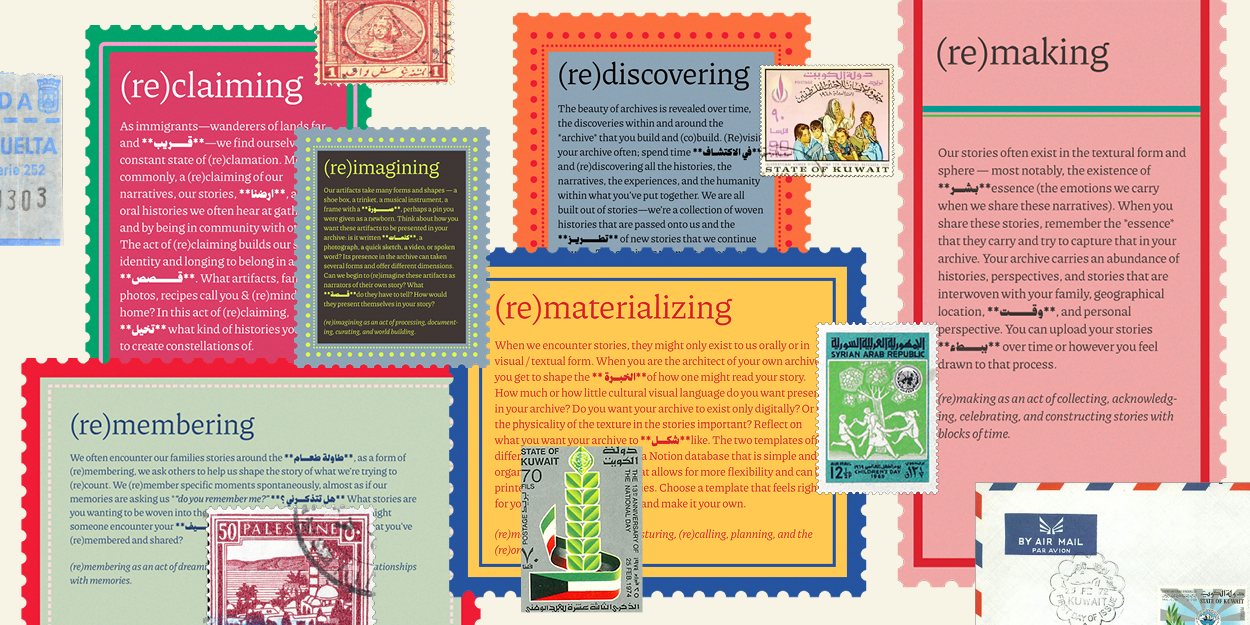
    These questions sit at the center of my project, How to Build an Archive. It is not a traditional archive but a toolkit, a proposal, an ongoing experiment. It gathers fragments: notes, images, recipes, glitches, videos, objects, questions. It is personal but also porous, designed to invite others in. This project expanded my view on what an archive can be: a living, breathing entity, never still, always in flux, in relation to something else. How to Build an Archive stemmed from my frustrations around access to knowledge about archiving practices — gatekept, locked up, only for a few to dive into. But what happens when we open up access to archiving so that it becomes communal? What happens when the collective gets to decide what information we should preserve? What happens if the materials, information, and stories within the archive are interwoven and intermingled? 

    During my residency at High Desert Test Sites, for instance, I began archiving shadows, tracing the movement of my own body through film photography and camcorder footage. In other moments, the archive takes the form of screenshots of software glitches currently existing on my computer in a folder called “screenshots archive,” or photos of family recipes that carry memory across generations. Each fragment holds a different register of time — fleeting, ordinary, intimate — but together they become a practice of resisting erasure. To me, the act of archiving is not just about saving the past; it’s about opening up multiple possible futures.


    I often think about the difference between institutional archives and community-driven ones. Institutions promise preservation but often exclude, gatekeep, or sanitize. Community archives may be ephemeral and messy, but they are alive. They carry memory in ways that resist assimilation: through food, through oral storytelling, through a shared Are.na board full of links that might seem disparate, but together form a constellation.

    In this sense, archiving becomes an act of care — and care itself is resistance.

    My practice slips between categories: design, research, pedagogy, archiving, art. I take screenshots of digital glitches. I document my working process through video and writing. I collect fragments that don’t always resolve into a finished object. These gestures counteract the capitalist demand for neatness, productivity, and finality. They also remind me that design is never just about the designed object. It is about relationships: between people, between histories, between what is remembered and what is forgotten.

    When I think about collective projects — cookbooks, zines, digital platforms like Are.na — I see them as extensions of this philosophy. They are archives in motion, practices of knowledge-sharing that resist singular authorship.

    The word I keep returning to is multiplicity. To be in multiplicity is to refuse resolution. It is to allow many truths, many voices, many timelines to coexist. It is to hold both the grief of what has been erased and the joy of what can be reimagined. Design, when practiced collectively, expands beyond itself. It becomes pedagogy, world-building, resistance, care. It becomes an invitation to imagine otherwise.

    So I leave you with questions, not answers: What if design were always already collective? What if archives were not about preservation but about relations? What if every act of design was also an act of care? What if we embraced collective consciousness to expand our worldviews? What if we gave ourselves permission to subvert our realities and to dream up new futures?   


    See also

    SEE ALSO: How to Build an Archive: howtobuildanarchive.comA History of Arab Graphic Design by Bahia Shehab and Haytham Nawar • Decolonizing Design by Dori Tunstall • Seeking Mavis Beacon (film) by Jazmin Jones and Olivia McKayla Ross • Kinstillatory Gathering by Karyn Recollet • The Body as Archive by Pélagie Gbaguidi • Queer Arab Glossary by the Queer Arab Glossary Collective • Contemporary designers and artists: Sherine Salla, Dina Benbrahim, Munirah Al Shami, Wael Morcos, Marwan Kaabour, Ibi Ibrahim, and many more whose work continues to remind us that design is not a solitary act but a collective one. 

    Author Bio

    Randa Hadi is a Kuwaiti designer, researcher, and informal archivist whose practice weaves memory, migration, and fragmented narratives into visual and spatial form. Trained in architecture and graphic design, she builds digital and material archives that hold what might otherwise be lost: glitches, whispers, family histories, and the shadows between them. Through exhibitions, publications, and speculative interfaces, their work traces how stories travel and transform, asking what we choose to remember, and what remembering can remake.

  • Creating Community: A Conversation with BIPOC Design History

    A conversation with BIPOC Design History

    Creating Community


    Silas: All of us have gone to some pretty amazing design schools, but if you look at the design curricula, there weren’t representations of our lineages there. 

    Ramon: We all sat in these ridiculous history classes, which, by the way, were usually taught through the lens of art history — looking at slides, memorizing, taking tests. None of those images showed anybody or anything that looked like any of the people I know. Even in New York City, graphic design was atrociously white. In a city where you can’t move an inch without seeing a person of color, that makes no sense.

    Silas: I never had Black faculty at RISD or CalArts. But then, conversations with ​​Tasheka Arceneaux-Sutton, one of a handful of other Black students at CalArts, turned me on to some of the first texts that would inspire BIPOC Design History. One was Saki Mafundikwa’s Afrikan Alphabets in 2006. And then, Ron Eglash’s African Fractals. I began seeking out friends, family, and other scholars worldwide, uncovering a whole set of histories that were not included in “normal” design curriculum or even in studio critique conversations. In the years that followed, I became an accidental design historian, teaching at places like Vermont College of Fine Arts and Otis College of Art and Design. I co-authored a book about W. E. B. Du Bois’s data visualizations. When the pandemic hit and George Floyd was murdered, the urgency just accelerated. In late June 2020, I posted a tweet asking if folks wanted a BIPOC history course, and the responses went viral. One of the people who responded was Tanvi Sharma. We ended up doing a crazy sprint in December 2020 to make a microsite, enlist speakers, and schedule class dates for Black Design in America. The response was overwhelming, so I was like, Brian, Randa, help . . .

    Brian: One day, Silas says, you want to start this school? And I was like, cool, let’s draw up some paperwork. We need a person of color who’s a lawyer, who understands IP law. We have to be able to defend this in case something happens, because we might be attacked by doing this. Silas reached out to different people to give talks, and that’s how it was made.

    Silas: Ramon was such a fixture as a student in the first course — he
    was always sharing in a powerful way and dropping resources from his Decolonizing Design Reader. As we wrapped up Black Design in America, it made sense for there to be another course.


    BIPOC Design History Reader, 2024. Designed by Randa Hadi, Sadeem Yacoub, Silas Munro, Brian Johnson, and Edgar Casarin. Courtesy of BIPOC Design History.


    ​​Ramon: Silas called me up one day and wanted to do a LatinX class. I love history, but I’m really challenged by history books these days, particularly design history books. There’s still so much missing. So I started gathering people to get this class together. I was really interested in trying to get as many different voices as possible. Latin America is a gigantic piece of land. There are dozens of countries in the whole region. And within those countries, there are smaller subsets of cultures: multiple, multiple, multiple Indigenous cultures that have their own structures and systems and visual languages. How are we going to tell the story in a continent that’s so diverse?

    Randa: There was an urgency to this information being out there. We’re responding to what people are saying, both inside and outside of the classroom, which is why we thought it was important to start aggregating those resources. I was also a learner, first and foremost, because there’s a lot of information that I wasn’t aware of, didn’t have access to, because of erasure.


    From left: Elizabeth (Dori) Tunstall, with illustrations by Ene Agi, Decolonizing Design: A Cultural Justice Guidebook, MIT Press, 2023; Jon Key, Black, Queer, and Untold: A New Archive of Designers, Artists, and Trailblazers, Levine Querido, 2024; Whitney Battle-Baptiste and Britt Rusert, W. E. B. Du Bois’s Data Portraits: Visualizing Black America, Princeton Architectural Press, 2018; Ron Eglash, African Fractals: Modern Computing and Indigenous Design, Rutgers University Press, 1999.


    Brian: Design is a deliberate planning and creation of something that solves a problem or meets a need. It involves research, ideation, planning, prototyping, and iteration. Design develops a solution that has a function or use, or is just aesthetically pleasing. To me, this definition of design is also the definition of craft. Take, for example, a basket weaver. You have a craft that specializes in processes and skills that were learned over years of practice and iteration and experimentation. What fiber is best? How do I find it? How do I harvest it? How do I dye it? How do I bend it? How do I shape it? It also takes a high level of understanding, complex math, algebra, strategic forethought, skill, and dexterity. It takes a deep knowledge of traditional ecological knowledge (TEK) of the area that you live in. The maker has to understand the people who are going to use this object. So, what is the purpose of the basket? Does it have multiple uses, but can it also tell a story? Can it also hold our culture and our lessons? You can answer yes to all of those questions. Craft is design. The only difference is power. The European or colonial hierarchical system asserted that the fine arts are better than applied craft or applied arts. Social class structures then asserted that intellectual work is greater than manual labor; craft is more manual, thus not as good. Then this leads to gender and cultural bias. Textiles, ceramics, basketry — primarily, these were done by women, so you have an issue of misogyny. Non-Western cultures are considered just completely not worth it. They’re savage, they’re uncivilized, they don’t ascribe to Western norms. Coloniality has placed these silos that destroy the breadth of what creativity has to offer.

    Ramon: Design can be defined in different ways in different communities. I like the idea of the lowercase “d” design. Capital “D” design is the material that’s in all those books that we study. Those are supposed to be the “standard.” But I think it’s all design if it’s serving a function for a particular community, whether I can understand it or not. If I’m not a member of that community, why would I understand that? Design doesn’t need to be universal. I don’t even know what that means. There’s no way you can do that. We don’t speak the same language; some people in the world don’t even use the same alphabet.

    Randa: Language shapes how we understand design. Terms like “clean” design, “minimal,” or “universal” — they carry assumptions of values, and they reinforce exclusion. And now, we’re having to do the work to unlearn that language that’s been imposed on us. I think about that more broadly, too, how a lot of the terminology that’s used in the workspace is rooted in vernacular taken from the military. Similar to divide and conquer. At Polymode, we actually use “split and sparkle,” which feels a little bit more gentle and not so military.

    Silas: And a little more gay!

    Randa: A lot more gay, actually. I think there’s also subjectivity in the language that we use. As someone who also speaks Arabic, and is also learning a little bit of Spanish and Portuguese, I often notice how certain concepts can’t be translated into English, and it reminds me, too, that design, which is basically a language, carries cultural specificity, and if we only use one language or design vocabulary, we erase the nuance and the possibility of expansion to this kind of more holistic overview of design. I think it’s important for us to be in that state of constantly learning, reclaiming language around design, reintroducing words, and redefining things. In a way, I feel like we are doing that collectively, which feels really powerful. To me, the labels become less important than the practices themselves. What is it that we’re actually making? What are we communicating? Who are we connecting with?


    From left: Baskets, clockwise from center: Madeline Tomer Shay, Fancy Basket, 1990s, courtesy of Theresa Secord Collection, Hudson Museum, University of Maine; Sarah Sockbeson, Basket, Fancy, 2013, courtesy of Frances Robinson Mitchell Collection, Hudson Museum, University of Maine; Theresa Secord, Penobscot, Storage Box, 2023, collection of the Farnsworth Art Museum, Rockland, Maine Museum purchase, Lynne Drexler Acquisitions Fund; Sarah Sockbeson, Glowing Sunset on the Carrabassett, 2011, courtesy of Maine Indian Basketmakers Alliance; Jennifer Sapiel Neptune, Basket, Miniature, 2007, courtesy of Hudson Museum, University of Maine; Mbuti People, Bark Cloth Paintings, 1900s, bark cloth and pigment. Courtesy of Andres Moraga Textile Art; Photos by Sebastian Bach and courtesy of the Ford Foundation Gallery.


    Randa: Societally, you can’t call yourself an artist unless your work is up in institutions. There are certain criteria, but why can’t my grandmother be an artist? Why can’t she be a designer? Why can’t she be a craftsperson if she’s already doing these things? She doesn’t have a degree in it, but why does that actually matter? We fall into these rules that are placed onto us. Why can’t my experience, my interests, and my curiosity be what is actually guiding me in calling myself something?

    Ramon: When I think of design in the Global South, I realize that a lot of designers, particularly in Latin America — not to generalize — are not just graphic designers but also multidisciplinary. In the US, in the Northern Hemisphere, we have been pigeonholed into specific places: You’re a textile designer, you’re a ceramicist. You’re an architect, you’re a graphic designer. But, Mexican art and design is riddled with architects, who are also painters, who are also graphic designers, who are also working with textiles. And it’s incredible, because they were asking, what is the medium that best helps me to tell this? To talk about this story, or this narrative? History can help you to do that, and to tell the stories in different ways. And I think that that’s all a function of design, and thinking of ourselves as designers who are really interested in so many crazy things. It’s an incredible thing, I think, to realize that as a designer, you kind of have to be interested in everything.

    Silas: Design was redefined for me in 2021 when my cousin Dorcas made matoke, a staple dish in Uganda that is made with a type of banana more savory than a plantain. The way she cooked this banana was a process of design. The banana is roasted in the leaves from the previous time the dish was prepared, along with fresh green leaves. Traditionally, there’s a fire built in the ground to steam the dish before it’s mashed. Dorcas built this structure underneath out of snapped stalks, which she wrapped in these beautiful folds of green leaves. Just the way that she built this kind of grid of leaves, I thought, “Oh my god, this is design.” That’s connected to some of the things Brian was talking about: women in the domestic landscape, being in intentional connection with the land and people, creating something that’s sustenance, and that also communicates something and is ritual. There are all these value judgments we’re unpacking in BIPOC Design History coursework. What I’ve been taking away, especially after your last course, Brian, is the importance of questioning everything, and that, to me, is part of bringing Indigenous ways of knowing into the conversation. 


    Mary Sully, Henry Ford, Edwin C. Hill, and John Philip Sousa, 1930s, colored pencil, ink, crayon, paint, 34 ¾ x 18 ¾ inches each. Photo by Sebastian Bach. Courtesy of The Mary Sully Foundation and Ford Foundation Gallery.


    Brian: I feel like we also came to this because of our work with Dori Tunstall and Decolonizing Design. There was this push to decolonize, to start breaking it down, but then after my course ((re)Creating Turtle Island), we’ve started to tweak that lens. Instead of deconstructing, or negatively impacting something, we would rather Indigenize: insert something, add something more to the dialogue so it’s more generative and not extractive. We want to then change that dialogue; it’s us making more space. And Native American and Indigenous cultures, especially within Turtle Island, are not homogeneous. There are hundreds of cultures speaking hundreds of languages, and we all see things in similar and different ways. It’s just that we like to use blanket terms to easily discuss something when it’s actually not beneficial — we find commonalities to meet in the middle. But my definition with you today could also change by this afternoon, right? 

    Randa: There’s multiplicity in definitions. Often during conversations, we’ll throw out a word and just assume that someone knows how we’re defining it. I’m trying to get into the habit of defining words in the moment. As an example, if I’m talking about red, describing what kind of red I’m talking about. There isn’t this assumption of a “universal red,” because my red could look totally different from Brian’s red, from Silas’s red, from everyone else’s red in this room. 


    BIPOC Design History course mash-up, 2025. Designed by Sundhya Anthony. Courtesy of BIPOC Design History.


    Brian: We can’t fully upend all of what imperialist culture and capitalism have done to us. We can’t just blow up the system while we’re literally on the plane. I think there is a way of inserting ourselves into the dialogue using an additive word; then, does the BIPOC Design History space allow us to also forgive each other? We need to learn in a space where you can still be vulnerable, where you can still make a mistake. You can make amends, and then grow from that. So, we all come with a sense of both vulnerability and awe.

    Silas: Some of this is really personal because during the course of the classes, I’ve lost both parents. I was just in Uganda to do a burial ritual for my mom. Some of the joy of doing this work has been connecting with different generations. Both ancestral memory and the presence of people like Colette Gaiter and Saki Mafundikwa, along with their experiences, create a lineage of voices that bring powerful and healing insights. This is achieved by invoking the Ghanaian idea of sankofa, which involves going back and bringing things from the past into the present. Having these four different courses and different perspectives, whether it’s an African perspective, SWANA, Latiné, or an Indigenous perspective, has been so healing and has helped us work through collective traumas. We’ve been seeing solidarity across different ways of being. You can see your experience in someone else, even if they have a different ethnocultural perspective. You find that you share a common understanding of pain, and that you can help transcend it and see each other’s experiences in a new light.


    From left: Silas Munro, Strikethrough: Typographic Messages of Protest, Letterform Archive Books, 2022; Saki Mafundikwa, Afrikan Alphabets: The Story of Writing in Afrika, Mark Batty Publisher, 2006.


    Ramon: I think it’s actually even more rewarding, because you start to see how history ends up being more multidisciplinary as well. You’re engaging in the totality of how communities, human beings, have developed ideas, languages, ways of seeing — and that it’s not the same. It also gives us an opportunity to have a conversation with the ancestors. You have to go back home and really start to dig through that incredible archive and elevate it. It requires a lot of unlearning. It gives you a better perspective, and I think it makes you a better designer. 

    Brian: Some of that is a choice, too. You have to turn to the hardships, to the sadness. My Native past was erased from me. There are 2,300 Monacans that remain. We were not given Federal recognition as a tribe until 2018. That doesn’t diminish the fact that I’m as Indigenous as other tribes. We have no language. Tutelo died in the 1870s. We are trying to awaken it from its slumber, but it will be a new, modern version of the language. We can either be stressed and squashed by the sadness, by the fear, or we can make a choice to call out the elephant in the room and then say, I’m gonna work through this. Yes, I’m surrounded by fear, but did you notice how pretty this is? Did you notice that the sun still came up today? Did you notice that I can still take a large, deep breath? I can feel the earth under my feet? You can consciously say, yes, this is harrowing, and I felt it, and I’m really sad about that. I didn’t cause these things to happen. I am not perpetuating these things. But I can then also say: let’s talk about the goodness that’s also around this.

    Silas: In your course, Brian, you held space for people to process the hard things. It’s complicated to hold space for that. You can be in the conflict and be in the painful moments, to give us time to chew on that. I feel like there is a cathartic part of that, learning by doing. 

    Randa: So much of doing this work of facilitating, curating, researching, and putting together these courses means confronting histories that were intentionally erased — and obviously at different scales, at different levels of erasure. I want to be clear that colonization, genocide, and trauma for Indigenous, Black, SWANA, and POC folks is different. I don’t want to paint it as being at the same level. But I think that discovering something about your culture or your lineage can be both joyful, but also painful. It’s almost like you’re finding a gem, but then there’s also grief in realizing that it was hidden from you. It’s important not to be in that headspace of what if, what if, what if. It’s just really daunting. But I think that’s why the balance feels crucial: taking pauses, making space for rest, finding joy in the small moments to sustain the work that we’re all doing. I do think that there’s joy in teaching, in witnessing students connect the dots, and sharing stories together. Asking these big questions that I think we’re often scared to ask because there’s so much complexity and nuance. It’s fucking complicated, you know?


    From left: Frank Reyes y Yovanny Polanco, Igua Bar, concert poster, Dominican Republic. Photo by Ramon Tejada; Burhan Karkoutly, Palestine Lives, c. 1978, print, 17 x 11 1/2 in. Image courtesy of the Palestine Protest Project Archive.


    Brian: It relates to how we approach teaching time. From a very Western standpoint, time is linear. It goes from A to B to C to D, and it keeps moving in a one-directional sense. Absolutely not! That’s trash. Time is a circle; it is cyclical, and it’s also a cylinder at the same time, it wraps on itself. The lesson changes as you age, and when we think about teaching time as past, present, and future . . . no, they are all happening simultaneously. Our small, little human brains can’t wrap around that.

    Silas: When I am facing all the challenging ideas of these problematic things in the past, and present, I think there is still hope that learning from history can help us iterate in new ways. That is the power of design, this idea of iteration, of reshaping or recycling the past to create a new experience in the present that can lead to a new future. I’m thinking of a timescale not for next week or next month, but seven generations from now. How will that change the way that I think about treating someone else, or how does that make me think about a design process that’s not about an eighteen-month cycle of packaging design, necessarily, but about eighteen years, or eighteen generations?


    Get perhaps in print!


    Randa: I love this conversation about time. I grew up in Kuwait, where we used the Hijri calendar, which is an Islamic calendar based on the moon. I remember being in high school and middle school, and having to contend with two different forms of time. What does it mean for a calendar to be constantly in motion, versus the Gregorian calendar, which is fixed? It doesn’t actually move; it’s always the same. Versus the Hijri calendar, which is constantly in motion. That’s why Ramadan is always ahead each year.

    Brian: This also makes me want to go back and change my entire definition of design that I started with. Design becomes the liminal space between. It’s not the start and it’s not the end. It is the process.


    Luba People (Democratic Republic of the Congo, primarily South-Central region), Lukasa Memory Board, late 1800s or early 1900s, wood, metal, beads. Courtesy of Brooklyn Museum, gift of Marcia and John Friede.


    Brian: BIPOC Design History is full in the face of what we are going through. No, we were not given this at RISD. We were not given this at any other school. Of all the things that show resistance, it’s twofold. Show up and learn something new to allow your brain to be plastic, and to change, and to evolve, and to grow. And also, at least for me, is to live my truth. So there’s a difference in understanding, like, yeah, I want to go out, and I want to use design to sort of fix everything. That level of Pollyanna doesn’t work for me. I feel like I have to kind of do all the things. I do have to resist, but I also have to think about care. I also have to take care of other people. Like, it’s little incremental changes versus, I’m just gonna get some kind of big weapon and just break it all down. I think it’s both/and. That’s why I love just holding space for BIPOC Design History, and then saying, cool, I’m still going to be an out-queer person who is Native, who is growing my hair long, to resist this idea of what masculinity is, especially white masculinity with how you have to look, and yeah, this [my hair] is a lot to take care of, but it’s also holding a level of what was cut off from me when our ancestors were sent to boarding schools. So I feel like living in that truth and being in that space is just a mode of design. 

    Randa: Knowledge and literacy are power. There is a form of resistance in actually learning and having access to this knowledge that we didn’t have previously. We’re archiving every single resource, every single question that people are dropping in the chat into our resource page that anyone can access. We’re also pointing it back to the person who dropped the link in the chat, who dropped the question, who dropped what we call a nugget of knowledge, for people to look at and to know the citation of who this is coming from. This becomes a resistance to or a critique of institutional archiving, which operates in a very different way. There, you have one individual who decides what is important or not important. To us, everything that’s being said is important, and we’re trying our best to just capture all of it and keep it in a space where people are able to visit and revisit and relearn. This collective knowledge is also a network or an ecosystem of different entry points into learning design history, not just through talking, but through visual references. There are so many music references and film references that are in the collective knowledge. It becomes really expansive — you can fall into a rabbit hole and spend hours. That, to me, is a form of really powerful resistance.

    Silas: The citational practice is such a powerful form of resistance, and we’re not the only ones that do that. I was thinking about Mindy Seu, who is not part of BIPOC Design History, but she frequently discusses the concept of collective voice. I also think about the literal protests, like Colette’s talks about Strikethrough, which evolved into a comprehensive publication and exhibition that Polymode worked on, exploring the history of protest and civil rights. Protest is something that can be passed on. We haven’t even used the word “ally” yet in the conversation, but that’s also one of the things that I’ve seen come out of BIPOC Design History — how allies can navigate and be supportive, how to hold space for their part of the process, or how we all can have a form of allyship in the way that we live. That’s a form of protest, too.


    From left: Aqa Mirak, Fereydun Tests His Sons, c. 1535, opaque watercolor, gold, and ink on paper, Tabriz, Iran. Courtesy of the Aga Khan Museum; Kay Khusrau and Fariburz with Chained Prisoners, 1493–94, painting, Gilan, Turkman dynasty. Courtesy of the British Museum.


    Randa: The way that BIPOC Design History started was very much about responding to the current moment. I know that Silas did that with his class, and I know that Ramon was also doing that in his class when he was curating it. I was also looking at what was happening politically in the SWANA region and bringing that to the forefront. I invited someone to speak about Palestinian typography, the Women, Life, Freedom Movement, and the Sudanese Revolution. It’s important that those come to the forefront and highlighting them is a form of resistance. Instead of not talking about it, instead of siloing ourselves and existing in the space of, oh my god — what is actually happening? — we’re opening up dialogue for hard and difficult conversations. I don’t think we often have that opportunity in a class or institutional setting, because there are obstacles. Opening things up for vulnerable and deep discussion and dialogue feels like it’s fighting against that.

    Ramon: At this particular moment, design can create community. Look at the ways that design has always been a part of many communities. Some communities literally embedded their stories into artifacts because that was the only way that they were going to be able to survive — everything was being demolished. When I think of design, I think of teaching as well. The space of the classroom is like a workshop, and we can talk about a lot of things in this workshop, and you can use your knowledge of form-making. You can use that to tell these stories to empower, to elevate your people, in essence, to elevate your community.


    EXPLORE: BIPOC Design History

    Randa Hadi is a Kuwaiti designer, researcher, and informal archivist whose practice weaves memory, migration, and fragmented narratives into visual and spatial form. Trained in architecture and graphic design, she builds digital and material archives that hold what might otherwise be lost: glitches, whispers, family histories, and the shadows between them. Through exhibitions, publications, and speculative interfaces, their work traces how stories travel and transform, asking what we choose to remember, and what remembering can remake.

    Brian Johnson, a member of the Monacan Indian Nation, is an award-winning designer, creative director, writer, and curator. He is a partner at Polymode and formerly UNC Chapel Hill’s Marketing Creative Director, developing scalable, multi-platform brand campaigns. His research centers on Indigenous-made works to combat erasure. Johnson co-curated Reverberations: Lineages in Design History, will curate Designed To Be Red (Poster House, 2026), and is a 2025 Mellon Fellow at the IAIA Research Center for Contemporary Native Arts (RCCNA).

    Silas Munro is a designer, artist, writer, curator, surfer, and descendant of the Banyole People of Eastern Uganda. Founder of the LGBTQ+ and minority-owned studio Polymode, he co-curated Reverberations: Lineages in Design History and curated Strikethrough: Typographic Messages of Protest (Letterform Archive, 2022–23). He was a contributor to W. E. B. Du Bois’s Data Portraits and co-author of Black Design in America. His art has shown nationally and is held in major collections. He is founding faculty and chair emeritus at Vermont College of Fine Arts.

    Ramon Tejada is a DominicanYork (of Dominican-American, Afro-Caribbean, and LATINX descent) designer and educator based in Providence, Rhode Island. His hybrid design and teaching practice focuses on collaboration, inclusion, unearthing, and the responsible expansion of design — a practice he calls “puncturing.” Ramon is associate professor and Department Head of Graphic Design at RISD and principal of El Estudio RT. He was the facilitator of BIPOC Design History’s Incomplete Latinx Stories of Diseño Gráfico Borderlands / La Frontera* course and is a 2024 recipient of the Vilcek Prize in Design.

  • Welcome

    Welcome

    What if we are not all doomed?

    This thought was a turning point in our conversations about founding a magazine during a time of crisis. We asked ourselves what it meant to start a creative project amid the political, economic, ecological, and other challenges that confront us every day, some of which are explored in this issue. From record flooding driven by climate change to words that have been banned based on political ideology, these are only some of the many problems that need our attention, and urgently.

    We also recognize a feeling of hopelessness that comes with this moment, a sense that our efforts will not make a difference or that the issues are so large and complex that there’s simply nothing we can do. Against this feeling of despair, we wanted to give form to something meaningful. Not something that solves all the problems we face today — what can? — but something that creates a space for wondering, that contemplates the world in a different way, and opens up new avenues when more and more possibilities seem foreclosed. There is power in making space, in the margins if not in the mainstream, as Ash Holland reminds us in her exploration of comics and the queer community.

    As we consider this moment, it feels like an in-between time — not settled and certainly not stable, but also not yet finished — like the traces of light and memory that haunt the empty spaces in Kathleen Creighton’s photos in this issue. It is a time of transition, not just a space of possibility but also a space for movement — but movement towards what? Our essay on void moons suggests that there are times we might be freed from the forces that normally push and pull us and instead be left to pause, reflect, and look ahead.

    Sometimes new ideas come from putting things together in unexpected ways, like this issue’s piece on heart memory, which places art and emotion in conversation with science and medicine, or our cover art, Immigrants by Lilli Muller, a series of chairs that have been cut in half and arranged in mismatched and precarious positions. A little space is left between each half, making the liminal almost tangible. Installed in Joshua Tree National Park in 2021, these chairs suggest both that we live in a fragmented world and also that we can build new connections, even from broken parts. For Muller, it speaks to a notion of home that is neither the country of her roots nor the one she lives in. In a political climate that is increasingly hostile to immigrants, her work highlights the importance of being seen within cultural landscapes that fail to reflect one’s own experience. Immigrants is included in the Amplification Project, a digital archive of art and cultural productions related to forced migration and refugeehood, which Kathy Carbone frames here as an act against erasure.

    In starting a print magazine, we aimed to slow things down a bit and dwell within these ideas. Creativity, like hope, needs time to grow. Several of the pieces here think about the process of creation, from Rosa Chang’s work with indigo and dyeing techniques that connect to her cultural roots to Andrea Gough’s collection of recent books about traditional crafts and ways of making. A printed object is something that gets handled, passed along, read on the train, and carried to and from homes, bookstores, cafés, and all the places in between. With all of that physicality comes other people, and opportunities for new and unexpected interactions with those around us.

    Part of what excites us about this project is being in community with contributors, readers, and everyone else involved in producing a magazine. To launch this effort, we’ve called on our networks of friends, family, colleagues, and neighbors to trust us with their work, offer advice, and lend their attention. We’ve talked with others who are starting their own print magazines and sustaining creative projects in these uncertain times. We’re getting to know our local booksellers and shop owners on a first-name basis. Across all of these interactions, we’ve encountered people who are trying to make a difference, create something beautiful, or simply imagine otherwise. Like them, we are making a little room to grow.

    Welcome to the first issue of perhaps
    We are so glad you are here.

    Michael, Nancy, and Chris

    On the Cover, Issue One
    Lilli Muller, Immigrants, 2021.

  • Weeping Trees and the Art of Indigo

    Weeping Trees and the Art of Indigo

    Art & Text BY Rosa Chang

    Weeping Trees and the Art of Indigo

    Art has always been a way for me to navigate my emotions, identity, and place in the world. As a first-generation immigrant artist living in the United States, my work is deeply intertwined with my heritage, memories, and the cultural threads that shape me. At the heart of my practice is the concept of reincarnation — a belief deeply rooted in Korean tradition — which manifests in both the themes and materials I use. I find beauty in giving new life to old materials, whether through natural dyes, textiles, or repurposed objects, mirroring the cycles of nature and personal transformation.

    Storytelling has also been something I wanted to incorporate into my art. Perhaps I simply wanted to share my story, and in doing so, I found a sense of connection and understanding. In the beginning, I wasn’t sure which medium I enjoyed the most. I felt immense internal pressure to choose — fine art or illustration, traditional painting or digital media. Would I remain a fine artist, or should I take any job I could find? These questions brought confusion and uncertainty throughout my college years, my twenties, and even into my thirties.

    One of my works, The Weeping Trees, is an ongoing illustration and drawing series that explores human relationships and resilience. This series began on my little sketchbook during an emotional period while caring for my father in the ICU in 2015

    One day, while working at a book fair in New York, I received a call from 911. My father was being transported to Georgetown University Hospital in Washington, DC. Without hesitation, I rushed to catch the next Amtrak train, unprepared for what lie ahead. He had suffered a severe stroke and was diagnosed with global aphasia — a condition that affects a person’s ability to speak, understand language, read, and write. For the first five days, he spoke in a language I had never heard before. It wasn’t just slurred or fragmented speech; it was as if he were speaking an entirely unknown language.

    Oddly, despite this, I could still understand him. Through his gestures and expressions, I instinctively interpreted his needs — something the doctors and nurses couldn’t do. Without a change of clothes, without meals or rest, I stayed by his side, translating his non-existent language. At times, his misfiring neurons led him to call me “wife.” Then, on the seventh morning, his language ability suddenly returned — almost 80% restored. 

    It was the longest and most difficult week of my life.

    During that time, I began sketching. These tree-like figures, with their tangled and interconnected branches, became a metaphor for the unseen bonds between people — the ways we support, shape, and hold one another up, even in the most uncertain moments.

    A couple of years after the incident, my friend Ivanny gifted me a book, The Hidden Life of Trees by Peter Wohlleben, after seeing my Weeping Trees series. Through this book, I learned how real trees support one another — sharing nutrients through their interconnected roots, sustaining ailing trees, and even helping rival trees for the sake of a larger symbiotic ecosystem. This deeper understanding reinforced the meaning behind my work, highlighting the resilience and interconnectedness that exists not only among trees but also among people.

    For over a decade, I have been immersed in the world of indigo. The traditional dyeing techniques of Korea and East Asia have become a cornerstone of my work, not only for their aesthetic qualities but also for the philosophy they embody. Indigo is resilient. It thrives in poor soil, replenishing it rather than depleting it. This mirrors my own journey — learning to adapt, grow, and give back to the communities around me. 

    Working with Polygonum tinctorium, the indigo species cultivated in Korea and Japan, has been a way for me to reconnect with my cultural roots. When I first encountered natural dyeing, I was unaware of Korea’s rich indigo traditions, despite being born there. Up until the 1940s, growing indigo and dyeing clothes were common practices in rural areas of Korea. A young bride’s mother would hand-stitch a blanket from indigo-dyed fabric as a wedding gift for her daughter. According to old scripts from the Chosun period, farmers and lower-class people who could not afford medicine would boil indigo-dyed fabric in water and drink it as a remedy during epidemics. In fact, indigo has antiseptic and antioxidant properties, and people in the past discovered these benefits long ago.

    Now, indigo is a bridge — connecting past and present, tradition and innovation, my old home and my new one. By growing the same indigo plants my ancestors cultivated, and practicing similar methods to extract pigments from these magical plants, I honor their legacy. Additionally, I incorporate indigo into my daily life, embedding their wisdom into my own journey.


    Get perhaps in print!


    I explore various natural dye techniques, drawing from traditions like Japanese boro and Korean bojagi — both methods of mending that honor sustainability and longevity. Through patchwork, hand embroidery, beading, and resist-dye techniques such as katazome and shibori, I create layered narratives that expand my storytelling beyond paper and canvas. Each piece carries a history, a connection to the land, and a reflection of my personal journey. In 2021, after my grandmother’s passing, I returned to Korea and brought back sambae, a traditional hemp fabric used for summer clothing and funeral rituals. This material inspired my large-scale installation Relics, in which I dyed sambae with black walnut and indigo to symbolize mourning and memory. I also mended two of my grandmother’s old cotton sheets, incorporating fabric scraps as a way to honor her life and the generations of women before me.

    My journey with indigo, textiles, and my research-based online project, Indigo Shade Map, eventually led me to publish My Indigo World, a picture book that weaves together science, art, and storytelling. The book celebrates the cultural significance of indigo and my personal connection to it. Writing and illustrating this book became another form of storytelling — one that allowed me to share my love for indigo with a wider audience, particularly children. Seeing how the book has resonated with readers has been incredibly rewarding, reaffirming my belief in the power of art to educate, connect, and inspire.


    Through all my work, I seek to honor tradition while forging new paths, to celebrate resilience while embracing change. Whether through paintings, textiles, or books, my art is a conversation between past and present, between what was and what can be. It is my way of remembering, healing, and offering something back to the world — one stitch, one brushstroke, one indigo-dyed thread at a time. 🌿


    Rosa Chang is an artist based in Baltimore and New York whose work is deeply rooted in fostering a harmonious relationship between humans and nature. Drawing inspiration from natural materials and environments, Rosa creates art in various forms, mediums, and scales. Her current focus is on sharing the cultural significance of Korean and Asian traditional indigo and natural dye processes through community engagement and exchanges. Rosa is an adjunct faculty member at the Maryland Institute College of Art and serves as the Executive Director of Hand Papermaking, Inc., a nonprofit publication dedicated to advancing both traditional and contemporary practices in the art of hand papermaking. rosafulgarden.com


  • How Much the Heart Can Hold

    How Much the Heart Can Hold

    Essay by Nancy Smith

    How Much the Heart Can Hold

    The Art of Dario Robleto and the Science of Heart Transplants

    The artist Dario Robleto has a sculpture called Lunge for Love as If It Were Air, which consists of two small, black feathers floating in a glass jar, positioned upside down, conjuring the image of a pair of shadowy lungs. The feathers were created with stretched audiotapes of two deceased lovers’ recordings of each other’s heartbeats. I was drawn to this object because of its beautiful form, and upon learning about the underlying material, the piece became even more captivating. A recording of a heartbeat already generates a deep sense of wonder in me — to even capture this mysterious beating organ feels like a kind of magic — but to then reconfigure the tape into an unexpected pair of feathers gives the heart a whole new dimension of awe. I encountered this piece in The Heart’s Knowledge: Science and Empathy in the Art of Dario Robleto, a book about a range of his works, including those that were part of an exhibit at The Block Museum of Art at Northwestern University in 2023. Jennifer L. Roberts, in writing about this piece in the exhibition’s catalog, says, “The span and stretch of their love is sealed in the jar like a black moth. Or like the cold filament of an inverted light bulb. Or perhaps like a dark firefly, a speck of rapture once perceived.” While looking at this piece and Robleto’s intriguing collection of heart-inspired work, such as sculptures and prints of early waveform recordings of the heart, I was reminded of the first human-to-human heart transplant, which took place in Cape Town’s Groote Schuur Hospital in 1967.

    Dario Robleto, Love, Before There Was Love, 2018. Earliest waveform recordings of blood flowing through the heart during an emotional state (1870), rendered and 3D printed in brass-plated stainless steel, and brushed steel and glass vitrine. Image courtesy of the Mary and Leigh Block Museum of Art, Northwestern University.


    I had a brief stay at Groote Schuur in 2003 when I was sick from what was eventually diagnosed as dengue fever. I remember sitting in a dimly lit waiting room, drooping from a fever and a light delirium, my muscles on fire. Dengue fever is sometimes referred to as break-bone fever because it is so painful. I tried to move as little as possible as I eyed the other patients, wondering what they had — were their insides shattering like mine? I was taken to an exam room, where I sat alone and waited for a doctor to see me. I have no particular connection to the first heart transplant, other than my profound curiosity and those lonely moments in the exam room when I imagined what it must have been like for the heart’s recipient, Louis Washkansky. If I hadn’t been so sick at the time, I think the sense of wonder would have been more heightened than it was, but still, I remember sitting on the exam table, my legs dangling, aware that this was an especially historical place. 

    Washkansky was a 53-year-old grocer who had suffered multiple heart attacks and ultimately developed congestive heart failure. He had ended up in Groote Schuur after numerous surgeries and months of decreasing heart capacity until his heart had only about one-third of its capacity to circulate blood through his body. On a sunny morning in early December, as Washkansky slowly declined in the hospital, 25-year-old Denise Darvall was out in the city, shopping with her family, when a car hit her as well as her mother. Although her mother died instantly, Denise was taken to the hospital with a severe head fracture. It was soon determined that she had no brain function, but her heart was still viable. The surgeon, Christiaan Barnard, carefully discussed the options with Denise’s father and soon secured her heart for the transplant. The very concept of an organ transplant was not readily accepted and, in the early days, was often criticized for being unethical, especially as the concept of brain death was not widely adopted until the 1970s. Which is to say, someone can be effectively dead but still have a beating heart. Indeed, this was an issue with Denise Darvall, and there was significant debate about how to actually declare her death. 

    Remarkably, Ann Washkansky, Louis’s wife, had driven by the scene of the accident that morning, unaware that her husband’s new heart would be recovered, some hours later, from that gruesome scene. Ann had been conflicted by the fact that to receive a heart transplant someone else had to die and as she came to understand details about Denise, the donor’s heart took on a sense of identity. “Knowing about that girl, and her life and her family, made it all so inhuman, somehow. My husband’s heart had an identity. It wasn’t just a piece of flesh anymore,” she said. The Heart of Cape Town Museum, in detailing the story of this first transplant, refers to the heart as “the symbol of the essence of life,” and it is especially within the context of a transplant that the organ seems to take on these dual characteristics — form and essence. 


    Above: Dario Robleto, The Boundary of Life is Quietly Crossed (still), 2019. Two-channel 4K video, color, 5.1 surround sound installation. Image courtesy of the Mary and Leigh Block Museum of Art, Northwestern University. 

    Dario Robleto, Unknown and Solitary Seas (Dreams and Emotions of the 19th Century), detail, 2018. Earliest waveform recordings of blood flowing from the heart and in the brain during sleep, dreaming, and various emotional states (1874–96), rendered and 3D printed in brass-plated stainless steel; lacquered maple, 22k gold leaf. Image courtesy of the Mary and Leigh Block Museum of Art, Northwestern University.

    The sphygmograph, invented by Karl von Vierordt in 1854, and further developed by Etienne Jules Marey in 1863.

    Robleto has several other sculptures that put recorded heart rhythms into physical form. Unknown and Solitary Seas represents the earliest waveform recordings of inhalation and blood flowing through the heart and brain during various emotional experiences. Recorded during 1874–96, these sound waves were solidified in brass-plated stainless steel. The pieces are presented as a series of golden waves, creating an elegant snapshot of centuries-old pulse waves. Other early recordings, wavy oscillations in Sparrows Sing to an Indifferent Sea, capture the heart’s reaction to different experiences: riding a bike, being scolded, and listening to music, among others. Roberts writes, “All of Robleto’s recording sculptures have a quality of waiting about them — waiting for someone or something to recognize that there is something to detect about them, that they still harbor messages to decipher. Waiting to tell them that they are not alone.” This strikes me as analogous to falling in love. There is a sense that your beloved holds secrets for you to uncover while you are quietly waiting to be understood through each increasingly intimate interaction. This piece makes me wonder why hearts are the physical place where we situate love. The heart is a common metaphorical catchall for emotion — though there are many arguments to be made that love happens all over the body, from the brain to the fingertips. So, why this organ in particular? How did the heart become the place that signifies our emotional center?

    Some of the earliest Western poetry, written by Sappho for her female companions in the seventh century, identifies the heart as a place of passion. She writes, “And then Love shook my heart / like the wind on the mountain / troubling the oak trees.” Likewise, philosophers Plato and Aristotle situated the deepest human emotions in the heart. Plato says, “Every heart sings a song, incomplete, until another heart whispers back. Those who wish to sing always find a song. At the touch of a lover, everyone becomes a poet.” Venus, the goddess of love, is said to have coupled humans by setting their hearts on fire. This mythical history has ingrained in Western culture a sense that there is something special about the heart, and within it, something meaningful to be unearthed in our fellow humans. 

    The heart and its connection to the human condition are central to much of Robleto’s artwork. In Radical Fiber: Threads Connecting Art and Science, he has written about the organ: “For most of history, across time and cultures, the heart wasn’t simply a metaphor. It was considered the literal vessel of the soul, this conduit between the immaterial and material domains. Our great poets and philosophers and priests have all weighed deep questions about identity and emotional authenticity, fate and faith, around the heart.” This tendency to hold the heart above other organs doesn’t only happen in philosophy or poetry; hearts have always been special in the world of science and medicine too. Part of what makes Robleto’s work so interesting is that it exists at the complicated intersection of art and science, often bringing poetic observations to scientific discovery. 

    Another piece in The Heart’s Knowledge exhibit, First Pulse, 1854, captures the first time a human heartbeat was recorded. Karl von Vierordt, a German doctor, created a sphygmograph, a device that wraps around a person’s wrist, captures their pulse, and records it. The recording is not entirely unlike a contemporary blood pressure reading or an EKG, if not exactly as precise. The sphygmograph used a soot-covered piece of paper under a tiny rod of metal that reacted to the pulse and created a set of curvy lines on paper, representing the arterial movement. This device, like many medical breakthroughs, made the invisible visible. The unknown, inside world of our bodies, was now represented on the outside. Making something visible is the first step in knowing it, and knowing the heart meant we could record it, change it, and, ultimately, operate on it. Even heart cells in a petri dish do one thing: beat.


    When I lived in Cape Town, my house was only a short walk from the Main Road, where Denise Darvel’s accident occurred. I didn’t know it at the time, but reflecting now, I am struck by the way paths cross: Denise and the drunk driver who killed her, Ann as she drove past the scene, and some decades later, me, as I walked to a nearby cafe. And then, there are the many cars and pedestrians who have crossed over that same street since. What kinds of histories do we unknowingly pass every day? The routine moments and the remarkable lives, mostly unknown, under our feet. The first heart transplant, and those physical human connections, contain within it that sense of mystery, of magic — the same feeling I get from Robleto’s artwork.  

    My most vivid memory of Groote Schuur Hospital wasn’t the nurses or doctors, the other sick folks around me, or even the exam itself — all of which feel hazy in my mind. For some reason, I have a clear image of a long hallway I walked down after I exited the exam room. Feeling tired and confused, I’d taken a wrong turn back to the lobby and found myself in a deserted hallway, a dark corridor with a window at the end, and a lone wheelchair stationed at the far end of the hall facing the window, as if a ghost might have been sitting in it watching the clouds float by, carefree in the blue sky.

    The wheelchair was an older variety, turn-of-the-century, wooden, with a tall back. It felt like something that could have existed at the time of the heart transplant. Perhaps the very wheelchair that Louis Washkansky might have been transported around the hospital after his surgery. He survived the transplant but died 18 days later from pneumonia. Denise’s father lamented her death for a second time.

    Why does this quiet memory remain so clear in my mind? I was only in that hallway for a few moments. Nothing eventful happened. It was silent and there wasn’t a single person there. I think now it might have been because I was afraid I would die alone in a country that wasn’t mine and that hallway would have been my last memory. I didn’t experience anything so severe as a heart transplant, but there is something about being in a hospital with an uncertain set of painful symptoms that can make you imagine the worst. I stood for a moment, and then turned and found my way back to the main waiting room where I picked up some medication, went home with a friend, and, surprisingly, recovered a few days later.

    The duality of the heart, as both an emotional and biological entity, is clear in the case of broken heart syndrome, which occurs after someone suffers severe emotional distress or intense loss, such as the death of a loved one. The technical name for this, Takotsubo Cardiomyopathy, comes from Japan, where it was first described in the early 1990s. A person’s heart develops a weakness in the left ventricle, which causes the rest of the heart to work harder. As the shape of the left ventricle becomes enlarged, it takes on a bulging form similar to the small, round container called a takotsubo, which is used to catch octopuses in Japan. The physical symptoms seem to be a reaction to emotional trauma; the heart materializes what it feels. Elizabeth Gilbert suggests that having a broken heart is a good thing. “It means we have tried for something,” she writes. However, anyone who has suffered a broken heart might find this perspective to be of little comfort, as the residue of loss remains with us long after our companion has departed. 


    Get perhaps in print!


    In the case of a transplant, it is sometimes thought that an organ recipient takes on the emotions, memories, or personal qualities of their organ donor. This is not just a superstition or myth. The kinds of changes that have been reported include shifts in preference, such as for certain foods, alteration in emotions or temperament, modifications of identity, and intriguingly, memories from the donor. Many of these memories are of the actual moment of death and seem to be more common in recipients who received a heart from someone who experienced a violent death. For example, one transplant recipient had a repeated visualization of a blinding light and an intense sense of fear. His heart donor was a police officer, killed by a gunshot wound to the face. The changes, though anecdotal, are quite commonly reported. One woman was able to recall the name of her donor, despite never having been told his name. Another woman said that she even feels love differently, and after the transplant, she became a less emotional person. A straight man, after receiving a heart from a lesbian woman, became a significantly better lover, saying that he simply had a better understanding of the female body. This was verified by his wife. 

    Above: Dario Robleto, First Pulse, 1854 from the portfolio The First Time, The Heart (A Portrait of Life 1854–1913), 2017. Photolithograph with transparent base ink on hand-flamed and sooted paper, brushed with lithotine and lifted from soot, fused with shellac and denatured alcohol. Mary and Leigh Block Museum of Art, Northwestern University, gift of Northwestern Engineering. Image copyright Dario Robleto.

    A Lady, A Map of the Open Country of Woman’s Heart, Exhibiting its Internal Communications, and the Facilities and Dangers to Travellers Therein, c. 1830.Lithography of D.W. Kellog & Co.

    F.T. Lewis and M. E. Abbott, Model of the Heart of a Human Embryo 4.6 mm long x 108, 1915.

    Pieter van Gunst, Anatomical Study of the Blood Vessels and Circulation, 1685. Engraving after an image by Dutch painter and art theorist Gerard de Lairesse. 

    Johannes Gossner, The Heart of Man Who After His Conversion Has Fallen Again Into Former Sins, And Is Now Entirely in the Power of Satan, 1851.


    Recent research has shown that there are four types of memories that live in cells: epigenetic memory, DNA memory, RNA memory, and protein memory. Scientists are still unearthing the various ways these kinds of memory function — in our hearts and the rest of our bodies — but the connection between the heart and the brain is so strong that doctors have coined terms like “heart memory” and “heart feelings.” This was something Ann Washkansky seemed to intuitively know, as she, at one point, wondered if Louis would acquire any of Denise’s personality traits. He may not have lived with her heart long enough for us to know if he experienced any changes related to her identity, but there is every reason to believe that he could have.   

    Despite the recipient taking on personal qualities from the donor, a primary issue with transplants is organ rejection. The body instinctively tries to reject a transplanted organ because it is a foreign object. Transplant recipients have to take immunosuppressive drugs for the rest of their lives, which ironically, makes them more susceptible to other diseases, like cancer, which are often stopped by early immune responses. It is strange that to understand another person’s memories through their heart, we have to suppress another embodied reaction — our own capacity to fight off intruders that can cause us real harm. It raises questions, too, about the people who love a heart transplant recipient. Do they have to relearn their relationship, adjusting to these new personality traits?  

    Perhaps this is somewhat true, even without a transplant. What do we shut down in order to understand another person? What part of ourselves do we let go of to be with, and to better know someone else? What happens as we change and become new people over and over again in the course of a relationship? What part of us is lost when we lose someone we love? The heart generates 50–60 times more electrical power than the brain, and 5,000 times more electromagnetic power. I wonder if this is why, when we’re in love, our hearts flutter and spark, race and drop. 

    Another potential tactic to avoid organ rejection can be found in the ghost heart, something I first learned about from Robleto’s writing on the subject. Initially, the concept behind a ghost heart, which is being developed in Dr. Doris Taylor’s lab at the Texas Heart Institute, was to take a damaged human heart and wash it clean, literally, removing all the cells, and reducing it down to its shell, or what is called an extracellular matrix protein. The result is an uncanny and hauntingly ghost-like heart, entirely white, almost translucent, every damaged cell stripped away. If a person’s faulty heart could be removed, cleaned, infused with the person’s own stem cells to rebuild the muscle, and reinserted back into the body, it is thought this might prevent the rejection issue altogether because you are effectively getting your own heart back. However, it’s not quite that simple. Despite the remarkable capacity of stem cells to regenerate healthy cells, it is difficult to get a damaged human heart to work again, and scientists have yet to perfect the ghost procedure in humans (and are currently experimenting with pig hearts), though the possibility itself is fascinating. Why is the ghost heart so intriguing? It is visually arresting — and like Robleto’s artwork, generates a new vision of the heart and what it can be — but there is also something seductive in the way it offers a sense of newness, of starting over, as if we could simply wash away the damage we’ve done to our bodies and begin again. 

    Robleto’s sculptural piece, Love, Before There Was Love, captures a waveform recording of blood flowing through the heart before and during an emotional experience. Two waveforms, captured in brass-plated stainless steel, stand side by side, solidly grey and decidedly different. The first wave has a softer form, a calm, steady rhythm, while the second wave has sharper, deeper angles, suggesting a more intense heartbeat. Recorded in 1870, this early recording forever froze a heart’s physical reaction to emotional feelings. Some of the other emotions captured in Robleto’s work — through photolithography created with invisible ink and hand-flamed and hand-sooted paper, evoking the original sphygmography recordings — illustrate human experience at various times, both mundane and extraordinary: 8 Months Pregnant, 1870; Umbilical Cord, First Gasp, Cutting of the Cord, 1886; Riding a Bike, 1906; Name Softly Called While Sleeping, 1877; Emotion of Fear from Shouting the Word Snakes 1896; Sadness from Listening to a Sung Melody, 1896; and, my personal favorite, Smelling Lavender, 1896. The original recordings rendered everyday emotional connections as scientific data, and Robleto both retains the science and simultaneously re-renders them into art, centering the emotional capacity of the heart. The works included in The Heart’s Knowledge ultimately collapse the boundary between what is known and what is felt, a boundary that was always tenuous.  

    Zelda Fitzgerald writes, “Nobody has ever measured, even poets, how much a heart can hold.” In looking at Robleto’s work, I get a sense of how much the heart can hold, though it’s not a physical capacity or a number of beats, but rather an indescribable, infinite range of feelings. If the heart has memories, what else does it have that we have not yet uncovered? If emotions shift when we receive a new heart, what hidden traits are we carrying around in our own hearts? Art and science are both exploring these kinds of questions, and despite the many advances in medicine, the heart remains mysterious, not because we don’t know how it works, but because we don’t know what it can truly do. 💜  

    SEE ALSO: The Heart’s Knowledge: Science and Empathy in the Art of Dario Robleto, edited by Michael Metzger, Mary and Leigh Block Museum of Art, 2023 • Radical Fiber: Threads Connecting Art and Science, edited by Rebecca McNamara, The Tang Teaching Museum and Art Gallery at Skidmore College & DelMonico Books, 2023.


    Nancy Smith is a writer and artist in Brooklyn. She is currently working on a climate fiction novel and a collection of essays. Her work has been published in McSweeney’s, The Rumpus, Santa Fe Writers Project, Your Impossible Voice, and elsewhere. She received her MFA in Creative Writing from the University of San Francisco.  somequietfuture.com


    Ghost Heart, image courtesy of the Texas Heart Institute.

  • Queer Mediums and Life in the Margins: What Comics Have to Offer Us

    Queer Mediums and Life in the Margins: What Comics Have to Offer Us

    Essay by Ash Holland

    Queer Mediums and Life in the Margins: What Comics Have To Offer Us

    It feels like queer artists have been front and center in the past decade, in popular artistic mediums like TV, film, and music.

    The seeming queer takeover in mainstream and pop culture art, however, belies a volatile and often violent world. Today, queer communities battle an oppressive sociocultural moment in which nearly 400 anti-LGBTQ+ bills were proposed in the first two months of 2025 alone. The current US administration is actively rolling back protective policies, prohibiting gender-affirming care in federal healthcare programs, and attacking the federal right to same-sex marriage.


    No matter how much queer representation seems to flourish, our communities are continually pushed to the margins. 

    But queer folks have always turned, and likely will always turn, to the creativity available in the margins as a means of expression and survival. And the margins just might offer a key to unlocking a better world. What if within that marginality lives a creative and generative power? What if we look beyond the themes and subjects and makers of creative forms to consider the queerness of the forms themselves? Can a queer form lend us any tools for navigating an increasingly hostile world?

    Artistic revolutions and reclamations have happened in nearly every medium and every time period. The Harlem Renaissance, the Beatniks, and even the birth of MTV were all countercultural reactions to oppression of various kinds, with artists reinventing creative mediums to birth political engagement. 

    The forms these movements focused on aided in such potential. Television and film offer widespread popularity that lend themselves to mobilization. Theater provides spatial and temporal liminality that allows viewers to consider new ways of being. Literature, poetry, music, and visual arts give creators the flexibility to expand ideas of what’s possible.

    Among these creative forms, though, comics offer a unique — even seemingly contradictory — blend of these various potentialities: temporal liminality, yet images set in time. Sequentiality, yet the ability to move the eye across the page as desired. Visual cues, yet active and kinetic margins filled with potential.

    So if we’re going to look at the intersections of creative mediums, queerness, and marginality, comics are a great place to start.

    Comics have historically been a much-maligned and marginalized medium themselves. The rise of crime and horror comics in the 1940s produced a cultural anxiety about the medium, largely in the all-too-common “save the children” vein. Psychiatrist Dr. Frederic Wertham advocated for a “regulation or banning of comic books” in an effort to care for the wellbeing of child readers — or so he claimed. His call to action reflected a larger post-WWII cultural regression in which the country collectively sought to tighten its once-loosening set of cultural norms.

    What became of Wertham’s complaints? His 1954 book, Seduction of the Innocent: The Influence of Comic Books on Today’s Youth, combined with his testimony at the Senate Subcommittee to Investigate Juvenile Delinquency, eventually led to the Comics Code Authority (CCA). While most publishers have since abandoned the CCA, it was originally a self-regulatory body (à la McCarthyism) that put strict guardrails around what content was allowed in comic books. It was not unlike the crackdown on violent video games, R-rated movies, or other mediums that “corrupt” our children.


    From left: Reproduction of Fredric Wertham’s Seduction of the Innocent: The Influence of Comic Books on Today’s Youth. Cover of the 2019 edition of Joseph Sheridan Le Fanu’s 1872 Carmilla, Lanternfish Press.


    Here’s a snippet of what Wertham had to say: “The comic books, in intent and effect, are demoralizing the morals of youth. They are sexually aggressive in an abnormal way. They make violence alluring and cruelty heroic. They are not educating but stultifying.”

    Based heavily in Wertham’s disparaging take on comics, the CCA was fundamentally concerned with perpetuating a traditional moral code, specifically when it came to sex and sexuality. In fact, the code’s “Marriage and Sex” section explicitly prohibited humorous depictions of divorce, sexual “abnormalities,” and sexual “perversions,” all while demanding a “respect for parents, the moral code, and for honorable behavior.”

    Importantly, Wertham and the CCA were preoccupied (almost obsessively so) with the vampire as a perverse and corrupting figure. This is critical because the vampire has taken its place as a symbolic queer figure among mythic creatures, starting with one of the first vampires, Sheridan Le Fanu’s 1872 Carmilla, a lesbian-coded figure who seduced young women. Since then, vampires of all genders have evoked a specifically amorphous, alluring sexuality that very often threatens the status quo.

    Speaking of the lesbian vampire trope specifically, Paulina Palmer says this: “Her shape-changing abilities can be read as denoting her refusal to become entrapped in the conventional domestic role, while her erotic relations with women represent a challenge to the institution of marriage and the control men seek to exert on female sexuality. Transgressive sexuality is a key feature of the lesbian vampire’s representation.”

    This transgressive sexuality is central to the figure, and for Wertham, that simply wouldn’t do. The fact that Wertham’s and the CCA’s concerns centered on the “abnormal and unhealthy” sexual desires caused by comics creatures like the vampire only lent to a prevailing notion of the day: If we don’t watch out, comics will turn our kids into “sexual deviants.”

    So it was that in the middle of the century, comics took their place in the margins of popular media. 

    But out of that marginality came a reclamation through which the countercultural Underground Comix movement was born in the 1960s. The so-called “sexual deviants” of the underground came out in full swing. Mary Wings, Lee Marrs, Howard Cruse, Roberta Gregory — the era was full of queer artists who didn’t just tolerate, but embraced, marginalization as a generative position. 

    While the CCA was still effectively regulating comics from more mainstream publishers, for example, these underground artists used their marginal position to depict images like women lying naked in bed together, hairy armpits out for the world to see. Or a person birthing a child surrounded by community and stating, “Here’s a squirt for Sappho!” Or a lesbian lamenting her lack of long-lasting love.


    A selection of panels from Mary Wings’ body of work (left to right): “What Lesbians Do” from Dyke Shorts (1978), birth scene from Dyke Shorts, and abstract reflection from Come Out Comix (1979). Courtesy of the Lesbian Herstory Archives.


    This kind of work was a direct response to the oppression of the time — oppression that unfortunately hasn’t changed much in the past 50-plus years. In a letter to Tee Corinne, an artist and creator of the Lesbian Herstory Archives’ comics collection “The Yellow Binder,” Mary Wings states, “when I did Come Out Comix it was actually a response to another woman who published what I felt was an anti-gay coming-out story and I got really ticked at men who were ripping off all women and dykes in their macho porno comic strip. I did Come Out Comix because SOMEBODY had to do it!”

    Wings and other underground artists hand-drew copies of their work or bribed folks to use company printers to clone their illustrations, then stood on the street corners of New York and San Francisco passing out deeply political, super queer art to passersby. It was a magical moment that was amplified by a magical core element of the comics medium: the margins or gaps that grace the pages of any good comic book. 

    In comics, an artist creates fragments of a visual narrative, often in the form of panel images. These are mere snippets of a story, and it’s up to the reader to stitch the fragments together to form the narrative itself. Scott McCloud demonstrates it best in Understanding Comics: The Invisible Art (even if he is simultaneously accusing us of murder): McCloud presents two panels for the reader, one depicting an axe being raised behind a terrified person, and the next zooming out to a scream ringing out across the cityscape. McCloud writes, “I may have drawn an axe being raised in this example, but I’m not the one who let it drop or decided how hard the blow, or who screamed, or why. That, dear reader, was your special crime. Each of you committing it in your own style.”

    Here’s the magic of the medium: The creative momentum lies within the margins, the empty space between images — rather than in the images themselves. In comics, the reader holds the narrative possibility in their hands and co-creates the story alongside the artist.


    The concept of closure, as explained by Scott McCloud in Understanding Comics.


    We use the process of closure to weave together two disparate images, closing the gap to form a narrative that makes sense to us. Closure is the reason why each reader can take away something different from the narrative based on their own imagination. When we read comics, we perform closure in a number of ways: between two images, between two pages, between the visual and textual divide, between the real and fantastical, between the tangible and implied, and even between various codes of significance (icons, colors, artistic style, font, typography, etc.). 

    The margins are everywhere. They allow for innovation and imagination, albeit imagination anchored in visual cues from the artist. For example, a spread splash page — an image that reaches wall-to-wall of the recto and verso pages of a comic — could be a visual cue for the reader to pause and immerse themselves in the depths of the scene. Multiple small panels aligned in an organized grid, on the other hand, creates a staccato reading experience that may convey time passing quickly. A pop of color on a black-and-white page could draw the eye, indicating a crucial metaphor or clue to the narrative.

    Consider page 2 of A.K. Summers’ memoir Pregnant Butch: Nine Long Months Spent in Drag, for example.

    At the top of this page, the author’s avatar, Teek, holds a subway car railing, which also functions as a margin between two panels. The spatial concerns of Teek’s queer pregnant body — one that she notes offers both a bodily dissonance and the ability to pass as “just another fat guy on the subway” — are both separated and connected by the margins. As a structural element typically meant to denote two distinct times and spaces, the margins here muddy that distinction, highlighting the fact that Teek’s body exists both as a whole and a fragment, in both the “straight world” and the queer one, in both one and many temporal moments and spaces. 


    Two (or three? or four?) panels from A.K. Summers’ Pregnant Butch: Nine Long Months Spent in Drag. Reproduced with permission from Soft Skull Press. 


    These tensions and convergences give Teek the power to reorient her gender performativity — and give the reader of Pregnant Butch a rich opportunity to consider these queer logics. The margins here make the narrative bigger than the sum of its parts: In its preservation of queer pregnancy, with the margins blurring how Teek moves through space and time, Pregnant Butch is as much an archive as it is a memoir. It validates stories of female masculinity and queer reproduction that are typically left untold.

    But here’s the important caveat: This is just my reading, as both the writer of this essay and a big fan of Summers’ work. The beauty of comics is that the artist gives readers a glimpse of something anchored in both the narrative context and the reader’s imagination, so every reading offers the potential for something unique. As “silent accomplices,” we’re given an opportunity to consider unseen spaces and times. And for queer folks, that’s life.

    Queer communities have always lived in the margins. With no scripts for how to live or love, we’ve built our various and varied cultures from our collective imaginations. We’ve been pushed to develop a creative adaptability to survive. It’s the double-sided coin of what J. Jack Halberstam has called a “queer time and place,” an in-between position and a liminal temporality that both oppresses and empowers a people. 

    Like other queer theorists, Halberstam claims that queerness can open up new narratives and histories that have otherwise been neglected or erased. Queer space refers not only to the bounded places we create for our communities, but also to the process of creating and sustaining those places in the face of conservative notions of public respectability. In Halberstam’s words, it “refers to the place-making practices within postmodernism in which queer people engaged and it also describes the new understandings of space enabled by the production of queer counterpublics.”

    Queer space is about inhabitation as much as it is about spatial boundaries. It’s what makes a gay bar so powerful: You can get drinks with friends anywhere, but there’s something special about being surrounded by other queer folks in a dimly lit, safe, probably grungy space. The bar becomes the marginal space in which we can imagine, create, and inhabit something uniquely our own.


    Sasha Velour’s Body Language, 2014. Reproduced with permission from the artist.


    Queer time, on the other hand, can help us form new temporal logics that don’t rely on heteronormative reproduction for meaning. At the center of an imagined futurity, Halberstam argues, is the transgender body — a symbol and embodiment of a possible queer utopia, exemplifying the “potentiality of a life unscripted by the conventions of family, inheritance, and child-rearing.” (Summers would likely amend that statement to traditional conventions of family.)

    Interestingly, Halberstam situates queer time and space within marginality with this bold rallying statement: “The project of subcultural historiography demands that we look at the silences, the gaps, and the ruptures in the spaces of performance, and that we use them to tell disorderly narratives.”


    Get perhaps in print!


    The “gaps” Halberstam refers to make comics the perfect example (though not the only one) of what queer time and space can look like. Their inherently fragmented nature creates gaps that inspire innovation, while their staticness and sequentiality lend toward a strange interplay of various timelines. 

    Consider how you actually read a comic book, for example. When you open a comic book, you see the whole page, taking in — even subconsciously — the whole narrative, however briefly. But then you likely follow each panel as it leads through each specific moment within the larger narrative. Since fragments imply time in a comic book, you’re simultaneously seeing the long- and the short-term timeline of the story. Time, in comics, is a weird iteration of the margins that allows you to go at your own pace or even create your own timeline.

    What does this all mean for the queer and trans folks just trying to make it through each day? It’s a call to action to use our relegation to the margins to embrace creativity and possibility, to envision a new time and space, and then to work to manifest it. Art, in all its various forms, enables vulnerability alongside resistance. It allows for intimacy, connection, critical thinking, energy exchange, joy, anger, and possibility. It can heal wounds and cause them. It offers the potential for interrogation, self-love, and community.

    When queer communities are bombarded with anti-LGBTQ+ legislation and the very real threat of continued violence — as they are today — art provides a way to both cope and fight back. It’s why the history of queer comics and comix is full of political engagement and why queer artists today are reinventing the form yet again for political engagement. Just look at Sasha Velour’s work as an example.

    In 2017, drag queen Sasha Velour won season 9 of the hit reality TV show RuPaul’s Drag Race, marking a turning point for the show by validating a particularly cerebral kind of drag. Velour’s style is at once experimental, visceral, cartoonish, illustrative, political, silly, and performative. It’s a charged commentary on identity.

    But Velour is also an accomplished comics artist, with a gender studies and arts education from the Center for Cartoon Studies. When taken together, her combination of live performance and innovative comics muddies the idea of comics as a static and material art form. In fact, her piece “What Now” was originally a performance piece that she then transformed into “comics poetry” in 2015 for INK BRICK, no. 4.

    In the self-portrait featured in that piece, Velour draws herself with her signature monstrousness: long, sharp talons, a contorted body, and a furrowed brow. Her body isn’t simply drawn within marginal space. Rather, it is the marginal space. She’s only made legible by the surrounding color, made possible by the margins that form the body she actively chooses to inhabit. In this way, Velour embraces the margins as a place of becoming and uses what we typically see as emptiness as a form of self-narrativization. The margin — the gap, the emptiness, the negative space — ends up being a place to create herself in her own image. 

    For Velour, the marginal space also offers an opportunity to grapple with the relationship between queer embodiment and family. Velour dedicates the comic to her late mother, stating “I want to be my mother’s drag queen.” It’s a declaration that stakes a personal and familial claim in gender performativity, and Velour uses her drag and her marginal embodiment as a way of understanding her loss.


    Sasha Velour’s self-portrait character, who originally appeared in INK BRICK no. 4. Reproduced with permission from Sasha Velour.


    Throughout “What Now” — the performance and the comic — Velour plays with the idea of “putting on” gender. She says, “I learned that it can be empowering to wear your mother’s dress. Or power suit. At first, I was worried that it was a little Norman Bates psycho, but then I just embraced it and now I’m a murderer.” Loss, becoming, monstrosity, performativity, marginalization — it’s all wrapped up in a complex web of queerness for Velour.

    It’s no wonder she chose comics and drag as her mediums for expressing this complexity. 

    W.J.T. Mitchell, an academic who’s built a career analyzing humans’ relationships to pictures and seeing, once said something I just can’t forget: “Vision is (as we say) a ‘cultural construction,’ that it is learned and cultivated, not simply given by nature; that therefore it might have a history related in some yet-to-be-determined way with the history of arts, technologies, media, and social practices of display and spectatorship; and (finally) that it is deeply involved with human societies, with the ethics and politics, aesthetics and epistemology of seeing and being seen.”

    Every time I walk into a gay bar or see two women kissing on a street corner, I’m reminded of Mitchell’s thoughts here, that what some see as deviant or abnormal or simply different, I and others in the queer community often see as empowering, enriching, and energizing. If seeing itself is wrought with the baggage of social construction — just as the images, dialogue, and margins of a comic book are — then we all have the power to change that meaning. We can construct what we see and how we fill the margins in different ways.

    And if Mitchell is correct that vision itself is a construct, then what we don’t see becomes just as important as what we do. Readers can become “silent accomplices” who envision a better, more just world. We can imagine the possibilities of the margins, the gutter, the gaps, and combine that with our anchoring in reality as a tool for change.

    What do queer folks do with our marginalization in a literal sense? How do we actualize the potential of the margins? I’m not sure, exactly. But I know it happens. I see it every time queer folks gather, or choose their family, or provide allyship for other marginalized groups. I feel it every time I see my wife. I’m called to it when I flip through the pages of one of the many queer-authored comics out today, or when I imagine new possibilities in the margins of comics that are decidedly not queer.

    Just as the comics margins allow us to imagine a resonant narrative, in this politically fraught moment in which our very right to live and love is under constant attack, the marginal space offers us something we very much need: hope.  


    SEE ALSO: J. Jack Halberstam, In a Queer Time and Place: Transgender Bodies, Subcultural Lives, New York University Press, 2005 • Scott McCloud, Understanding Comics: The Invisible Art, HarperCollins, 1993 • W.J.T. Mitchell, What Do Pictures Want? The Lives and Loves of Images, University of Chicago Press, 2005 • Paulina Palmer, Lesbian Gothic: Transgressive Fiction, Cassell, 1999 • A.K. Summers, Pregnant Butch: Nine Long Months Spent in Drag, Soft Skull Press, 2014 • Sasha Velour, The Big Reveal: An Illustrated Manifesto of Drag, 2024 • Mary Wings, Come Out Comix (1974)and Dyke Shorts (1978), Self-published.

    Ash Holland is a writer, editor, and comics scholar who lives in Portland, Maine, with her wife, pup, and orange cat. She currently writes and edits for various education and environmental conservation nonprofits. Ash is also the owner of The Lucky Fox Bookshop, a pop-up bookstore that curates collections of queer fiction for communities across New England. theluckyfoxbookshop.com


  • Ways of Making

    Ways of Making

    COLLECTION By Andrea Gough

    Ways of Making: Six Views on Craft and Tradition

    Tradition can be a fraught concept these days, used by politicians and tradwives alike to evoke some monolithic, perfect bygone era when everything was in harmony. But far from making tradition a cudgel of conformity, makers, crafters, and creators know that the traditions their work is grounded in are indispensable — especially in a society increasingly hell-bent on creating AI art and manufacturing disposable goods. How did patterns and techniques evolve, in response to which stimuli, connected to which places? How do those connections enrich contemporary practices, grounding us even as we innovate? 

    Andrea Gough, Color Study #3, 2024. Bargello “pomegranate” stitch, wool on canvas.

    Andrea Gough, Color Study #2, 2024. Bargello “flame” stitch, wool on canvas.

    Andrea Gough, Untitled, 2024. Bargello “flame” stitch variation, wool on canvas.


    The authors of these books tackle these questions through different lenses. Like them, I’ve been on my own lifelong journey through craft, from finding community through knitting at college and beyond, to learning to weave in the Bolivian highlands. More recently I’ve gone on a deep dive into Bargello, a style of embroidery distinguished by its focus on repeated geometric motifs and named after fabric found on seventeenth-century Italian shoes and furniture upholstery. This type of needlework saw a revival in the 1970s, and now a second contemporary revival. I’ve loved exploring the evolution of classic stitch patterns and their pairing with modern bright color palettes (acrylic yarn in the 70s, artisanally-dyed yarn today), even as I rely on Margaret Boyles’s 1974 book, Bargello: An Explosion in Color, when making my own patterns. How lucky I am to explore crafts with such depth of history and to follow along as others document the variety of ways of making.


    Water, Wood & Wild Things: Learning Craft and Cultivation in a Japanese Mountain Town 

    by Hannah Kirshner 

    After forming a friendship with the owner of a bar in Japan, Kirshner immersed herself in Yamanaka, a remote town in Japan’s Ishikawa prefecture. Over four years, she delved into the myriad industries and cultural traditions rooted there, from saké making and serving, to lacquer making and painting, woodworking, traditional methods of hunting, charcoal making, and much more. In doing so, she explored how a specific place deeply influences the items created there, the customs that develop, and how they feed and support one another. For example, at one point the author tastes various sakés in different, locally made bowls, each combination subtly impacting the flavor of the saké. The result is an enthralling portrait of a place enriched by its artisanal history and the contemporary artists continuing that work. (Penguin Books, 2022)

    This Long Thread: Women of Color on Craft, Community, and Connection 

    by Jen Hewett 

    Professional artist and designer Hewett noticed that many organized craft spaces (retreats, guilds, craft fairs, online spaces) were overwhelmingly white. So she sought out BIPOC women and nonbinary creators of textile arts and crafts, diving deeply into questions of how and why they learned different skills and how their creative practices connect them to their families and communities. Through survey responses, in-depth interviews, and commissioned essays, this collection presents a compelling and beautifully varied tapestry exploring the perspectives and experiences of women of color across the fiber arts community. From a seventh-generation Navajo rug weaver, to the founder of the Modern Quilt Guild, to artists who combine activism and craft, there’s a tremendous variety and depth of voices represented. (Roost Books, 2021)

    Almost Lost Arts: Traditional Crafts and the Artisans Keeping Them Alive

    by Emily Freidenrich 

    This beautifully produced work highlights 25 artisans keeping traditional ways of creating alive: weavers and watchmakers, bronze and plaster casters, mapmakers and neon sign makers, and many more. Interviews reveal the artists’ paths and philosophies, while gorgeous photography shows the artists at work, with photos of their workspaces, materials, and final products — an element absent in other books in this collection. Two essays highlight the continuation of knowledge, from Harvard’s pigment collection to making calligraphy a living art. There’s a joy to reading about the deep skill involved in these arts, while witnessing both the preservation of knowledge and practice, as well as the creation of beautiful and interesting work. (Chronicle Books, 2019)


    A Short History of
    Black Craft in Ten Objects

    by Robell Awake

    Awake, a chairmaker and teacher, illuminates the skill and history of Black craftspeople through an examination of ten objects and the people who made them: from the more well-known, such as the quilters of Gee’s Bend and South Carolina’s Gullah sweetgrass basket makers, to the perhaps lesser-known, such as the Haitian architectural innovation that brought the front porch to Louisiana, or Tennessee chairmaker Richard Poynor’s refinement of the ladder-back chair. It’s a history obfuscated by slavery and written record-keeping that intentionally anonymized individual artisans and their innovations. What Awake does is, in part, a reclamation of credit, such as in the chapter where he describes a chest of drawers attributed to a white furniture maker in early 1800s South Carolina; when the piece was purchased in 2016, a penciled-in name was found, likely the free Black maker who worked in the shop and made the piece. From there, Awake discusses two other Black cabinetmakers of the time. This is a short, accessible work that draws on thorough research, a chronicle of some of the ways Black people have carried knowledge and skill through enslavement, passing on both knowledge and a spirit of innovation. (Princeton Architectural Press, 2025)

    Custodians of Wonder: Ancient Customs, Profound Traditions, and the Last People Keeping Them Alive

    by Eliot Stein 

    As a BBC writer, Stein’s background as a travel reporter is evident in this lovely tour of ten people preserving cultural customs. Stein casts a wide net, not only chronicling areas perhaps easily categorized as traditional craft (making pasta, hand-painting film posters, building a bridge from woven grass) but also taking a wider view with things like oral storytelling, or the tradition of the nightwatchman atop the medieval church tower in Ystad, Sweden. It’s a work in which Stein follows his own sense of curiosity and wonder. By highlighting forms of resistance to the smoothing out or homogenization of local eccentricities, he counters the flattening of experience that can be a byproduct of internationalization. (St. Martin’s Press, 2024)

    American Flannel: How a Band of Entrepreneurs Are Bringing the Art and Business of Making Clothes Back Home

    by Steven Kurutz

    Many of the crafts discussed by other books were once industries, before automation, industrialization, and international trade agreements drove them into a “heritage” distinction. In American Flannel, Kurutz asks: What does it mean for a country to lose the ability to make their own clothing, and what would it take to bring it back? Kurutz, a reporter for The New York Times, looks at the different elements in the process of making clothing (design, production of cloth, cutting and sewing, etc), the history of those industries in the United States, and how they were displaced in the last 30–50 years. He also profiles two companies determined to make clothing in the United States: American Giant founder Bayard Winthrop became fixated on crafting entirely made-in-America clothing from beginning to end; and Gina Locklear of Zkano is still making socks in Fort Payne, Alabama, once the “sock capital of the world.” It’s a fascinating look at what we lose when we lose the ability to make — on both a large and small scale — and how difficult it can be to regain expertise once lost. (Riverhead Books, 2024)


    Andrea Gough is a librarian and crafter in Seattle, WA.


    Get perhaps in print!


  • Is All Leaving Flight?

    Is All Leaving Flight?


    Get perhaps in print!


  • Portraits of Sandy: Alternate Renderings of Climate Change

    Portraits of Sandy: Alternate Renderings of Climate Change

    SOURCES AND FURTHER METHODOLOGY: All data and shapefiles are from NYC Open Data and nyc.gov. Percentages for land coverage were calculated using Overlap Analysis in QGIS.

    SEE ALSO: PlaNYC, A Stronger, More Resilient New York, June 11, 2013 

    Michael L Kelly is a Brooklyn-based designer, educator, and writer who does everything he can to make those roles overlap, ideally with civic engagement somewhere in the mix. He has worked with small non-profits and large companies around the world, and is Creative Director for a small mapmaking company, Good Foot Enterprises. mlkelly.com